At a teenage white belt laughing after a hard round because her partner had helped her up instead of standing over her.
“He almost did,” Sarah said.
“But he didn’t.”
“No,” she said. “He didn’t.”
Years later, Sarah became an instructor herself.
She did not teach like Derek.
She did not teach like Greg.
She watched the room.
Always.
She watched for the student who laughed too loudly after being hurt because they were embarrassed.
The smaller person who kept getting picked by the same aggressive partner.
The beginner who tapped and then apologized for tapping.
She made rules clear from the first class.
A tap ends the exchange.
Immediately.
No exceptions.
No jokes.
No delayed releases.
No explanations.
If someone says stop, you stop.
If someone freezes, you stop.
If someone cannot speak, you stop.
And if your ego cannot survive that, you do not train here.
Some people thought she was too strict.
They did not last long.
That was fine.
Sarah had learned that a healthy room is not defined by who it attracts, but by what it refuses to tolerate.
One evening, after teaching a beginner class, a young woman stayed behind.
She was maybe nineteen, quiet, nervous, and still tying her belt the way all beginners do, like the knot was arguing with her.
“Coach Sarah?”
Sarah turned.
“Yeah?”
The young woman swallowed.
“There’s a guy in the advanced class who keeps asking me to roll. He goes really hard, and I don’t want to be rude.”
Sarah felt the old memory move in her throat.
Not pain now.
Recognition.
“You’re not being rude,” she said. “You’re setting a boundary.”
“What if he gets mad?”
“Then he proves you were right to set it.”
The young woman looked down.
Sarah softened her voice.
“You do not owe anyone access to your body just because they are ranked higher than you.”
The student nodded slowly.
Sarah walked with her to Marisol, and together they handled it before the story had a chance to become another whispered warning.
That night, Sarah called Cole.
She told him what happened.
He listened quietly.
Then said, “Good.”
“That’s it?”
“That’s everything.”
She smiled.
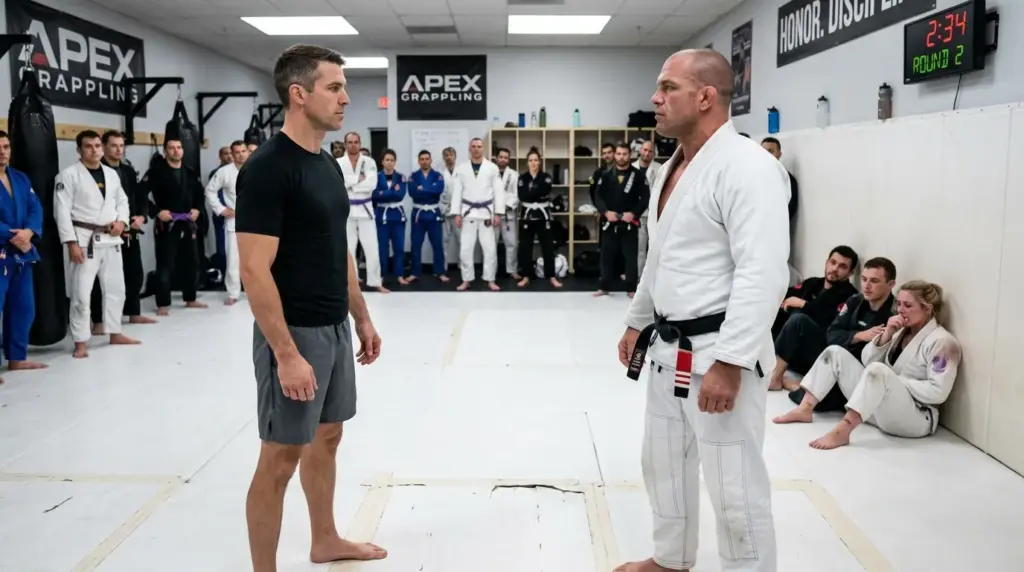
“You still think about Apex?”
“Sometimes.”
“Me too.”
Cole was silent for a moment.
Then said, “I think about how many people watched.”
Sarah leaned against her kitchen counter.
“Yeah.”
“That part bothers me more than Derek sometimes.”
“It used to bother me more too,” she said. “Now it teaches me what kind of person I don’t want to be.”
Cole exhaled softly.
“Fair.”
There was a pause.
Then Sarah said, “You know, you scared everyone that night.”
“I know.”
“You scared me a little too.”
“I know.”
“But you stopped when they tapped.”
Cole said nothing.
Sarah continued.
“That mattered.”
His voice was quieter when he answered.
“It should always matter.”
That was the part people often missed when they retold the story.
They loved the dramatic version.
Gym bully chokes woman unconscious.
Her Navy SEAL brother steps on the mat.
Black belt gets humbled.
Coach gets crushed.
The bad guys learn fear.
It was a satisfying story in that simple form.
But real justice is rarely as simple as one frightening man defeating another.
Cole did not fix Apex by throwing Derek.
He exposed it.
He made visible what silence had protected.
He forced the room to look at the thing it had been stepping around for years.
Derek was only one bully.
Greg was only one coach.
Apex was only one gym.
The larger problem was the bargain everyone had accepted.
We all see it.
We all know.
We all stay quiet.
That bargain breaks only when someone refuses to keep paying.
Sometimes that person is the victim who speaks.
Sometimes it is the witness who finally tells the truth.
Sometimes it is the coach who removes a dangerous student before harm happens.
And sometimes it is an older brother standing by the cubbies, watching his sister tap, and deciding the room has had enough chances to do the right thing without him.
Sarah never became famous.
Cole never told war stories.
Derek disappeared from the local gym scene after a while, though rumors said he tried training somewhere else and was asked not to return within a month.
Greg’s gym survived for a time, then shrank. Some students stayed loyal. Some left quietly. Some eventually admitted they should have left sooner.
Apex Grappling became one of those places people mentioned with a grimace.
Old culture, they would say.
Bad room.
Not safe.
Sarah’s new gym grew.
Not because it was soft.
It was not.
Rounds were hard.
Training was demanding.
People got tired, frustrated, bruised, humbled.
But no one had to wonder whether their tap mattered.
No one had to earn the right to safety.
No one’s rank protected them from accountability.
That was the difference.
And every time Sarah saw a beginner tap, then laugh in relief when their partner immediately let go, she remembered the night she could not breathe.
She remembered the mat under her palm.
Tap.
Tap.
Tap.
She remembered Derek holding on.
She remembered the room looking away.
Then she remembered the voice from the edge of the mat.
I am.
Quiet.
Flat.
Final.
Not the voice of a hero arriving to make a scene.
The voice of consequence.
Bullies thrive in rooms where rank matters more than character.
They grow strong in silence.
They hide behind rules they expect others to follow while they break the spirit of them.
But every false kingdom has a weak point.
A moment when someone who does not fear the hierarchy steps onto the mat and tells the truth plainly.
She tapped.
That was all Cole said at first.
Two words.
Enough to crack the room open.
Because respect is not proven by a belt.
It is proven by what you do when someone is vulnerable beneath you.
Honor is not a poster on the wall.





