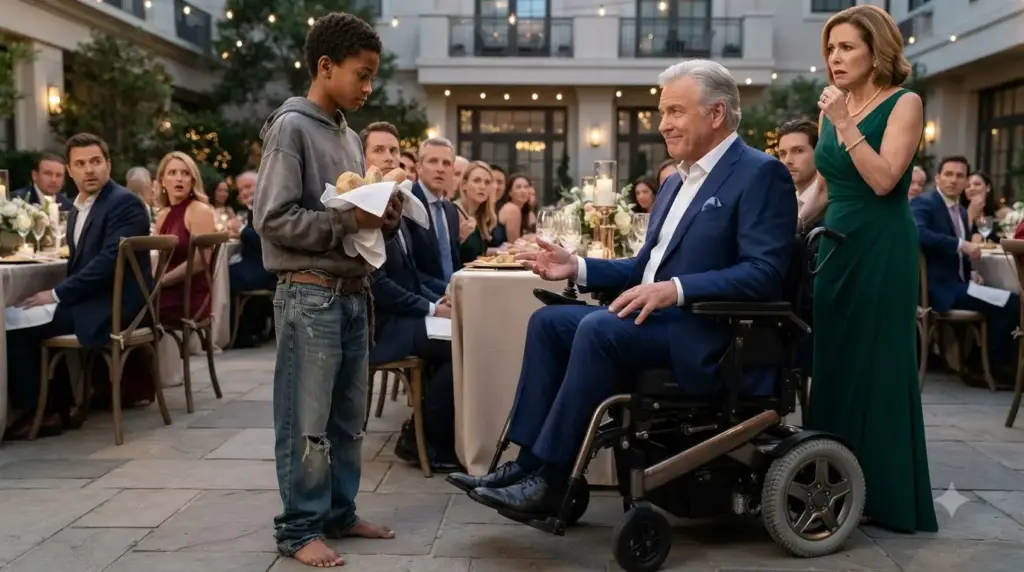
“He had no idea he just challenged someone who carried three generations of forgotten healing knowledge in his hands. Isaiah knew what would happen after he succeeded. The mockery and backlash that would follow. But some truths are worth the cost of speaking them even when the world isn’t ready to listen. The charity dinner glowed like a different world.
String lights crisscrossed the outdoor courtyard of the Riverside Hotel, casting warm light over polished tables draped in white linen. Waiters in crisp uniforms moved between clusters of wealthy donors, carrying trays of champagne and appetizers that cost more than most people’s grocery bills. Laughter floated through the evening air, punctuated by the clink of crystal glasses and the soft hum of a jazz quartet playing in the corner. Isaiah Cole stood at the edge of it all, barefoot on the cool pavement watching.
He wasn’t supposed to be there. Not really. The charity event was for people who wrote checks with multiple zeros. People who arrived in cars that purred instead of rattled.
Isaiah had wandered over from the bus stop three blocks away. Drawn by the smell of food and the possibility of leftovers. Now he stood near the service entrance, holding a few pieces of bread wrapped carefully in paper napkins a kind waiter had slipped him. At 13, Isaiah had learned to make himself small.
He wore jeans two sizes too big, held up by a fraying belt and a gray hoodie that had seen better years. His hair was cut short, practical, and his dark eyes tracked everything with a sharpness that made adults uncomfortable when they bothered to notice him at all. Most people looked right past him. That was usually fine with Isaiah.
He watched the guests move and laugh, but his attention kept returning to their bodies. The way that woman in the blue dress favored her left hip. The man near the bar whose shoulder rolled forward, probably from years, hunched over a desk. The teenage girl who walked on the balls of her feet, knees locked, heading toward knee problems before she turned 25.
Isaiah saw these things the way other people notice someone’s hairstyle or the color of their shirt. It was automatic, unavoidable. His grandmother had taught him to see this way back when he was small enough to fit in her lap. She’d press his tiny fingers to her own wrist, teaching him to feel the pulse, to understand the maps beneath the skin.
Muscles, tendons, nerves, the architecture that held bodies together. Her mother had taught her, and her mother before that—a chain of knowledge stretching back through generations of people who’d never had the luxury of doctors or hospitals. They’d learned by necessity. In plantation fields and boxing rings, in wars where black medics patched together soldiers who’d never acknowledged their skill, in neighborhoods where a broken bone meant choosing between rent and healing.
Isaiah’s father had known even more. He’d been able to look at an athlete and spot the injury before it happened, adjust a fighter’s stance, and add years to their career, ease chronic pain with his hands in ways that seemed impossible until you watch him do it. But his father was gone now and his grandmother, too. And Isaiah was alone with knowledge that nobody wanted to believe a poor black kid could possess.
He took a small bite of bread, chewing slowly to make it last. When the crowd’s energy shifted, heads turned, voices dropped, and then rose again. Someone important had arrived. The wheelchair came through the main entrance, pushed by a young attendant in a black suit.
But the man in the chair wasn’t being quiet about his condition. He rolled himself forward with strong arms, dismissing the attendant with a wave, his voice carrying across the courtyard. ” Don’t worry, I won’t run anyone over. “Richard Halvorson called out and the crowd laughed.
Though at this point, that might be the most exercise I get. More laughter, though this time it sounded uncomfortable, unsure if the joke was permission to find the situation funny. Richard didn’t seem to care. He was a big man, probably athletic before his injury, with silver hair swept back from a face that looked used to getting its way.
His suit probably cost more than three months’ rent. A woman walked beside him, elegant and tense, touching his shoulder in a way that looked more like duty than affection. Isaiah recognized her from a magazine cover he’d seen at a corner store. Evelyn Halvorson, Richard’s wife.
She smiled at the guests, but her eyes kept darting to her husband, tracking his mood. ” Richard, so glad you could make it. “A man in a burgundy blazer said, approaching with an outstretched hand. ” Wouldn’t miss it, Tom.
“Richard shook his hand firmly. Besides, sitting at home feeling sorry for myself gets boring. Figured I’d come out and show everyone what all those donations are supposedly fixing. He gestured at his legs with a theatrical flourish.
Spoiler alert, still not walking. The crowd didn’t know whether to laugh or look away. Isaiah watched Richard’s face. The practice smile that didn’t quite hide something bitter underneath.
Anger maybe or fear dressed up as confidence. “” You’re looking well, though. “”A woman in pearls offered carefully. “” I’m rich, Margaret.





