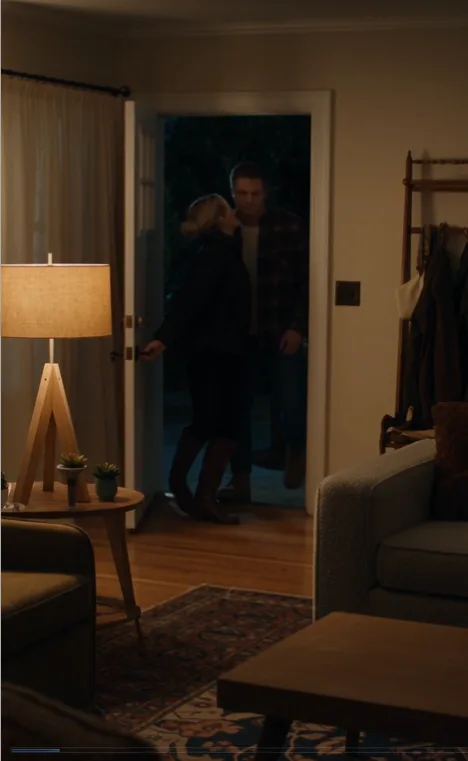
“It’s fine,” Calder muttered, slipping his feet into his shoes without untying the laces. “I’m not… I’m not meant for this kind of place.”
“Who told you that?” Hayes asked.
Calder looked up. Hayes was watching him with that same calm, unblinking focus. Up close, Calder could see the tiny sun-crinkles around the older man’s eyes, the faint silver line across the bridge of his nose, and the quiet stillness that seemed to occupy the air within three feet of him.
“Nobody had to tell me,” Calder said softly, looking down at his worn sweatshirt. “I’ve been sitting in a quiet apartment for two years watching the clock run down. I came here because my son… my son looks at me like I’m already gone. I wanted to show him I was trying. But I don’t belong on a mat. I don’t belong in a fight.”
Hayes turned his head slightly, looking toward the dark windows facing the street outside. “A fight isn’t what happened here tonight, son. A fight requires two people who know why they’re standing there. What happened here was just noise.”
Hayes reached down, picked up his dark blue jacket, and threw it over one shoulder. He looked at Calder again. “I get a cup of black coffee at the diner across the tracks every Tuesday at nine. They don’t have mats. They don’t have belts. But the tables are clean. If you want to learn how to stand up straight, bring that notebook.”
Hayes didn’t wait for an answer. He turned and walked out the double doors, his heavy work boots striking the floorboards in a steady, unhurried rhythm that didn’t miss a single beat.
Part 2: The Table Across the Tracks
The diner was called The Iron Horse, though the neon sign had lost its ‘H’ sometime during the previous winter, leaving it to glow a pale, buzzing IRON ORSE into the damp October mist. It sat beside a rusted spur of the old rail line, where freight cars carrying gravel and timber idled during the midnight hours.
Calder sat in the parking lot inside his eleven-year-old sedan for twenty minutes before turning off the ignition. The heater was blowing lukewarm air against his knees, but the chill inside him wasn’t the kind that came from weather. It was the residual frost of two years of isolation.
When his wife, Clara, had died of an aggressive liver infection forty-eight hours after her diagnosis, Calder’s world had compressed into the size of his living room armchair. He had kept his job as an archival clerk at the county records office because it required zero emotional output—just index cards, microfiche, and quiet rooms. But his son, Leo, had grown up anyway. Leo was fourteen now, tall, lanky, with his mother’s sharp, questioning eyes and a growing wall of silence that matched Calder’s own.
Calder pushed the car door open and stepped out into the night.
Inside the diner, the air smelled of burnt bacon, stale coffee, and floor disinfectant. Hayes Mercer was sitting in a corner booth, his back to the wall, a heavy porcelain mug held between his broad hands. He wore a flannel shirt over his t-shirt now, the sleeves rolled up to reveal forearms that looked like cured oak.
Calder slid into the vinyl seat across from him. The seat groaned under his weight.
“You’re seven minutes late,” Hayes said without looking up from his coffee.
“I sat in the car,” Calder admitted honestly.
“Good. That means you thought about turning around and didn’t. Courage isn’t the absence of hesitation, Rowan. It’s the decision that the thing you’re walking toward matters more than the comfort you’re leaving behind.”
A waitress set a heavy cup down in front of Calder and poured coffee without asking. Calder cupped his hands around the warm ceramic.
“Sensei Thomas told me who you were,” Calder said quietly. “After you left. He said you were in the Special Warfare Group for twenty-four years. Coronado. Virginia Beach. Places I’ve only read about in history books.”
Hayes set his cup down with a dull clunk. His expression didn’t change, but his eyes narrowed slightly. “Thomas talks too much when he’s embarrassed. What I did thirty years ago pays zero rent on who I am today. I’m a man who knows how to lay brick and how to keep my posture clean. That’s all you need to care about.”
“Why did you step in?” Calder asked. “Garrick was younger, faster, stronger. You could have been hurt.”
Hayes leaned back, his broad shoulders settling into the vinyl frame of the booth. “Voss has muscle, but he doesn’t have balance. A man who uses force to make himself feel tall is already falling over—he just needs someone to show him where the ground is.” He paused, looking directly into Calder’s eyes. “And I didn’t step in for him. I stepped in because you were looking at the floor like you belonged under it.”
Calder looked away, staring at the faint grease ring his coffee cup had left on the Formica table. “I feel like I do sometimes. Ever since Clara died…”
“Loss is a heavy weight,” Hayes said gently, his voice losing its iron edge for a fleeting second. “It’ll crush you if you try to carry it in your hands. You have to learn to build a structure around it. You don’t get rid of the weight, Rowan. You just get stronger underneath it.”
“How?” Calder asked. “I tried going to that dojo tonight to show Leo I wasn’t just… fading away. Instead, I proved to a room full of strangers that I can be pushed around by anyone with a loud voice.”
Hayes reached into his pocket, pulled out a small piece of chalk, and laid it on the table between them.
“Take that,” Hayes said.
Calder picked up the white cylinder. It felt dry and light in his hand.