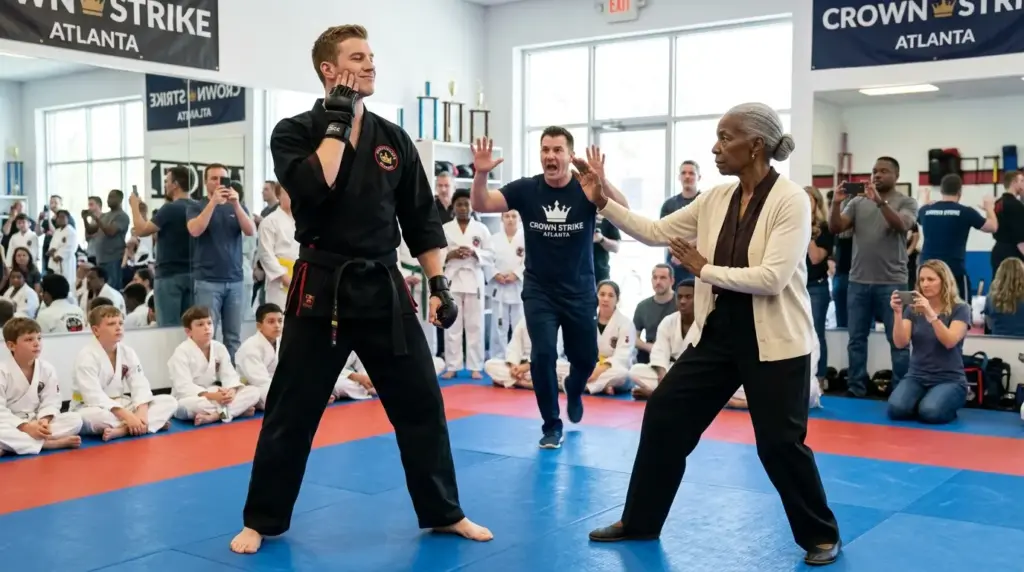
And Colby thought about himself standing in front of her, waving money in her face, calling it a game.
His stomach turned.
Arthur came by every afternoon.
Sometimes to check on him.
Sometimes to make sure he was eating.
Sometimes to sit in silence.
On the fifth day, Colby asked, “Do you think she’ll talk to me?”
Arthur looked up from his coffee.
“Why?”
“I want to apologize.”
Arthur studied him carefully.
“A real apology?”
Colby nodded.
“I think so.”
“You think so isn’t enough.”
Colby winced.
“Okay. Yes. A real apology.”
Arthur set down the cup.
“Then you don’t film it. You don’t post it. You don’t turn it into content. You apologize because it’s owed, not because it saves your brand.”
Colby looked down.
His brand.
That had been the first thing his manager asked about.
How to spin it.
How to monetize the recovery.
How to make “I got humbled by Grandma” merch.
Colby had hung up.
That was new.
A week later, Arthur found Evelyn through one of her former students, a woman who ran a community self-defense nonprofit in South Los Angeles.
Evelyn agreed to meet.
Not at a gym.
Not at a studio.
At a church basement where she still taught classes twice a month.
Colby arrived wearing a plain hoodie and sunglasses, though no one there cared who he was. His face was still swollen. His jaw made speaking difficult, but the doctor had allowed limited talking.
Arthur came with him but stayed near the door.
Evelyn was stacking folding chairs when they entered.
She wore the same olive cardigan.
The same canvas sneakers.
She did not look surprised.
“Mrs. Carter,” Colby said carefully. “Thank you for seeing me.”
“It is Miss Carter,” she replied.
“Miss Carter. I’m sorry.”
She waited.
Colby swallowed.
His jaw ached.
He deserved that too.
“I disrespected you,” he said. “I treated you like a joke. I put money in your face, blocked your path, and tried to make you look foolish for people online. I thought because I knew how to fight, I had the right to play with people. I was wrong.”
Evelyn said nothing.
Colby continued.
“I’m not here to ask you to forgive me. I just wanted to say I’m sorry. And I wanted to thank you for not hitting me clean.”
Arthur’s eyes moved to Evelyn.
For the first time, something like amusement touched her face.
“You should thank him for that,” she said, nodding toward Arthur.
“I did,” Colby said. “But you pulled the punch too, didn’t you?”
Evelyn looked at him for a long moment.
“A little.”
Colby exhaled shakily.
“Why?”
“Because I saw your trainer move. And because even fools should live long enough to become less foolish.”
The words landed quietly.
Colby’s good eye filled with tears.
“I don’t know how to do that,” he admitted. “Become less foolish.”
Evelyn picked up another folding chair and leaned it against the wall.
“You start by doing useful work when nobody is watching.”
For the next month, Colby came to the church basement twice a week.
He did not train.
He did not spar.
He did not teach.
He set up chairs.
Carried mats.
Handed out water.
Cleaned floors after class.
The first time Evelyn gave him a mop, he almost laughed.
Then he realized she was not joking.
So he mopped.
The women in the class did not trust him at first.
They had seen the video.
They knew exactly who he was.
He could feel their suspicion like heat on his skin.
He did not blame them.
Some were survivors of domestic violence.
Some were teenagers from dangerous neighborhoods.
Some were older women who had spent their entire lives being told to stay polite in the presence of men who meant them harm.
Evelyn taught them differently.
“You owe politeness to no one who blocks your exit,” she told them. “You owe kindness to yourself first.”
Colby listened from the back of the room, holding a stack of towels.
He heard more wisdom in one hour than in years of fight seminars.
Evelyn did not teach people to be impressive.
She taught them to survive.
“Do not admire violence,” she said. “Understand it. Respect what it costs. Then avoid it until avoiding it becomes impossible.”
One evening, a teenage girl named Nia struggled with a wrist escape. She got frustrated and muttered, “I’m too weak.”
Colby almost stepped forward automatically.
The old version of him would have corrected her technique loudly, made it about himself, shown the move better and faster.
Instead, he stayed quiet.
Evelyn noticed.
She walked over to Nia.
“Weak compared to who?” she asked.
Nia shrugged.
“Everybody.”
Evelyn took the girl’s hand.
“Strength is not always size. Sometimes strength is knowing where the door is. Sometimes it is making noise. Sometimes it is surviving long enough to tell the truth.”
Nia nodded, eyes wet.
Then she tried again.
This time, the escape worked.
Everyone clapped.
Colby felt something twist inside him.
He had spent years making people feel small for missing.
Evelyn made them feel human for trying.
That was teaching.
What he had done was performance.
Three months after the parking lot incident, Colby released a video.
No music.
No edits.
No sponsors.
Just him sitting in a chair, face still faintly scarred, speaking directly into the camera.
“I built my platform by humiliating people,” he said. “I called it entertainment. I called it confidence. I called it martial arts. It wasn’t. It was bullying with a budget.”
He paused.
“I challenged an elderly woman because I thought she would be easy content. She turned out to be a teacher, a survivor, and a person I should have respected from the beginning.”
He did not mention Evelyn’s full name.
He did not tag her.
He did not use her face in the thumbnail.
Arthur had insisted on that.





