I’m not sure you’d be comfortable here. Amara’s grip tightened on the phone. What kind of expectations? You understand what I mean. No.
Please explain. Another pause. I think we’ll pass on your application. Best of luck in your search. The line went dead.
Amara set the phone down and pressed her palms against her eyes. She wouldn’t cry. She’d already cried enough this month. She kept applying. 3 days later, she got a call back from a place called Benny’s Diner.
The manager, a man named Lou, told her to come in for an interview that afternoon. Benny’s was in a rough part of town. The sign out front was missing two letters. Inside, the booths had rips in the vinyl, and the floor was sticky. The smell of old grease hung in the air.
Lou was a heavy man with gray stubble and tired eyes. He looked at her resume for maybe 10 seconds. When can you start? I—you’re offering me the job. You can work nights?
Yes. Weekends? Yes. $7.50 an hour plus tips. Tips aren’t great. Most people who come here don’t tip well.
He shrugged. But it’s work. $7.50 an hour. She made 12 at the Meridian. I’ll take it. Good.
Start tomorrow, 5:00 p.m. Wear black pants and a white shirt. Bring your own apron. The first night was brutal. The customers were rough, construction workers who smelled like sweat, truck drivers passing through, groups of teenagers who ordered water and split one plate of fries.
No one looked at her like a person. They looked at her like an inconvenience. Hey, waitress, where’s my coffee? This burger’s cold. Take it back.
What’s taking so long? We’ve been waiting 10 minutes. She smiled through it, apologized, brought more napkins, more ketchup, more coffee. Her feet ached. Her back hurt.
She got home each night and collapsed into bed, too exhausted to even shower. The tips were terrible. One night she made $11 in 5 hours. Another night, a table of six people left her 37 cents. Lou didn’t seem to notice or care.
You’re doing fine, he said when she asked if there was anything she could do better. Just keep the food moving. After a month, she’d gotten used to it. The grease smell, the sticky floor, the way her body hurt every morning. She’d gotten used to being invisible again.
Except this time it felt different. At the Meridian, she’d been invisible because she was staff. Here, she was invisible because no one thought she mattered. One evening, a woman and her daughter came in. The daughter was maybe 7 years old with pink barrettes in her hair.
Amara took their order, smiling at the little girl. When she brought their food, the mother looked at her plate and frowned. This isn’t what I ordered. Amara checked her notepad. You ordered the chicken sandwich with I said no mayo.
There’s mayo on this. Amara looked at the sandwich. There was no mayo, just lettuce and tomato. I don’t see any mayo, ma’am. Are you calling me a liar?
No. I just Get me your manager. Lou came out, listened to the woman complain, then took the sandwich back to the kitchen. He brought out a new one, identical to the first. Here you go, ma’am.
Our apologies. After they left, Lou pulled Amara aside. You need to learn when to just agree with the customer. But she was wrong. Doesn’t matter.
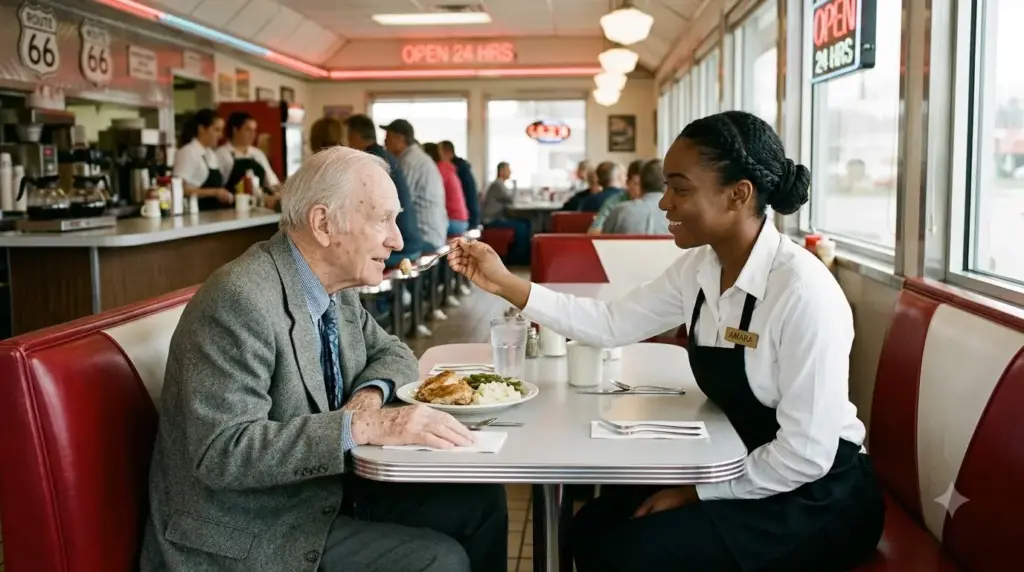
Customer’s always right, even when they’re not. Amara thought about that on the bus ride home. The customer’s always right, even when they’re cruel, even when they’re lying, even when they treat you like dirt. She thought about the old man at the Meridian, about how he’d needed help and she’d given it, about how that single act of decency had cost her everything. Was that wrong?
Should she have looked away? Should she have let him sit there, hungry and humiliated, just to protect her job? She looked at her reflection in the bus window. She barely recognized herself anymore. The exhaustion had carved lines into her face.
Her eyes looked older, sadder. But when she thought about the old man’s smile, about the way his shoulders had relaxed when she’d helped him eat, she knew she’d make the same choice again, even if it cost her everything, even if no one ever thanked her, even if the world kept punishing her for caring. She got off the bus and walked the three blocks to her apartment. The medical bills were still on the counter. The heat was still turned down.
Her mother’s photograph still sat on the nightstand. I’m still here, she whispered to the empty room. I’m still trying. But she was so, so tired. Sunday afternoon, and Amara had 4 hours between her lunch shift and her dinner shift at Benny’s.
She sat on a bench in Riverside Park with a library book she wasn’t really reading. The sun was warm, the breeze gentle. For a few minutes, she could almost forget how exhausted she was. Children played on the swings nearby. A couple walked past with their dog.
An old woman fed pigeons from a paper bag. Amara closed her eyes and tilted her face toward the sun. Excuse me. She opened her eyes. A man stood in front of her, maybe in his 40s, wearing an expensive suit and sunglasses.
Handsome in that polished, put-together way of people who never had to worry about money. Next to him, leaning on a cane, was the old man from the Meridian. Amara’s breath caught. The old man’s eyes widened. It’s you, the young lady from the restaurant.
She stood up quickly. Hello, sir. How are you? I’m I went back there the very next week. I wanted to thank you properly, but they said you didn’t work there anymore.