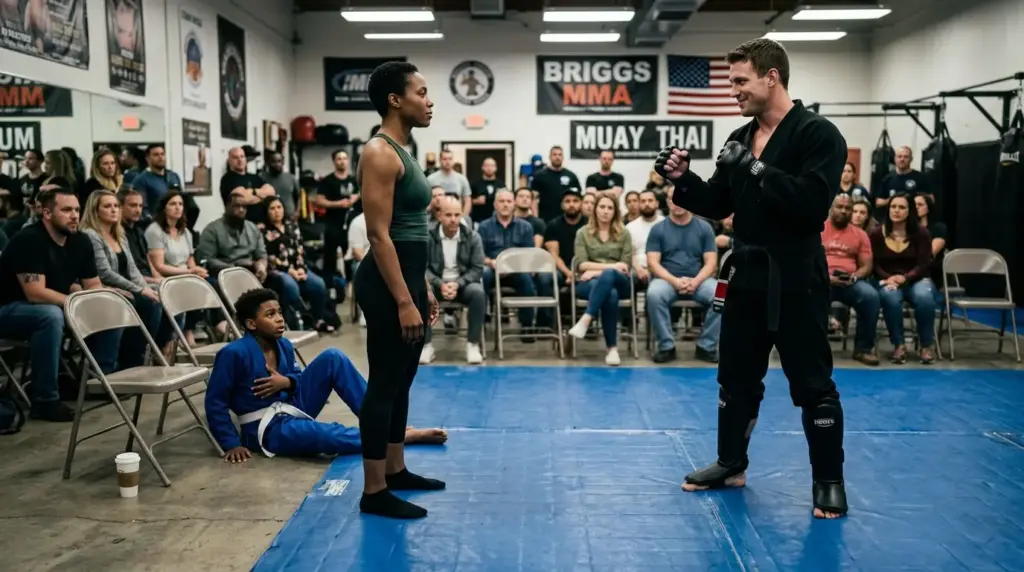
Then she gave him the three conditions.
“Full refund.”
He nodded.
“A direct apology to Eli.”
Another nod.
“And you never again use a student as a demonstration partner just because you know they can’t challenge you.”
Wade looked toward the parents.
Nobody looked away this time.
He nodded.
“Okay.”
Naomi sat.
Laced her shoes.
Same pace as always.
No victory speech.
No dramatic stare.
Then she picked up her coffee cup.
It had gone cold.
She threw it away.
Outside, Eli sat in the passenger seat with both hands hidden inside the front pocket of his hoodie.
He tried to look unconcerned.
Failed immediately.
Naomi opened the driver’s door.
“Did you win?”
She sat.
Closed the door.
“That wasn’t really what happened.”
Eli made a face.
The face he always made when an adult gave him a technically correct answer that avoided the question.
Naomi saw it.
She started the Corolla.
Pulled out.
Then drove several blocks before turning into an empty parking lot.
She shut off the engine.
“This conversation deserves more than red lights.”
Eli looked at her.
For several seconds, Naomi searched for the right beginning.
She had hidden much of her past from him.
Not lied.
Simply withheld.
There was a difference.
At least, there had always seemed to be.
“There’s something you should know about me.”
Eli waited.
“I was in the Marines.”
His eyebrows rose.
“I know that.”
“You know I served.”
“Yeah.”
“You don’t know what I did.”
“No.”
Naomi looked through the windshield.
“I spent eleven years doing work where the most important thing wasn’t being stronger than everybody.”
Eli listened.
“It was knowing what was happening before things got worse.”
She told him enough.
Not deployment details.
Not names.
Not violence.
She told him what mattered.
Training.
Awareness.
Discipline.
Learning exactly how far a situation required you to go.
And, just as importantly, how far it didn’t.
“For a long time,” she said, “I thought strength meant how much you could endure.”
Eli looked down at his hands.
“That sounds kind of bad.”
Naomi smiled slightly.
“It can be.”
She thought about Jonathan.
About herself after his funeral.
About all the years when endurance had become a substitute for asking whether something should be endured at all.
“The strongest people I knew weren’t people who never got scared.”
Eli looked at her.
“They got scared?”
“Of course.”
“But they still did all that stuff?”
“Fear isn’t failure.”
Naomi turned slightly toward him.
“Fear is information.”
Eli frowned.
“What does that mean?”
“It means your body is telling you something matters.”
She paused.
“The question isn’t whether you feel fear.”
“Then what is it?”
“What you do after you feel it.”
Eli stared out the windshield.
The parking lot was empty except for a shopping cart resting against a curb.
“I didn’t really want to learn how to beat those guys at school.”
“I know.”
“I just wanted to stop feeling scared.”
Naomi let the sentence sit.
Then said:
“That part doesn’t disappear completely.”
He looked disappointed.
“What changes is your relationship with it.”
“How?”
“You stop letting fear make every decision.”
Silence again.
Then Eli asked:
“Were you scared in there?”
“Yes.”
His head turned sharply.
“You were?”
Naomi nodded.
“Of what?”
“Several things.”
“You knew you could beat him.”
“That wasn’t the part I was worried about.”
Eli waited.
“I was worried about being angry.”
That answer surprised him.
Naomi continued.
“I was worried about doing more than the situation required because he hurt you.”
She looked directly at her son.
“That’s why what happened after he tapped mattered more than anything before it.”
“You let go.”
“Yes.”
“You held it for a second.”
“I did.”
“Why?”
Naomi considered the question carefully.
“So he understood exactly where the boundary was.”
“Could you have hurt him?”
“Yes.”
Eli became quiet.
“Bad?”
“Yes.”
“Would you?”
Naomi didn’t answer quickly.
“I knew how far I was willing to go before I stepped onto the mat.”
He looked at her.
“And he was never going to have to find out what was past that line.”
Eli processed that.
Naomi added:
“That’s control.”
She tapped one finger lightly against the steering wheel.
“Not knowing how to hurt someone.”
“Knowing when not to?”
“Exactly.”
Eli sat back.
Then he asked:
“What actually happened after I left?”
Naomi gave him the honest version.
Simple.
No exaggeration.
Wade challenged her.
They sparred.
She gained control.
He tapped.
She released.
Then she requested a refund and an apology.
“That’s it?”
“Mostly.”
“You didn’t punch him?”
“No.”
“Kick him?”
“No.”
Eli looked almost disappointed.
Naomi raised an eyebrow.
“Sorry my afternoon wasn’t cinematic enough.”
He laughed for the first time that day.
Then became serious again.
“What if he doesn’t apologize?”
“I’ll follow up.”
The quiet certainty in her voice made Eli smile.
“That sounds like a threat.”
“It isn’t.”
“What is it?”
“What happens next.”
They sat quietly.
Then Eli asked the question Naomi hadn’t expected.
“Will you train me?”
She looked over.
“You’re already training.”
“No.”
He shook his head.
“I mean you.”
Naomi didn’t answer.
“Not you sitting in the chairs drinking coffee.”
That made her almost laugh.
“I want you on the mat.”
Naomi looked at her hands.
Nine years.
For nine years, her old life had stayed compartmentalized.
There was Marine Naomi.
Then there was Mom Naomi.
Hospital Naomi.
The woman who replaced porch bulbs and checked homework and remembered dental appointments.
All of those versions were real.
But they had never occupied the same room.
Maybe they needed to.
Eli was thirteen.
Old enough to understand complexity.
Old enough to know his mother had been someone before she became his mother.
Naomi thought of Jonathan.
What would he have said if he had been sitting beside her in that gym?
Would he have stopped her?
Encouraged her?
Handled Wade himself?
For years, Naomi had asked herself questions like that.
Grief has a way of turning a dead person into an imaginary adviser.





