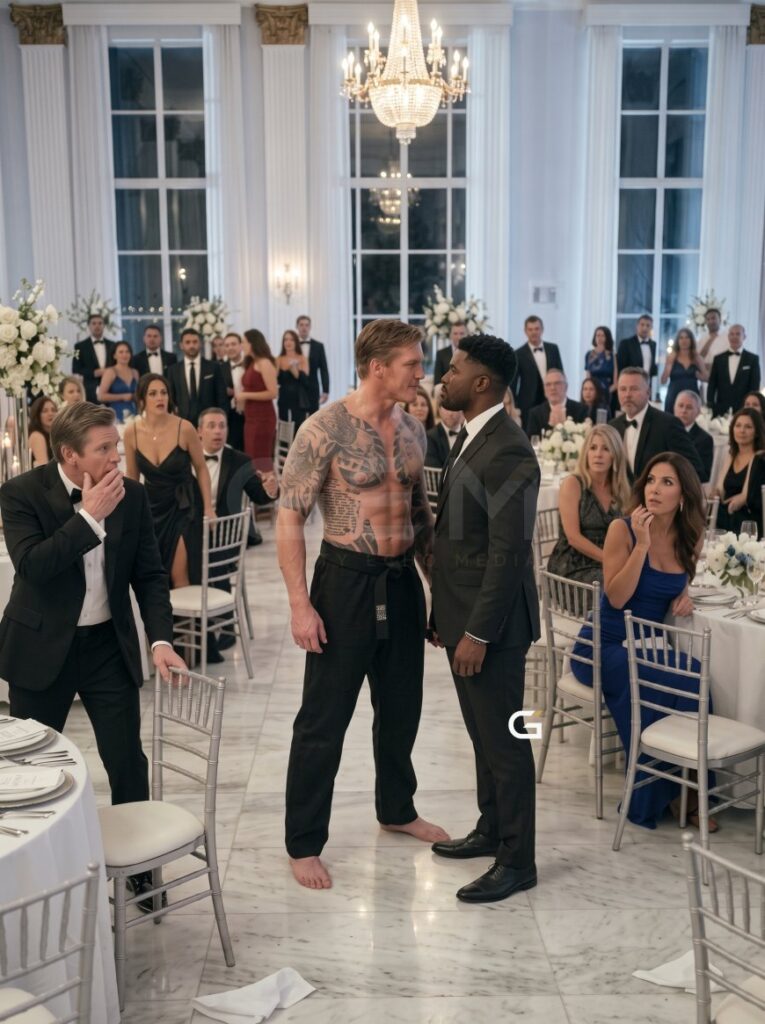
He checked the rear left tire one more time before he put the car away for the night, and it was two PSI low, the way it always was, and he filled it and closed the door of the garage and went inside.
And in a room across the city, on a laptop in a kitchen that smelled like cold coffee, Gavin Ror watched the footage of himself walking to the back wall and standing there with his back to the room, and he replayed it three times, and then he closed the laptop and sat in the dark for a while.
The video was already online.
By morning it would be everywhere.
The video was everywhere by 6:12 a.m.
Calvin knew because his phone would not stop. He had left it face down on the counter next to the coffee maker, and it buzzed against the laminate in a rhythm that was almost polite — three short pulses, a pause, three more. He poured the water. He measured the grounds. He did not turn it over.
He had learned a long time ago that a phone was only a problem if you answered it.
By the time the coffee was done, the buzzing had stopped. He drank half a cup standing at the window. The street below was empty except for a woman walking a small brown dog and a delivery truck idling at the corner. Normal. He rinsed the cup. He showered. He dressed in the same dark trousers and gray shirt he wore every day.
Then he picked up the phone.
Fourteen missed calls. Nine from numbers he didn’t recognize. Three from Martin. One from Erica’s assistant, Priya. Two voicemails. He played the first one.
A man’s voice, young, eager: “Hi, this is Danny with The Morning Drop — we’d love to have you on the show, just a five-minute segment, we can pay—” He deleted it. The second was a woman who wanted to know if he was “the driver.” He deleted that too.
He read Martin’s text.
“You’re trending. Don’t worry. I won’t give anyone your number. But you should know the kid from last night — Thomas, the staffer — he quit this morning. He told me he wants to learn what you do. I told him I’d pass it along.”
Calvin set the phone down. He looked at his reflection in the dark window. Same face. Same quiet. He put the phone in his pocket and left the apartment.
He arrived at Erica’s building at 8:05. Hector was at the door, same posture, same uniform. But his eyes were different. He held the lobby door open with one hand and grinned with half his mouth.
“Morning, Calvin.”
“Morning.”
“You see it yet?”
“See what.”
Hector laughed.
“Come on, man. You know what.”
Calvin stepped past him into the lobby. The marble floor gleamed. The elevator chimed. He did not look at the small television behind the front desk, where a morning show was playing with the sound off. He did not look at the screen. He stood by the elevator and waited.
Erica came down at 8:14. Gray suit, black coffee, phone in her hand. She walked past him without a word and out to the car. He followed. He opened her door. She got in. He closed it. He walked around and got behind the wheel.
They pulled out onto the street before she spoke.
“My phone has been ringing since five.”
“I’m sorry.”
“Not your fault.” She paused. “Or maybe it is. I haven’t decided yet.”
He kept his eyes on the road.
“Martin called me,” she said. “He said he’s had six people ask for your number. He didn’t give it.”
“Good.”
“He also said the young man from last night — the staffer — quit this morning. He told Martin he wants to train with you.”
Calvin’s hands stayed at ten and two. The light ahead turned yellow. He slowed.
“What do you want to do?” Erica asked.
“I’m driving you to your 9:15.”
“That’s not an answer.”
“It’s the only one I have.”
She looked out the window. The city slid past — the same buildings, the same corners, the same morning traffic. Nothing had changed. Everything had.
At the corner of Trade and Church, a pickup truck pulled up beside them. The driver was a man in a baseball cap, maybe forty. He glanced over. Then he did a double take. Then he lifted his phone and took a picture.
Calvin didn’t turn his head. He watched the light. The light turned green. He drove.
“That’s going to keep happening,” Erica said.
“Only if I stay visible.”
“And if you don’t?”
“Then it stops.”
She didn’t say anything for three blocks. Her phone rang again. She looked at the screen, then answered.
“Erica Langley.”
A pause.
“No, he’s not available. No, I’m not confirming that.”
Another pause.
“You can quote me as saying the event was private.”
She hung up.
“Reporter?” Calvin asked.
“Business Journal. They want to know if my driver is a retired fighter.”
“What did you say?”
“I said I don’t discuss personnel.”
“Good.”
“It won’t hold.”
“It doesn’t have to. It just has to last until they find something else.”
She looked at him. He kept driving. He pulled into the parking deck of her office building. He found her spot on the third level. He put the car in park.
She didn’t get out right away.
“Calvin.”
He looked at her in the rearview.
“The offer stands,” she said.
“For as long as you want it. Longer, if you need it.”
He nodded once.
She got out. She closed the door. She walked toward the elevator without looking back. He watched her go. Then he sat in the car for a long time.





