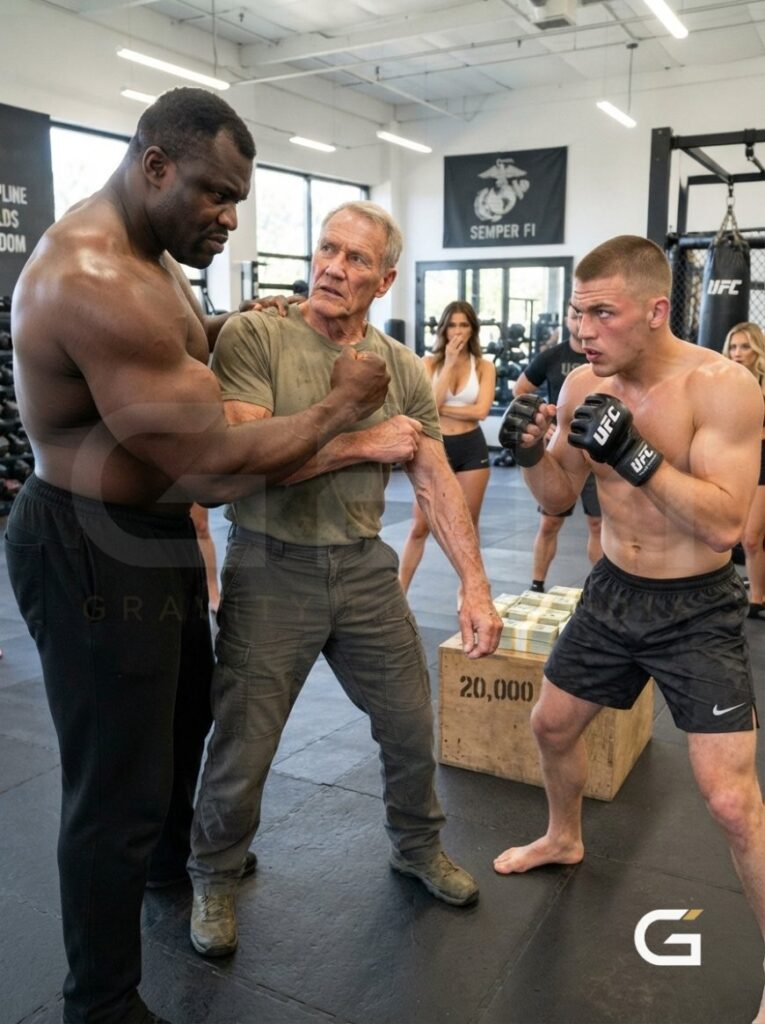
He came alone. No cameras. No Toby with the stabilizer rig. No custom leather duffel bag. He carried a battered nylon string bag and wore a plain, unbranded black rash guard.
He didn’t look at the crowd. He didn’t strut. He walked straight to the front desk, swiped his key tag, and gave me a curt nod.
“Frank.”
“Dorian.”
I replied, grabbing a clean towel from the stack and tossing it to him.
“Locker room’s open.”
Antoine walked in exactly ten minutes later.
Same gray Marine t-shirt. Same faded sweatpants. Same heavy, methodical limp.
The gym went quiet again. A collective holding of breath.
Antoine dropped his bag by the water fountain. He began wrapping his hands in silence.
Dorian stepped onto the edge of the mat, waiting. He looked like a dog that had been kicked but kept coming back to the porch. He was nervous, shifting his weight from foot to foot.
Antoine finished his second hand, tore the tape with his teeth, and walked over.
“You’re early,” Antoine said.
“I didn’t want to waste your time,” Dorian answered.
“Good. Strip the gloves. We aren’t hitting anything today.”
For the next two hours, nobody sparred in the main cage. Nobody even hit the heavy bags very hard. Half the gym was covertly watching a sixty-two-year-old man tear down a Division I All-American to his absolute raw foundations.
Antoine didn’t teach Dorian submissions. He didn’t teach him striking combinations or fancy escapes.
He taught him how to stand.
“You’re balanced on your toes,” Antoine instructed, gently tapping Dorian’s calf with his heel. “That’s a track runner’s stance. It means you’re planning to run or jump. If I push you right now, you fall. Drop your weight. Feel the floor through your heels. You don’t fight on the canvas. You fight inside it.”
Dorian shifted his weight, trying to flatfoot his stance. Antoine immediately pushed Dorian’s shoulder with just two fingers. Dorian stumbled backward, his arms flailing slightly to catch his balance.
“Too stiff,” Antoine corrected. His voice was gravelly but devoid of mockery. “You’re bracing for impact. Bracing breaks bones. You need to absorb it. Bend your knees. Relax your jaw. You’re holding tension in your neck. Tension is a liar. It tells you you’re safe when you’re just brittle.”
It was agonizing to watch.
Dorian was a physical specimen capable of back-flipping off a cage wall, yet he was struggling to execute a simple pivot without Antoine correcting his hip alignment.
But the kid didn’t complain. He didn’t snap back. Every time Antoine pushed him off balance, Dorian reset, closed his eyes for a second, internalized the failure, and tried again.
Sweat poured off Dorian. Not from cardiovascular exertion, but from the sheer mental taxation of unlearning two decades of sports-optimized habits.
“We are going to walk,” Antoine commanded, stepping back. “Just walk across the mat toward me.”
Dorian looked confused but complied. He took three athletic, bouncing steps.
“Stop.” Antoine barked. “Your weight is falling forward. You’re catching yourself with every step. That’s momentum, not control. If I sweep your lead leg while you’re falling into your step, you go down.”
Antoine demonstrated.
He walked. It didn’t look like a martial artist moving. It looked like a predator creeping through dry brush. Every footfall was deliberate. His center of mass hovered perfectly between his hips, never committing to a step until the foot was securely anchored to the vinyl.
“Move from the core, not the shoulders,” Antoine said, pacing slowly around Dorian in a tight circle. “Your shoulders are loud. They broadcast your intentions to anyone paying attention. Keep them dead.”
Dorian wiped his forehead with the back of his wrist.
“How do I fix it? It’s muscle memory.”
“Stop thinking about winning,” Antoine said flatly. “Winning is an ego construct. Think about surviving. Think about eliminating the threat with maximum efficiency. You throw a strike to break a structure, not to look pretty for a lens. You fight the clock in here. You know you have five minutes, so you pace yourself for five minutes. Out there on the concrete, there is no clock. The fight lasts until someone is broken. If you hold back ten percent of your energy for the third round, that ten percent gets you killed in the first ten seconds.”
This became the new normal.
For weeks, Dorian—who used to blast hip-hop out of a portable speaker—trained in absolute silence.
The regulars at Southside noticed the shift. The whispers died down. The mockery faded into a strange, unsettled respect. Dorian was no longer a peacock. He was stripping away the flash to find the iron underneath.
He stopped trying to impress the room and started trying to understand the floor beneath him.
—
When Dorian finally sparred again, it was against Robbie, the heavy-set blue belt from that fateful day.
It was a revelation.
Robbie came out swinging hard, wanting to test the new, subdued Dorian.
Dorian didn’t dance away. He didn’t throw a flashy counter-hook. He stepped into Robbie’s space exactly as Antoine had done to him. He found the inside tie, framed Robbie’s bicep, and simply disrupted his balance with a sharp, heavy downward pull on the collar tie.
Robbie stumbled.
Dorian didn’t follow up with rapid-fire strikes. He just maintained the dominant angle, stepping into the pocket and making Robbie carry his weight.
He exhausted the bigger man in sixty seconds of suffocating, invisible clinch work.
Robbie tapped out to sheer exhaustion, gasping for air, untouched by a single heavy punch.
“He feels like concrete,” Robbie panted to me at the desk afterward, shaking his head. “It’s not even fighting. It’s like trying to wrestle a building.”
Two months bled by.
The season shifted, turning the air outside sharp and biting, making the humid warmth of the gym feel like a sanctuary.





