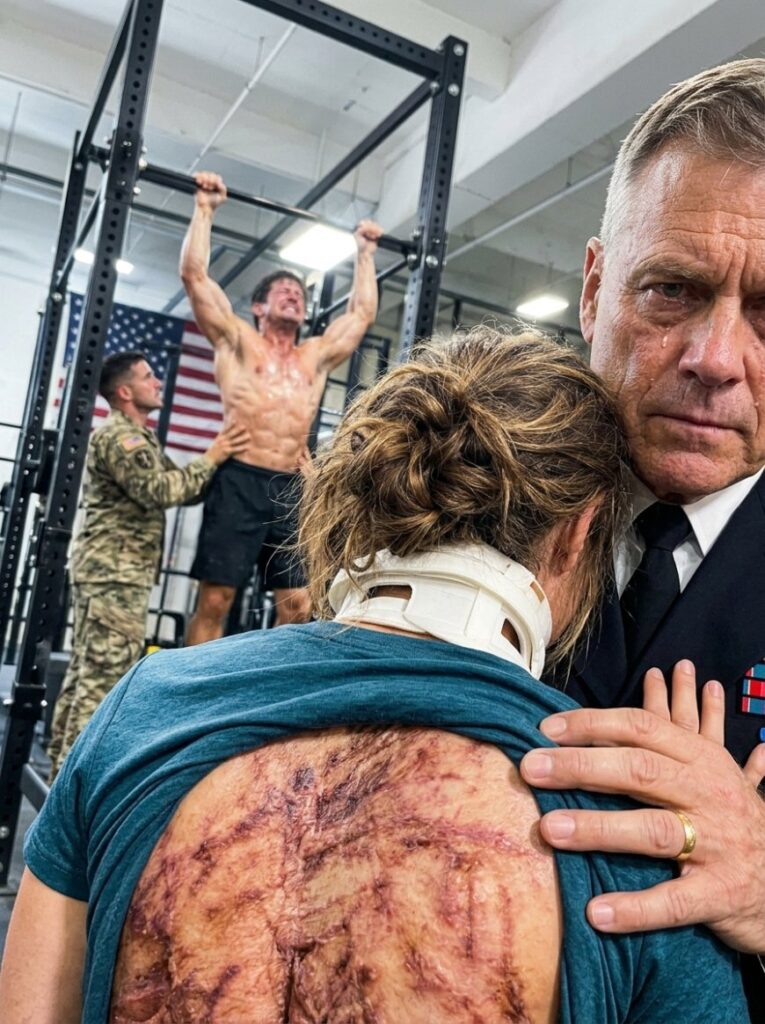
The last I heard, he was living in Nevada, working at a gym in Reno, keeping his head down.
Marcy recovered slowly. The physical wounds healed faster than the psychological ones. For months, she flinched at sudden movements. She jumped at loud noises. She slept with the lights on.
But she also started seeing a therapist who specialized in domestic violence. She started going to group meetings. She started writing in a journal, documenting her feelings and her fears and her hopes.
She started to heal.
Lisa and I attended family counseling with her. We learned how to support her without smothering her, how to listen without judging, how to be present without being overbearing.
It was hard. It was messy. Some days, it felt like we were making no progress at all.
But we kept going. That’s what families do.
One evening, about six months after the incident at the gym, Marcy came into my workshop. I was working on a new piece—a dining table for a neighbor who’d admired the jewelry box I’d made for Marcy’s birthday.
She watched me sand the edges of the oak, running my fingertips over the wood grain.
“You know,” she said softly, “I used to wonder what it must have been like for you. All those years in the Marines. All that training. All that violence.”
I paused, sandpaper in hand, waiting.
“I think I understand now.” She stepped closer. “It wasn’t about the fighting, was it? It was about protection. About being able to keep the people you love safe.”
I set down the sandpaper and turned to face her. She looked so much like her mother—the same dark hair, the same gentle eyes. But she had my stubbornness. My resilience. My willingness to fight for what mattered.
“That’s right,” I said. “The fighting was always the last resort. The most important thing was knowing when to fight. And why.”
Marcy nodded slowly. “I’m going to be okay, Dad. I know it’s going to take time. But I’m going to be okay.”
“I know you will.”
She crossed the room and hugged me. Not the careful, fragile hug of the hospital room. A real hug. Strong and sure.
“I love you,” she said.
“I love you too, sweetheart. Always.”
—
The sun was setting over the mountains, painting the sky in shades of gold and purple. I stood on the back patio, watching the colors shift and fade, thinking about everything and nothing.
Lisa came out with two glasses of wine. She handed me one and leaned against the railing beside me.
“She’s going to be okay,” she said quietly.
“I know.”
“She’s seeing someone new. Did she tell you?”
I turned to look at her. “What?”
“A nurse at the hospital. Melissa. They’ve been friends for a while, but it’s turning into something more. She’s good for Marcy. Patient. Kind. She understands what Marcy went through.”
I nodded slowly. I didn’t know much about Melissa, but if she made Marcy happy, that was all that mattered.
“Are you okay with it?”
Lisa shrugged. “I’m okay with whatever makes our daughter happy. I’ve learned that much.”
We stood in comfortable silence, watching the stars emerge one by one.
“You know,” Lisa said thoughtfully, “when I saw what Dustin did to her, I was so angry. I wanted to hurt him myself. I wanted to walk into that gym and break every bone in his body.”
“You would have been justified.”
“But you didn’t. You went in there and you scared the daylights out of him, but you didn’t actually hurt anyone. You made him understand that there would be consequences. That was enough.”
I thought about the moment in the gym when I’d had Dustin’s shoulder in my grip. The moment when I could have shattered his collarbone, dislocated his shoulder, ended his fighting career forever.
I hadn’t done it.
Not because I couldn’t. Because I’d chosen not to.
“I’ve spent my whole life training men to kill,” I said quietly. “But that’s not who I am. Not anymore. The most powerful thing in the world isn’t the ability to hurt someone. It’s the ability to choose not to. To find another way.”
Lisa took my hand and squeezed it.
“That’s why I married you.”
We stood there until the last light faded from the sky, together, at peace.
—
The full moon rose over the mountains, casting silver light across the backyard.
I turned to go inside, and Lisa followed, closing the door behind us.
The workshop was dark, but I could still smell the sawdust and linseed oil. I touched the unfinished dining table, feeling the smooth grain beneath my fingertips.
Tomorrow, I would finish it. Tomorrow, I would sand the edges, apply the stain, seal the wood in polish.
But tonight, I would sleep.
Tonight, I would rest.
Because the fight was over.
And I had won.
Not by throwing a single punch. Not by breaking a single bone. Not by threatening a single life.
But by using the skills I’d spent fifteen years mastering. The skills of patience. Of precision. Of knowing exactly when to strike and when to hold back.
The skills of a warrior.
The skills of a father.
The skills of a man who had learned that the greatest strength wasn’t violence.
It was love.
THE END
The tools hung on their pegs. The smell of fresh cut oak filled the air. I ran my hand over the table’s edge, feeling the perfection of a job finished.
Lisa appeared with two mugs of coffee. She set one on the workbench and leaned against the doorframe.
“You’re up early,” she said.
“Couldn’t sleep.”
“Thinking about Marcy?”
“Thinking about everything.”
She sipped her coffee.
“She’s going back to school next week. Did she tell you?”
“She mentioned it.”
“She’s nervous. But excited.”





