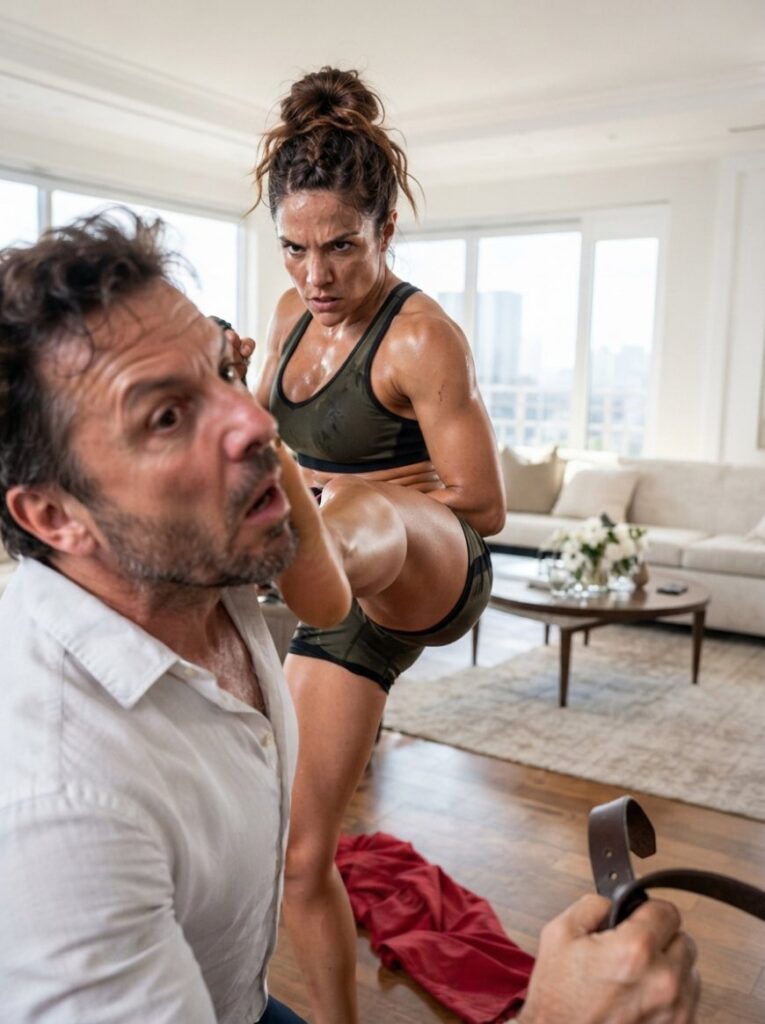
The evidence was too clear. The recordings were too damning. Leah and Camille agreed to testify, and their stories gave weight to everything I’d claimed. Ethan was arrested four months after that first night. His father followed two weeks later. Diane avoided prison but received a criminal conviction and a fine that wiped out her retirement savings. The civil settlement gave me back everything I’d lost—and more. I directed the excess into a fund for survivors of domestic abuse. I named it after Leah and Camille, because they’d been brave when bravery cost more than I’d ever had to pay. One year after the honeymoon ended, I stood in the sunlight of my expanded training center. Half the building remained a gym. The other half offered free legal aid, counseling, childcare, and self-defense classes for women trying to leave violent homes. A young woman lingered by the mats after class, her hands wrapped in borrowed tape. “Does the fear ever go away?” she asked. I thought about that first night—the sound of the belt sliding through the loops, the cold relief on Ethan’s face, the moment I realized my marriage had died. “No,” I said honestly. “But it gets quieter.” “And then?” I smiled. “Then you get louder.” She nodded slowly. Something shifted in her eyes—a spark I recognized. The moment when a survivor realizes she might become more. “What if I’m scared anyway?” she asked. “Be scared,” I said. “Be scared and do it anyway. That’s what courage is.” She thanked me and left. I stayed on the mats, alone, listening to the sounds of women laughing in the other room. My marriage had lasted fourteen days. My freedom would last the rest of my life. Six months later, I received a letter from Ethan’s new lawyer. He wanted a divorce—a real one this time, clean and quiet, no complications. I signed the papers without reading them. I didn’t need anything from him anymore. The annulment had been a technicality. The marriage had ended the moment he unbuckled that belt. I’d simply spent the following months making sure the world knew why. I walked home that evening beneath a calm blue sky, the city lights just beginning to glow. My phone buzzed with a message from my mother. “Dinner Sunday?” “Dinner Sunday,” I typed back. It was a simple thing, that exchange. Ordinary. Unremarkable. But it meant something to me now—something it hadn’t meant before. Family wasn’t about obligation. It wasn’t about fear or control or the careful performance of affection. It was about showing up. Consistently. Honestly. Without condition. The way my mother had shown up for me, every time I needed her. The way I would show up for the women who walked through my doors, looking for a way out. I paused on the sidewalk and looked up at the stars. They were faint, drowned by the city’s glow, but I knew they were there. Some things were like that—hard to see, but real. I had spent years learning to fight. To defend. To prepare for the worst and hope for something better. But that night, standing on the corner of Fifth and Main with my future stretching ahead of me, I realized I had learned something else, too. I had learned that freedom wasn’t the absence of fear. It was the presence of choice. And I had chosen well. **THE END** The walk home took forty minutes, and I took the long way. Past the laundromat with its buzzing blue sign, past the taqueria where a man was hosing salsa off the sidewalk, past the bench where an old woman fed pigeons out of a paper bag every night at exactly nine. I noticed all of it. That part was new. For years I had moved through this city reading threats — counting exits, tracking footsteps behind me, rehearsing the first three seconds of a fight I never knew when I’d have to start. Tonight my shoulders sat where shoulders were supposed to sit. At home I did not check the locks twice. I made tea, forgot to drink it, and slept seven hours without waking. Marisol was on the curb outside the center the next morning, hood up, arms wrapped around her knees. I parked and walked toward her. She stood before I got close, too fast, like a kid caught somewhere she shouldn’t be. “I’m not a member,” she said. “You don’t have to be a member to sit on a sidewalk.” She laughed — a short, startled sound, as if it had slipped out of her without permission. I unlocked the door and let her follow me inside. The lights came on in rows, one bank after another, until the mats gleamed like the surface of dark water. She stopped at the edge and wouldn’t step onto them. “I don’t know how to do any of this,” she said. “Nobody does on the first day. That’s what the class is for.” Her hands were shoved deep in her pockets, fists inside the fabric. I recognized the posture. I had worn it for years, back when I believed a closed fist could substitute for a plan. “I haven’t left yet,” she said finally. The words landed in the empty gym and stayed there. “Most people haven’t, the first time they walk in here,” I said. “The ones who come early are usually still deciding.” “I’m not deciding. I’m just—” She looked at the mats, then at the door, then at the ceiling, anywhere but at me. “I keep making lists. Reasons to stay, reasons to go. The stay column is longer.” “That doesn’t mean it’s right.” “How do you know the difference?” I thought about the belt on the carpet, the way it had slid through the loops without a sound, the way Ethan’s face had gone calm and blank and certain. I had not made a list that night. I had simply known. “Because one column makes you smaller and one doesn’t,”
PART 2: My husband unbuckled his belt the night our honeymoon ended and said, “Time to learn the rules of being a wife.”