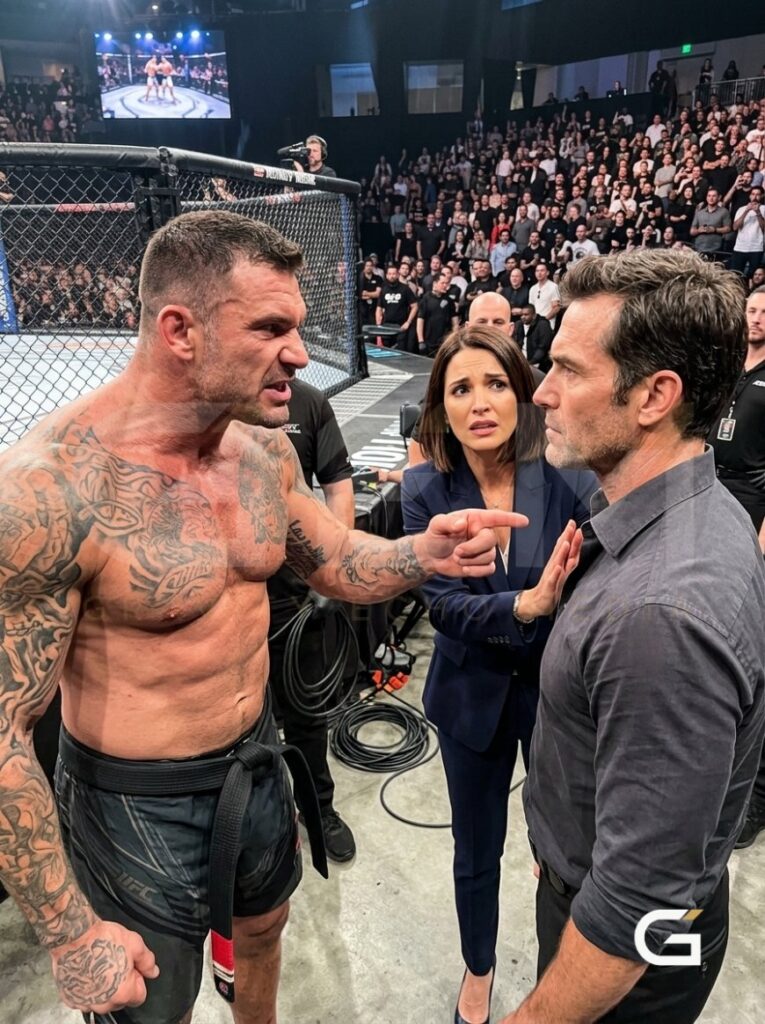
“Yeah.” He looked out the window, watching the city scroll past. “Everything’s okay.”
—
The fight happened three weeks later.
Knox didn’t attend. He never watched it live. But when the results came through that evening—EMTT Cade, victory by unanimous decision—he allowed himself a small smile.
He thought about the young fighter he had injured twelve years ago. He thought about the sound of that shoulder, sharp and wet and final.
He thought about all the choices that had brought him here—to this moment, to this life, to this version of himself he had spent years believing he didn’t deserve.
And for the first time, he stopped thinking about the past.
—
Ble found him on the rooftop terrace that evening.
The stars were out, faint but visible through the city’s glow. She carried two glasses of wine and a question she had been carrying for weeks.
“You never told me what you were thinking,” she said, handing him a glass. “In the cage. When you had EMTT locked in that submission and you decided to let go.”
Knox took the glass.
“I was thinking about a quote I used to teach at Fort Calder. Something one of my instructors told me years before that.”
“What was it?”
He sipped the wine.
“‘The measure of a warrior isn’t how many enemies he can destroy. It’s how many he can let walk away.'”
Ble was quiet for a moment.
“That’s a good measure.”
“It took me twelve years to understand it.”
They stood together at the edge of the terrace, looking out at the city, and something unspoken passed between them—an understanding, a recognition, a quiet acknowledgment of how far they had both come.
“You know,” Ble said finally, “when I hired you, I read through your file. All one hundred twelve pages. Commendations, redactions, everything. I knew what you were capable of.”
“And you still hired me.”
“I hired you because of what you were capable of. But I kept you because of who you chose to be.”
Knox turned to look at her.
“Same as me,” he said.
“How do you mean?”
“I stayed because you were the first person who looked at what I could do and asked what I wanted to do instead.”
She smiled.
“You’re welcome.”
They stood in comfortable silence, two people who had found something neither had been looking for.
And somewhere below, in the streets of Las Vegas, the world continued spinning—unaware that in a quiet moment on a quiet rooftop, two people had finally stopped running from themselves.
—
The story of Knox Garrison never became famous.
He never appeared on magazine covers or morning talk shows. He never gave interviews about his past or his choices or the night he stepped into a cage and gave a champion a choice he didn’t deserve.
He simply kept walking, three steps behind the woman he had sworn to protect, through a world that would never understand what he really was.
But that was fine.
He had spent twelve years trying to hide from himself.
He didn’t need the world to know who he was.
He just needed to finally believe it himself.
—
The final letter arrived two years later.
It was from EMTT—a brief note, handwritten on plain stationery, with no return address.
*Mr. Garrison,*
*I’m retiring next month. Not because I have to—because I want to. I’ve had a good career. Better than I deserved. And I want to end it on my own terms.*
*I wanted you to be the first to know.*
*Thank you for what you gave me. Not the submission. Not the lesson. The choice.*
*I hope one day I can pass it on.*
*—EMTT*
Knox read it and placed it in the drawer with the others.
Then he closed the drawer and went back to work.
He had a job to do.
And for the first time in his life, he was exactly where he was supposed to be.





