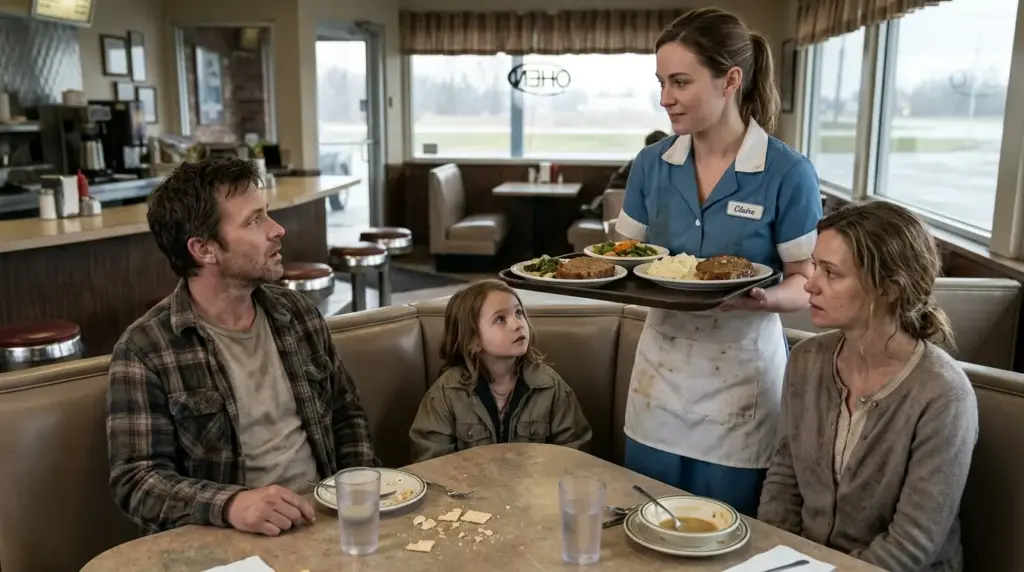
Claire discovered she had lost hers during the move. They drove to the county library that afternoon. Sophie chose seven books. Claire watched her carry the stack with both arms and thought about the crackers.
That evening, Arthur asked Claire again about the job. She still did not say yes. “I need one thing.” Arthur waited.
“If I work for your foundation, I don’t want to be used in advertisements every time we help somebody.” “Fine.” “I don’t want people filmed while they’re desperate.” “Fine.”
“I want restaurants to have emergency meal funds that employees can use without paying out of pocket.” Arthur nodded. “And job help needs to happen before families reach a motel.” Arthur smiled faintly.
“You’re negotiating before accepting.” Claire crossed her arms. “Is that a problem?” “No.”
He held out his hand. “It’s one of the reasons I hope you accept.” Claire took the job. Three weeks later, she left Willow Creek Diner.
On her last shift, Brent gave her a card signed by every employee. Tom gave her a new pair of nonslip shoes because he said foundation directors should not fall on their faces in public. Claire cried anyway. She also made Arthur agree that Willow Creek would become the first pilot site for the new emergency meal program.
They called it Open Plate. The idea was simple. Participating restaurants received a small monthly fund. Servers and managers could use it when they encountered someone facing immediate food insecurity.
No dramatic forms at the table. No public announcement. No requirement that a family prove humiliation before receiving dinner. Claire insisted on one rule.
The receipt printed only one phrase. YOU’RE COVERED TODAY. The first month, twelve restaurants joined. By the third month, thirty-eight.
Claire spent more time driving than she ever expected. She visited diners, school counselors, churches, shelters, factories, and community colleges. She met people whose problems could not be solved by a plate of chicken, but she also learned that one meal could create enough breathing room for the next decision. Arthur attended some meetings.
He did not dominate them. That was new for him. The MidRiver situation became larger than Noah Carter. An internal audit found that thirty-seven former employees had experienced errors or delays in transition payments after the plant closure.
Several had lost housing. Two had declared bankruptcy. One had moved in with relatives in another state. Arthur ordered the company to correct every verified error.
Then Claire pushed further. “What about the people who got exactly what the contract said but still got crushed?” Arthur looked tired. “That’s harder.”
“I know.” “You think we can undo every consequence of a closure?” “No.” Claire leaned across the conference table.
“But you can stop pretending severance is the same as transition.” The room went quiet. Arthur had built a company by being the hardest person in many rooms. At seventy-four, he was learning there were situations where hardness was not the same as strength.
Hale Hospitality created a new closure policy. When a company eliminated more than fifty jobs, affected workers received on-site placement assistance before their final day, direct access to partner employers, benefits navigation, and emergency housing referrals. Degree requirements were reviewed for roles where experience could reasonably substitute. Arthur never called the policy Claire’s idea.
Claire did not care. Noah passed his interview. He started at Hale Regional Distribution as an operations supervisor in October. The first weeks were difficult.
He had not managed automated routing software before, and several younger employees assumed he was another executive charity case. Noah nearly quit twice. Then an overnight shipment failure backed up six trailers ahead of a holiday weekend. Noah reorganized the dock manually, split crews by destination, and cleared the backlog before sunrise.
After that, nobody asked why he was there. Rachel recovered steadily. By winter, she began remote billing work for a physical-therapy clinic. Sophie joined an after-school reading club and became obsessed with drawing comic strips about a detective who solved crimes with a talking squirrel.
Their life did not become perfect. It became stable. That mattered more. Six months after the day at Willow Creek, Claire walked into the diner for lunch.
The bell over the door rang. Tom shouted from the kitchen, “Corporate!” Claire laughed. She sat in her old section.
A new waitress brought coffee. Then Claire noticed a family near the back wall. A woman with two boys. The mother was dividing one plate of fries between them while pretending she was not hungry.
Claire’s instincts sharpened immediately. Before she could stand, another man did. Noah Carter. He had entered five minutes earlier without Claire noticing.
He wore work boots, a clean navy polo with the Hale Regional Distribution logo, and an ID badge clipped to his belt. Rachel and Sophie were with him. Noah walked to the register. He whispered something to the cashier.
Then he paid. Claire watched. The struggling mother looked confused when full meals arrived at her table. The new waitress placed a receipt beside her.
YOU’RE COVERED TODAY. Noah returned to his booth. Claire crossed the room. “You did that?”
He looked guilty. “I had a good lunch day.” Claire stared at him. Then laughed.
Sophie grinned. “He says that every time.” Noah leaned back. “You told me to help somebody when I could.”
“I didn’t say become annoying about it.” Rachel smiled. The moment should have been the end of the story. It was not.
Arthur Hale arrived fifteen minutes later. Not by coincidence. He had asked Claire to meet him there. He carried no executives, no leather portfolio, no black SUVs.
Just a manila folder beneath one arm. He sat down with Claire, Noah, Rachel, and Sophie. “Why does everyone look guilty?” he asked.
“No reason,” Noah said. Arthur glanced toward the family receiving free meals. Then at Claire. She smiled.
Arthur understood. “Good.” He placed the folder on the table. Inside were documents related to MidRiver Packaging.