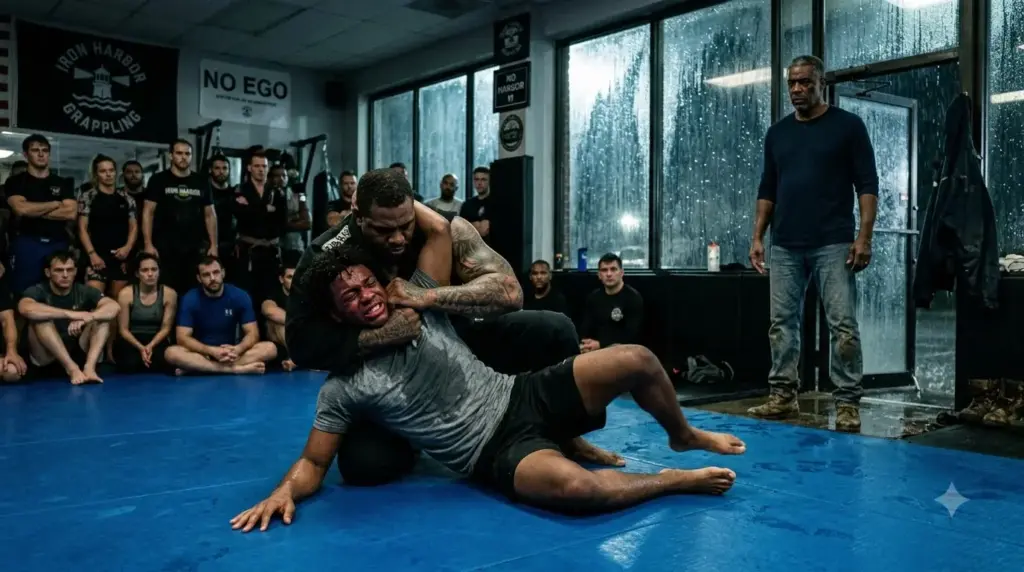
And if Dana asked the room what happened, Malik did not know how many people would tell the truth.
He had seen them standing there.
He had seen their eyes drop.
That hurt more than his neck.
The next morning, Malik woke before sunrise to the sound of his mother unlocking the apartment door.
He had slept on the couch because lying flat made his throat ache. Nia was curled under a blanket in the armchair, where she had apparently fallen asleep waiting for him.
Denise Reed stepped inside wearing black work pants, white sneakers, and a blue cleaning-company jacket. She looked exhausted. She was forty-two but the night shift could add ten years to her face before breakfast.
She closed the door quietly.
Then she saw Malik.
Her eyes moved immediately to the faint red bruising along his neck.
“What happened?”
Malik sat up.
“Training.”
Denise set her bag down.
“What kind of training?”
“Just a rough round.”
She came closer.
“Malik.”
“I’m okay.”
“You sound different.”
He did. His voice was slightly hoarse.
Denise reached toward his neck. He leaned away before she touched him.
Her eyes sharpened.
“Who did that?”
“No one did anything.”
“Then why are you lying?”
Nia opened one eye from the armchair.
“You’re loud,” she mumbled.
Denise glanced at her.
“Go to bed.”
“I was in bed.”
“That’s a chair.”
“It has a blanket.”
“Nia.”
Nia stood, wrapped herself in the blanket like a cape, and shuffled toward the bedroom she shared with their mother. Before disappearing down the hall, she looked at Malik’s neck.
Her sleepy expression vanished.
Malik shook his head once.
Don’t.
She understood.
She said nothing.
Denise folded her arms.
“Tell me.”
Malik stared at the floor.
“There’s this guy at the gym.”
“What guy?”
“A senior guy. Trent.”
“The tattoo one?”
“You met him once.”
“I remember.”
Malik explained it badly.
He left out the part where he tapped more than once.
He left out Lena shouting.
He left out the panic.
He left out Elias at the door.
Denise listened anyway.
When he finished, she was silent for several seconds.
Then she picked up her bag again.
“Get your shoes.”
“Why?”
“Because we’re going to the emergency room.”
“Mom—”
“Shoes.”
“I can’t afford—”
“I didn’t ask.”
“You have work tonight.”
“I said get your shoes.”
Malik rubbed his face.
“We don’t need another bill.”
Denise’s expression changed.
For a second, the exhaustion disappeared.
“We can owe money,” she said. “I can work more. You can work more. Bills can wait. You don’t gamble with your breathing because we’re broke.”
Malik looked away.
Denise lowered her voice.
“I didn’t work fourteen years of nights so you could learn that being poor means people get to hurt you and you have to stay quiet about it.”
The words found the exact place he had been hiding from.
He put on his shoes.
At nine that morning, after four hours in an emergency department waiting room, a physician told Malik he was lucky. There was bruising and inflammation but no sign of an airway emergency. He was instructed to rest, avoid strenuous training, and return immediately if his symptoms worsened.
Denise took the printed discharge papers and folded them carefully into her purse.
Malik noticed.
“What are you doing?”
“Keeping them.”
“Why?”
“Because paper remembers better than people.”
On the other side of town, Elias Ward sat in a diner booth across from Dana Mercer on a video call.
Dana’s face filled the phone screen. Behind her, a hospital corridor stretched past bright windows and plastic chairs. She looked tired and angry.
“He did what?” she asked.
Elias stirred his coffee.
“He kept the hold after the tap.”
“How long?”
“Long enough.”
“That’s not an answer.”
“Twelve seconds, maybe a little more.”
Dana closed her eyes.
“Oh, God.”
“There were witnesses.”
“Who?”
“About twenty people.”
“I mean who spoke up?”
“One woman. Lena Ortiz.”
Dana’s eyes opened.
“And everyone else?”
“Watched.”
Dana looked away from the screen.
Elias let the silence sit.
Finally she said, “I should come home.”
“No.”
“Elias—”
“Your father is in rehab after heart surgery. You said he’s got complications.”
“He’s stable.”
“He’s your father.”
“And Iron Harbor is my responsibility.”
“That’s why you asked me to go.”
Dana looked at him.
“I asked you to observe.”
“I observed.”
“Then what?”
“Now we find out if last night was an exception or a pattern.”
“You read the complaints.”
“Complaints aren’t evidence.”
“Last night is evidence.”
“Maybe. The camera was pointed at the mat.”
Dana leaned closer to the screen.
“You checked the recording?”
“Not yet.”
“You have the office key.”
“I do.”
“Go get it.”
Elias looked toward the diner window.
Rain had stopped overnight. The city outside looked scrubbed clean and cold.
“Dana.”
“What?”
“If he knows the camera caught him, the video may not be there.”
Her face went still.
“He doesn’t have the admin password.”
“Are you sure?”
She did not answer immediately.
That was answer enough.
Elias paid for his coffee.
Twenty minutes later, he stood in front of Iron Harbor with Dana’s key in his hand.
The door was already unlocked.
Inside, Trent Voss was waiting.
He wore black training pants and a gray sweatshirt. No belt. No smile.
“You’re early,” Trent said.
“I didn’t know I had an appointment.”
Trent’s eyes dropped to the key.
“Dana gave you that?”
“She did.”
“What are you supposed to be?”
“Today?”
Trent’s jaw flexed.
“Don’t play games.”
Elias stepped inside.
“I’m not.”
Trent blocked the path toward the office.
“Dana’s files are private.”
“She asked me to access them.”
“I run day-to-day operations while she’s gone.”
“She told me.”
“Then she told you I’m responsible for security.”
“No. She told me you were responsible for classes.”
Trent’s eyes narrowed.
“That sounds like the same thing to me.”
“It shouldn’t.”
For a second, neither man moved.
Then Trent stepped aside.
“Go ahead.”
Elias walked toward the office.





