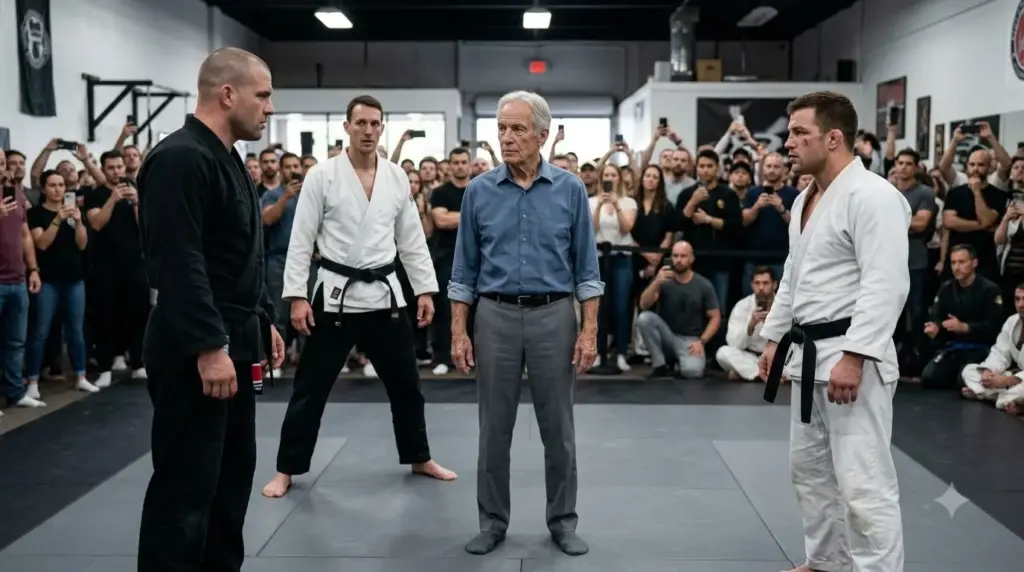
“I have a cardiologist. Different thing.”
“Arthur.”
“Tomorrow. Noon. Harbor Diner.”
Daniel was quiet for so long Arthur wondered if the call had dropped.
Finally he said, “One hour.”
Then the line went dead.
Arthur hung up.
The soup had stopped simmering.
He stood alone in his kitchen, looking at the phone.
For the first time since arriving at Northline, his calm expression disappeared.
He looked tired.
Not physically.
Older than that.
He opened the drawer beside the refrigerator and took out the note Daniel had mailed him.
I couldn’t fix it.
Arthur read the four words again.
Then he folded the paper carefully and slipped it into his shirt pocket.
Daniel Hart arrived at the Harbor Diner twelve minutes late.
Arthur knew him before the door had finished closing.
The years had changed almost everything visible. Daniel’s hair, once black, was mostly gray. His shoulders had narrowed. He wore work boots, a brown canvas jacket, and reading glasses hanging from a cord around his neck. A pale scar ran from the corner of his right ear toward his jaw.
But he still paused when entering a room.
He had done that at sixteen too.
Daniel would stop for half a second, take in every exit and every face, then move. Arthur used to tease him about it. Daniel had grown up in a house where knowing who was angry mattered.
Some habits were not habits at all.
Daniel spotted Arthur in a booth near the window.
Neither man smiled.
Daniel sat across from him.
“You look exactly the same,” he said.
Arthur raised one eyebrow.
“You were always a terrible liar.”
Daniel looked down at the table.
That finally pulled a smile from Arthur.
For a brief second, the thirty-five years between their first meeting and this one seemed to collapse.
Then Daniel’s face closed again.
“You need to stop going there.”
Arthur poured coffee from the small metal pot between them.
“You’ve said that.”
“I mean it.”
“So do I when I say no.”
Daniel leaned back.
“Still impossible.”
“Still dramatic.”
A waitress approached. Daniel ordered black coffee and nothing else. When she left, Arthur slid the folded note across the table.
“I couldn’t fix it,” he read quietly. “You had six weeks to imagine how those words would sound to me.”
Daniel stared at the paper.
“I shouldn’t have sent it.”
“No. You should have sent more.”
“I wasn’t thinking clearly.”
“What were you thinking?”
Daniel rubbed both hands together.
“That I was done carrying things I didn’t know what to do with.”
“The belt?”
“The belt. The photographs. The key.”
“What does the key open?”
Daniel looked toward the rain outside.
“A storage unit.”
“What’s inside?”
“Old gym records. Videos. Insurance documents. Training logs. Stuff I couldn’t throw away.”
Arthur’s expression sharpened.
“Why send me the key?”
Daniel did not answer.
The waitress set down his coffee.
He waited until she walked away.
“Because you’re the only person I know who wouldn’t use it to hurt somebody.”
Arthur stared at him.
“That is not the same as telling me what you want done.”
“I don’t know what I want done.”
“Then start with the truth.”
Daniel wrapped both hands around his mug.
The story came slowly.
Four years earlier, Northline Martial Arts had been called Hart Street Academy. Daniel had owned it for nineteen years. It had never made him rich. Some months it barely paid its rent, especially because Daniel allowed teenagers from the neighborhood to train free if their families could not afford dues.
Cole Ransom had arrived at seventeen.
He was angry, talented, relentless, and hungry for approval.
Arthur listened without interrupting.
“Cole wasn’t always like this,” Daniel said. “I need you to understand that.”
“No one is always anything.”
“He came in after getting suspended from school for fighting. His father was in prison. His mother worked nights. He slept in the locker room twice and thought I didn’t know.”
“But you knew.”
“Of course I knew.” Daniel smiled faintly at the memory. “I started leaving sandwiches in the office refrigerator and pretending I forgot them.”
Arthur looked down at his coffee.
That sounded exactly like Daniel.
“He got good fast,” Daniel continued. “Too fast, maybe. He loved winning because winning gave him rules he could understand. If he beat someone, he mattered. If he lost, he trained until he could beat them next time.”
“And you promoted him.”
“Yes.”
“Too soon?”
Daniel’s jaw tightened.
“No. Technically, he earned every belt. That’s part of what I got wrong.”
Arthur waited.
“I thought skill would mature him,” Daniel said. “I thought responsibility would. I made him help teach kids. I put him in charge of competition practices. For a while, it worked.”
“Then?”
“People started treating him like he was the reason the gym mattered.”
Sponsors appeared when Cole began winning regional events. Social media followers came. A local sportswear company paid travel costs. Marcus joined as a business manager. Mason and Trevor built the fight team around Cole.
Daniel had disliked the direction but tolerated it because money from the competition program paid for the youth classes.
“It felt like a compromise,” Daniel said. “I told myself all businesses compromise.”
Arthur said quietly, “Until the compromise decides what the business is.”
Daniel nodded.
Noah Reyes had joined at fifteen.
He was small, academically gifted, anxious around crowds, and fascinated by technique. Daniel described him as the kind of student who wrote down combinations after class and returned the next day with three questions about one grip.
By nineteen, Noah was one of the gym’s strongest competitors at his weight.
Cole saw potential in him.
And potential, in Cole’s mind, needed pressure.
The night of the injury, Daniel had been across town at a hospital with his older sister, who had suffered a stroke.
Cole ran the advanced session.
Noah had a tournament in nine days.





