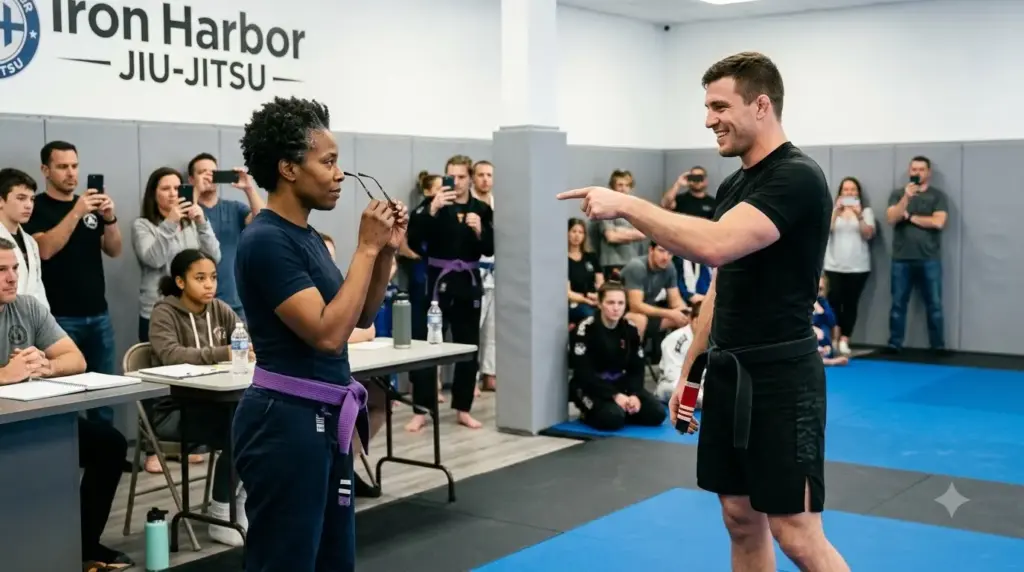
“We’re not allowed to give feedback now?”
“Ask.”
“That’s it?”
“Yes.”
“If they tap early?”
“Release.”
“Then ask if they want feedback.”
“What if the tap was pure panic?”
Victor smiled.
“Then the tap was pure panic.”
“And?”
“We stop.”
“Then maybe coach the panic after.”
Mason nodded slowly.
Victor continued:
“I realized we’ve created a room where newer people sometimes feel they have to justify leaving an exchange.”
“That is backwards.”
Nobody argued.
Mason lost assistant-coaching privileges for beginner class for three weeks.
He could train.
Could coach competition practice under Victor’s supervision.
Could not run beginner rounds.
It was not dramatic punishment.
It was a chance to watch.
Mason hated watching.
Then he started noticing.
A white belt declined a round with a blue belt.
“Not this one.”
The blue belt nodded.
“Okay.”
Nothing happened.
No social collapse.
Another student said:
“Light today.”
Partner asked:
“Thirty?”
“Thirty.”
They trained.
The smaller student escaped.
The partner did not accelerate.
Mason noticed how difficult that was.
Not technically.
Emotionally.
He had always believed intensity drifted naturally.
Sometimes it did.
Sometimes ego pushed it.
A teenager tapped to pressure.
Coach released.
The teenager apologized.
“Sorry.”
Coach asked:
“For what?”
“I panicked.”
“Want feedback?”
“Not yet.”
“Okay.”
Ten minutes later, the same teenager asked:
“What should I do there?”
Now coaching arrived.
Chosen.
Mason began understanding that respecting a stop did not end learning.
It made learning safer.
Naomi returned to her normal routine as best she could.
Work.
Gym.
Leah.
Grocery shopping.
She refused four podcast invitations.
A local news station asked for an interview.
No.
One martial-arts website offered money for an article titled:
How I Humbled a Champion With One Simple Judo Trick.
Naomi replied:
That headline is inaccurate in at least three ways.
Leah begged her to send it.
Naomi did.
The editor never replied.
At work, one nurse recognized the viral clip.
“That was you?”
Naomi sighed.
“Yes.”
“You’re secretly terrifying.”
“No.”
“You dropped that guy.”
“He lost balance.”
“Same.”
“No.”
The nurse laughed.
Naomi continued filling out family-support forms.
That ordinary work helped.
She spent that afternoon with a seventy-three-year-old man whose wife was dying.
He kept apologizing for crying.
Naomi finally said:
“Stop apologizing.”
He looked embarrassed.
“I’m supposed to be keeping everybody together.”
“Who told you?”
He stared.
Nobody.
His own identity had.
Naomi thought about Mason.
Different room.
Same problem.
People taking one role—
champion.
father.
black belt.
strong person—
and turning it into a prison.
The man said:
“I don’t want my kids thinking I’m weak.”
Naomi answered:
“They’re probably learning what love costs.”
He cried harder.
Naomi sat quietly.
No technique.
No fix.
Just presence.
That evening she went to training and lost three rounds in a row.
The first to a younger purple belt.
Second to a larger blue belt with excellent wrestling.
Third to Mason.
He had asked first.
“Want a technical round?”
Naomi thought.
“Yes.”
“Intensity?”
“Forty.”
“Forty.”
They started.
Mason stayed forty.
Naomi caught a grip.
He escaped.
He took her down carefully.
She worked.
He passed.
Naomi tapped.
Mason released immediately.
No comment.
They reset.
Second exchange.
Naomi used an angle.
Mason recognized it.
Stayed balanced.
Smiled.
She smiled too.
Then he controlled her again.
At the end:
“Want feedback?”
Mason asked.
Naomi almost laughed.
“Yes.”
He gave one technical note.
Then she said:
“You want mine?”
He hesitated.
“Yes.”
“You were looking at the mirrors twice.”
Mason frowned.
“What?”
“Checking who was watching.”
His face tightened.
“Damn.”
Naomi smiled.
“Less than before.”
He exhaled.
“I’ll take less.”
That became the beginning of something healthier.
Not friendship exactly.
Mutual respect.
Mason discovered Naomi was funny when she chose to be.
Naomi discovered Mason was far more anxious than his public personality suggested.
One evening after training, he asked:
“Why did you stop judo?”
Naomi sat against the wall.
“My husband got sick.”
Mason immediately softened.
“I’m sorry.”
“Thank you.”
“He died?”
“Five years ago.”
Mason nodded.
Naomi continued:
“Before that, I trained since I was seventeen.”
“Competed.”
“Coached children for a while.”
“Then Marcus developed cardiomyopathy.”
“Training became less important.”
Mason said:
“You could’ve gone back after.”
“I could have.”
“Why didn’t you?”
Naomi looked toward the mat.
“Because grief attaches itself to weird places.”
“Judo was the version of me that existed before hospitals.”
“Before pill organizers.”
“Before I knew the parking garage at St. Mary’s better than my own neighborhood.”
She smiled sadly.
“For a while, stepping on a judo mat felt like visiting somebody else’s life.”
Mason listened.
“What changed?”
“Leah.”
“What’d she do?”
“Insulted me.”
Mason laughed.
Naomi explained.
Leah had told her she spent all day helping grieving families move forward while refusing to let herself build anything new.
“That sounds like a teenager.”
Mason said.
“Cruel and correct.”
“Exactly.”
Naomi continued:
“I didn’t want to return to judo.”
“So I tried something related but different.”
“Jiu-jitsu.”
Mason nodded.
“Why stay quiet about the background?”
“Because I liked not being the experienced person.”
That surprised him.
“Why?”
“People leave very little room for experts to be confused.”
Mason looked away.
That sentence found him.
Naomi continued:
“I wanted to ask stupid questions.”
“Get caught.”
“Be wrong.”
“Have somebody explain something basic without feeling like my history was being graded.”
Mason smiled.
“Then I ruined that.”
“For a week.”
She shrugged.
“People forgot.”
“They didn’t.”
“People always forget faster than you think.”
Mason looked toward the empty gym.
“Not me.”
Naomi nodded.
“That part is your work.”
Months passed.
Iron Harbor changed slowly.
No miracle.
No instant transformation.
Some students thought Victor had become overly cautious.
A few complained that asking about intensity made training awkward.
Victor answered:
“Awkward is cheaper than injury and resentment.”
Competition rounds remained hard.
Very hard.
Mason still pushed athletes who specifically asked him to.
The difference became agreement.
Before competition rounds:
“Hard?”
“Yes.”
“Anything injured?”
“Left knee.”
“No twisting pressure there?”
“Right.”
“Tap still ends it?”
“Obviously.”
Mason smiled.
“Say yes.”