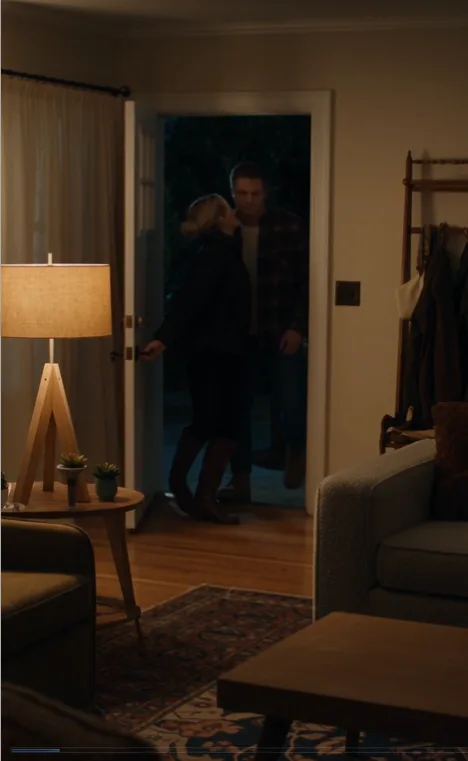
The physiological response was instantaneous and terrifying. Her vision tunneled. The humid summer air suddenly felt too thick to breathe. Her mind screamed commands—pull away, scream, run—but her muscles refused to obey. She was entirely at the mercy of the man holding her tethered to the asphalt.
Had she been alone, she did not know what would have happened next. Fortunately, she wasn’t. Her older cousin, David, who had been waiting in the car, saw the exchange. He was out of the vehicle in seconds, sprinting across the parking lot. He shoved the man hard in the chest, breaking the grip on Angela’s wrist, and shouted a string of aggressive warnings that sent the drunk man stumbling backward into the night.
Nothing worse happened. She drove home. She put the milk in the fridge. But the ghost of that grip lingered on her skin. For days, she couldn’t shake the memory of the profound, sickening helplessness—the realization that her safety was entirely contingent on the benevolence, or the intervention, of others.
Two weeks later, driven by a quiet, burning resolve, she walked into a recreational judo club housed in the basement of a local community center. The room smelled of old canvas and sweat, echoing with the sound of bodies hitting the mats.
She joined that evening. Judo was the beginning. She spent years mastering the mechanics of balance, leverage, and momentum. She learned how to unbalance a larger opponent, how to fall without breaking, how to use the earth as a weapon. When she moved to Chicago for work a few years later, she found a wrestling room, subjecting herself to the grueling, grinding endurance required to fight for every inch of space. Later, she discovered Brazilian jiu-jitsu, marveling at the intricate, suffocating chess match of ground fighting.
She trained relentlessly for twenty-six years. She competed in regional tournaments in drafty high school gymnasiums across the Midwest. She won some, her arm raised in exhaustion. She lost more, tapping out to tighter chokes or being pinned by superior wrestlers. Through it all, she persisted. She earned a second-degree black belt in judo, the worn cotton of the belt a testament to thousands of hours of throwing and being thrown. She reached the rank of brown belt in Brazilian jiu-jitsu, a rank that commanded deep respect in any room she walked into.
Then, life shifted its axis. She met Marcus. He was a brilliant, gentle man who worked in architecture and didn’t have a single martial bone in his body. They married. They had Ethan. Her training schedule, once the focal point of her days, gradually yielded to the beautiful, chaotic demands of family and career.
When Ethan was eleven, the world fractured. Marcus collapsed in their living room on a Sunday morning. A brain aneurysm. Sudden, massive, and entirely unapologetic. By the time the ambulance arrived, he was gone.
Angela survived the suffocating grief the only way she knew how: she kept training. Not as often, and rarely with the same fiery competitive ambition, but she stayed on the mats. It was the only place where the rules made sense, where pressure could be measured and neutralized.
Now, at forty-five, Angela was a vastly different martial artist than she had been at thirty. She was deeply experienced, her technical knowledge sharp and unforgiving. She possessed a structural strength that surprised younger, more athletic partners. But she was also undeniably slower. Her left knee held a dull, persistent ache after long sessions, protesting the decades of deep squats and pivoting throws. Her lower back had its own vocal opinions about heavy deadlifts and bridging out of bad positions.
She possessed no illusions about her capabilities. She harbored no cinematic fantasy that her decades of knowledge magically canceled out age, size, modern conditioning, or the explosive energy of someone actively training for competition. She knew the reality of violence, both on the mats and off them.
Which was why, when Ethan asked for her help, she didn’t try to teach him herself. The dynamic between mother and teenage son was already complicated enough without introducing joint locks and chokeholds in the living room. Instead, she helped him find a gym.
Chapter 3: The Sanctuary That Wasn’t
They had settled on Westbridge Martial Arts, a large, modern facility only fifteen minutes from their home. It had bright lights, clean mats, and a schedule that accommodated Ethan’s school hours.
For the first six months, it seemed like the perfect solution. Ethan threw himself into the training. The transformation was slow but undeniable. The boy who used to slump his shoulders and hide behind his hair began to walk with his chin parallel to the ground. The bullied kid from chemistry class found a place where physical contact wasn’t a precursor to humiliation, but a puzzle to be solved. He stopped talking about the boys who took his pencil case. Instead, dinner conversations were dominated by enthusiastic, if slightly confused, explanations of guard passes and cross-collar chokes.
He loved it. He hadn’t started training because he harbored grand dreams of becoming a professional fighter or standing in a steel cage under stadium lights. He had started because the world felt unsafe, and Westbridge offered a controlled environment to build armor.
But over the last few weeks, the tone of Ethan’s dinner-table reports had shifted. The enthusiasm became muted. He started coming home quieter, his face flushed not just with exertion, but with frustration. He spent more time icing his joints and less time practicing footwork in the hallway.
The shift crystallized on a Thursday evening. Ethan was sitting on the living room sofa, attempting to pull a sweater over his head. As he lifted his right arm, he let out a sharp hiss of breath, his face tightening in sudden pain. He dropped the arm, leaving the sweater bunched around his neck.
Angela, who was reading in the armchair opposite him, lowered her book.
“Your shoulder?” she asked, her voice deliberately neutral.