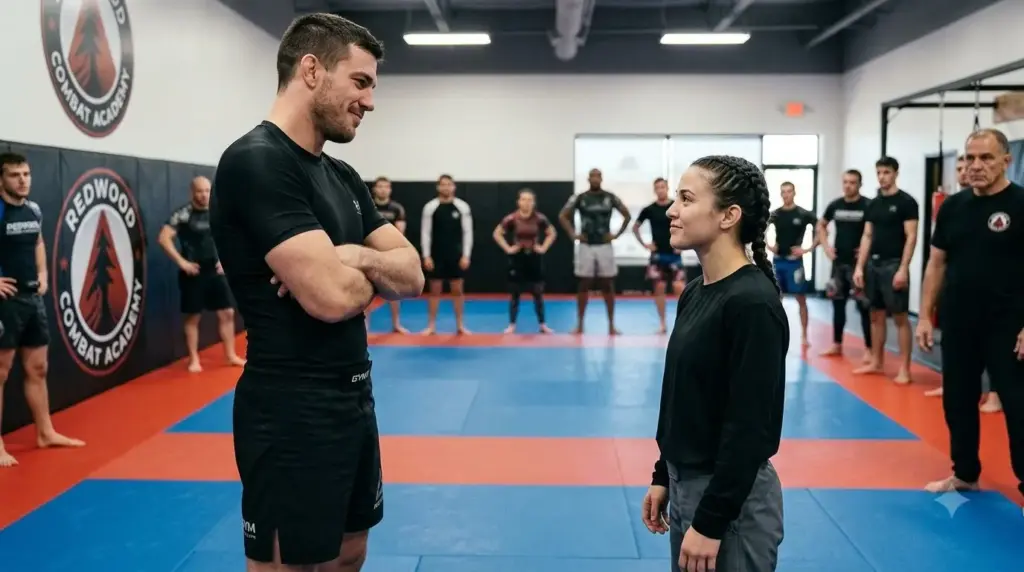
“The problem is that you wanted to know only after she became dangerous to you.”
Bryce hung up.
For two weeks, he trained harder.
That was his solution to everything.
Embarrassment?
Train.
Anger?
Train.
Confusion?
Train harder.
He convinced himself he wanted a rematch because he cared about truth.
What he wanted was the video replaced.
A new clip.
A corrected story.
He contacted Maya through Gabriel.
One full competition round. Ten minutes. No theatrics.
Maya replied:
No, thank you.
Bryce stared at the message.
Typed:
Scared?
Deleted it.
Typed:
You were willing before.
Deleted that too.
Finally:
Understood.
He hated writing it.
That mattered.
At Redwood, life continued.
But something had shifted.
Students began talking.
Not about Maya.
About Bryce.
A white belt named Sarah told Gabriel that during a previous seminar Bryce had repeatedly asked her to spar after she declined because of a recovering knee.
A teenage student said Bryce had chosen him during another demonstration specifically because he was inexperienced, then posted the clip online without asking.
A visiting blue belt remembered being called “fragile” after refusing a hard round.
None of these stories described serious assault.
No broken bones.
No catastrophic injury.
That was exactly why Gabriel had ignored the pattern.
Each incident was small enough to explain individually.
Humor.
Competitive culture.
Miscommunication.
Intensity.
Taken together, they looked different.
Gabriel reviewed the academy’s policies.
They had rules for dangerous techniques.
Rules for hygiene.
Rules for mat shoes.
Rules for competition registration.
Nothing about filming consent.
Nothing about repeated invitations after somebody declined.
Nothing about instructors selecting inexperienced partners for public demonstrations.
They had assumed good judgment would cover it.
Good judgment is a terrible policy when the problem is somebody’s judgment.
Redwood changed.
One invitation.
One answer.
No pressure after a decline.
No posting identifiable training footage without explicit permission.
Demonstration partners selected for instructional suitability, not entertainment.
Advanced students evaluated partly on how safe less experienced partners felt training with them.
Some competitors complained.
“Everything is getting soft.”
Gabriel answered:
“No.”
“We’re getting specific.”
“You can still train hard.”
“You just need somebody who agreed to train hard with you.”
Bryce returned to Redwood three months later.
Not for a seminar.
To speak with Gabriel.
“You blacklisted me?”
“No.”
“Two gyms canceled.”
“They called for references.”
“What did you say?”
“The truth.”
Bryce sat across from him.
Gabriel continued:
“You’re technically excellent.”
“You teach well when you’re teaching.”
“You also sometimes use smaller people to create moments where you look dominant.”
Bryce looked away.
“That sounds worse than it is.”
“Maybe.”
Gabriel leaned back.
“But if the description feels unfair, change the behavior until it stops being accurate.”
Bryce said nothing.
Gabriel gave him the card of Dr. Elena Price.
Sports psychologist.
Bryce laughed when he saw it.
“I don’t need therapy.”
“Then don’t go.”
Bryce put the card in his pocket anyway.
He called four weeks later.
Elena’s first question was not about Maya.
“What bothers you most?”
“That people think I’m a bully.”
“Are you?”
“No.”
She waited.
Bryce frowned.
“I’m not.”
“Then why does the accusation hurt?”
“Because it isn’t true.”
“Everything untrue hurts you this much?”
He stared.
“No.”
“What part might be true?”
He hated her immediately.
Which was probably useful.
For several sessions, Bryce defended the selection.
Maya volunteered.
Maya had experience.
Nobody was hurt.
The round was controlled.
All true.
Elena did not argue.
Then one afternoon she asked:
“If Maya had been six feet tall and two hundred pounds, would you have picked her?”
Bryce opened his mouth.
Stopped.
“That isn’t fair.”
“Why?”
“Because the whole point was showing technique against somebody—”
He stopped again.
“Somebody what?”
Bryce looked out the window.
Elena waited.
Finally:
“Somebody I could control.”
“Why?”
“For the demonstration.”
“Why did the demonstration require the other person to be easy to control?”
He rubbed his face.
“Because I wanted it to look clean.”
“And what did you assume about Maya when you saw her?”
“That she’d be easy.”
“Based on?”
“Size.”
“Anything else?”
Bryce thought.
“She was quiet.”
Elena nodded.
“Small and quiet.”
“Yes.”
“No famous gear?”
“No.”
“No visible status?”
“No.”
“So before speaking to her, you created a story.”
Bryce said nothing.
Elena continued:
“Then you became angry when her actual story contradicted yours.”
That sentence stayed.
Bryce still disliked it.
He also knew it was true.
Maya, meanwhile, went home to Chicago.
The viral clip followed.
Her students found it.
Her boss found it.
Former teammates sent messages.
Some congratulated her.
Some joked.
Some strangers sent requests to fight.
Others accused her of staging it.
A supplement company offered money if she would recreate the moment in an advertisement.
She declined.
A martial arts channel asked for an interview titled:
TINY GIRL DESTROYS PRO FIGHTER
She replied:
That title isn’t accurate.
They changed it to:
THE WOMAN WHO SHOCKED A BLACK BELT
She declined again.
Her father asked why.
“Because I didn’t destroy him.”
“You tapped him.”
“He nearly submitted me first.”