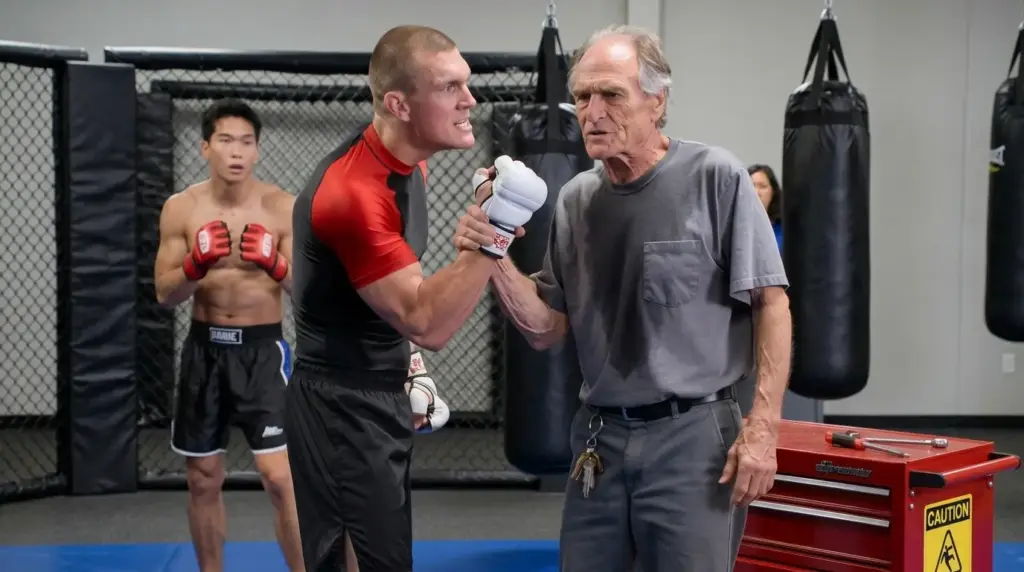
The pinky finger was missing from the second knuckle up. The healed skin was tight and shiny over the stump. The other knuckles were flattened and swollen with calcium deposits, like jagged stones pushed under the skin. A thick white scar cut from the base of his thumb across his palm and disappeared into his wrist crease.
A knife wound.
Deep.
Old.
“I spent twenty-five years working corrections at a maximum-security penitentiary in Nevada,” Hank said quietly. “Before that, I bounced at a biker bar outside Reno. I never fought for a plastic belt. Never had a referee step in when I was tired. I fought men who had nothing to lose. Men who would bite your nose off, gouge your eyes with their thumbs, or put a sharpened toothbrush into your kidney because they didn’t like how you breathed.”
He lowered his hand.
“You learn how to stop a man from killing you. And you learn fast. You learn what joints break first. You learn that pain restrains better than handcuffs. But mostly, you learn that violence is a filthy, ugly thing. It leaves a stain bleach cannot wash out.”
Hank opened the truck door.
The hinges screamed.
“That kid in there thinks hurting people makes him a man. He doesn’t know the first thing about pain. He thinks it’s a game. Today, I reminded him it’s not.”
Sam heard himself ask the question before he could stop it.
“Will you teach me?”
Hank paused halfway into the cab.
He looked at Sam with genuine pity.
“No,” he said. “Because if you’re lucky, you’ll never need to know the things I know. Go balance your spreadsheets. Be glad your biggest worry is a paper cut.”
Then he slammed the door, started the engine, and drove away.
Sam stood alone in the empty parking lot.
Brad did not come back the next week.
According to gym gossip, he had suffered a “training accident” and sprained the ligament in his thumb badly enough to keep him out for weeks. His Instagram went quiet. No shirtless flexing. No motivational quotes over workout clips. No declarations about war, discipline, and domination.
The followers who had orbited him quickly attached themselves to a new heavy hitter.
In the ecosystem of the gym, weakness was a terminal illness.
Brad was already becoming a ghost.
The atmosphere at Apex changed.
Subtly at first.
Sparring rounds became less vicious. The booming insults across the mats disappeared. Fighters wiped up after themselves more often. People gave Hank room when he crossed the floor with his mop bucket.
A quiet realization moved through the room.
The toughest man at Apex was not the one screaming for attention.
The toughest man was the one emptying the spit buckets.
Sam changed too.
He stopped trying to hit the heavy bag as hard as possible. Instead, he slowed down.
Footwork.
Balance.
Leverage.
Center of gravity.
He began to understand that tension was the enemy of power. When you forced something, you created resistance. When you moved with it, you could redirect it.
He did not tell anyone about the conversation with Hank in the parking lot.
The truth was heavier than the myth.
And Sam knew most of the men in that gym could not carry it.
Two weeks after the incident, a thunderstorm rolled through the city.
Rain hammered the cinder-block walls of Apex, masking traffic outside. Sam stayed late, working through stress from a complicated tax audit by hitting the heavy bags alone in the back corner.
At eleven, the main lights shut off, leaving only dim perimeter bulbs.
Hank emerged from the supply closet.
He looked worse than usual.
The damp cold was attacking his joints. His limp was more pronounced, a heavy dragging step that made his right shoulder dip with every movement. He carried a large industrial mop and a yellow bucket of soapy water.
Sam watched from the shadows.
Hank pushed the mop across the blue mats.
Slow.
Strained.
He winced as he leaned into the handle, lower back spasming. He stopped, rested his weight against the wooden pole, and closed his eyes. His breathing was shallow and tight.
The invincible old man from the gym floor was gone.
This was the real body behind the myth.
A body that had spent a lifetime absorbing impact.
The violence Hank had inflicted on Brad had cost him too. The drop in center of gravity. The twist through the core. The sudden pressure through damaged joints.
Those three seconds of mastery had awakened old injuries.
There was no glory in it.
No cinematic triumph.
Just a tired man in his sixties earning minimum wage to mop up the sweat of younger men.
Sam unlaced his gloves and dropped them beside his gym bag.
He walked out onto the mats, bare feet silent on the rubber.
Hank heard him and opened his eyes.
He tightened his grip on the mop, jaw set in a stubborn line.
He hated being seen when he was hurting.
“Gym’s closed, accountant,” Hank muttered. “I know.”
Sam stopped a few feet away.
Hank pushed the mop again.
The wet cotton dragged against the rubber, demanding force from his legs. His left leg buckled slightly. He hissed in pain and caught himself against the handle before he went down.
Sam stepped forward and placed his hand on the mop handle just above Hank’s grip.
Hank looked up, eyes flashing with prideful anger.
“Let go. I don’t need your help.”
“I’m not helping,” Sam said softly. “My calves are tight. I need the friction to stretch out.”
Hank stared at him.
Sam held his gaze.
No pity.
No condescension.
Just quiet stubbornness.
For ten seconds, the two men stood in a silent standoff over a dirty yellow mop bucket.
Rain drummed against the metal roof.
Slowly, the tension left Hank’s shoulders.
The anger faded from his eyes, replaced by weary resignation.
He let go of the handle.





