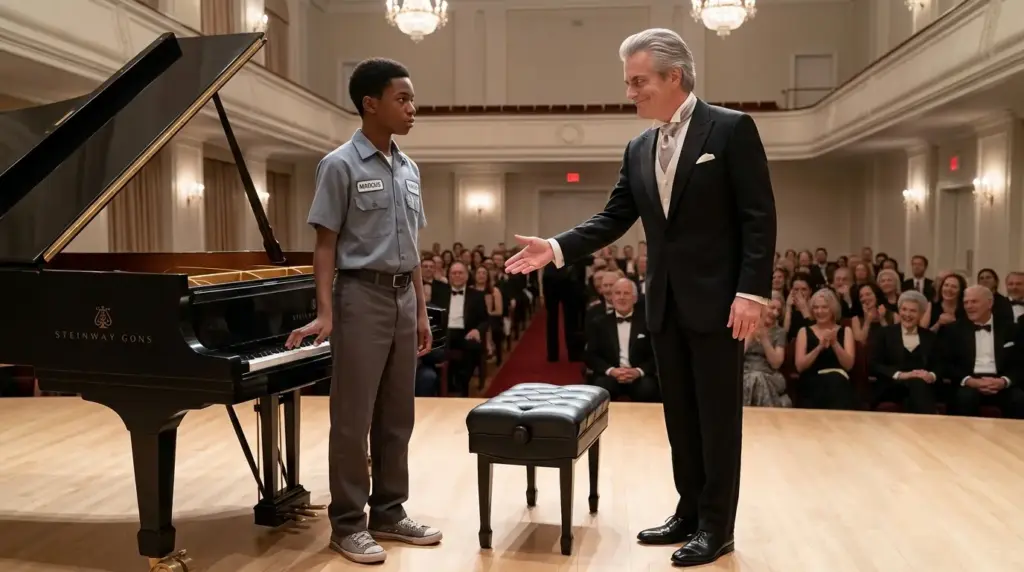
Marcus is a straight A student. He helps me with everything he can. But if he has a chance, a real chance to pursue his dream, I’ll move heaven and earth to make it happen. We’ve survived worse than inconvenience. This isn’t about inconvenience, Harrington said.
And for the first time, he sounded tired rather than angry. This is about reality. Teaching isn’t just about time and technique. It’s about compatibility, about shared understanding. Marcus and I come from completely different worlds.
How am I supposed to teach someone when I don’t understand where they’re coming from? Maybe that’s exactly why you should. Richard Peton said he’d been quiet for a while, but now he stood and approached the stage. Vincent, I’m going to be frank with you. As a major donor to the Harrington Foundation, I have significant influence over its direction.
And I’m telling you right now, if you don’t take Marcus as a student, I’m withdrawing my funding. All of it. $15 million over the next 5 years. Gone. The hall gasped. That was more than a threat.
It was potentially crippling for the foundation. Harrington turned on Peton, his face red with fury. You can’t blackmail me into It’s not blackmail, Peton said calmly. It’s accountability. You’ve built an institution on the premise of supporting musical excellence.
Well, here’s excellence standing right in front of you, and you’re trying to find every excuse to turn it away. That tells me the foundation isn’t actually about excellence at all. It’s about exclusivity. And I’m not interested in funding exclusivity dressed up as merit. I agree.
Catherine Worthington stood as well. Vincent, I’ve pledged 20 million to the foundation over 10 years. Consider that pledge conditional on your acceptance of Marcus as a student. Not as charity, not as some PR stunt, but as a genuine commitment to developing his talent, the same way you’d commit to any student you deemed worthy. Other voices began chiming in from around the hall.
Major donors, board members, influential patrons, all of them suddenly finding their spines, perhaps emboldened by the social media attention, perhaps genuinely moved by what they’d witnessed. The foundation’s reputation is at stake here, Vincent. One board member called out. How we handle this will define us for years to come. Harrington looked around the room, and Marcus could see the moment when he realized he was truly trapped.
Not by force, but by the architecture of the very system he built, a system dependent on wealthy donors, public image, and the illusion of meritocracy. He’d been willing to use that system to maintain the status quo, never imagining it might one day be turned against him. But there was something else in his expression, too, something Marcus couldn’t quite identify. Was it resentment, fear, or was it possibly the smallest hint of curiosity? Two years, Harrington said finally, his voice harsh.
Two years of lessons, three times per week, as with all my students. But understand this, Marcus Williams. I will not go easy on you. I will not make allowances for your background or your circumstances. If you want to be my student, you’ll be held to exactly the same standards as everyone else I teach.
Higher standards, actually, because you’ll be starting so far behind. I understand, Marcus said, his heart racing. I don’t think you do, Harrington said coldly. My current students have been playing since they were four or 5 years old. They’ve had the best teachers, the best instruments, unlimited practice time.
They’ve attended summer programs with master teachers from around the world. You have three years of self-eing and weekly lessons with a nice but unremarkable instructor. Do you understand how massive that gap is? Mrs. Chen isn’t unremarkable, Marcus said quietly.
She’s the reason I’m here. Something flickered across Harrington’s face, surprised perhaps at being contradicted. Be that as it may, you’re walking into a situation where you’ll be competing with students who have every advantage. I will compare you to them. I will judge you against their standards.
And when you fail to meet those standards, which you inevitably will, I will not coddle you. I will tell you the truth. And the truth may be that you’re not cut out for this level of performance. Can you handle that? Marcus thought about everything he’d already handled in his 14 years.
Watching his father waste away in a hospital bed. Listening to his mother cry when she thought he was asleep. Enduring the mockery of classmates who thought his dreams were stupid. Fighting against every message society sent that people like him weren’t supposed to want things like this. I can handle it, Marcus said.
Then we start Monday, Harrington said abruptly. 6:00 p.m. At my studio. 4:35 West 57th Street. Don’t be late.
And for God’s sake, get some proper sheet music. I won’t have you reading from photocopies and computer screens. With that, Harrington turned and stroed off the stage, leaving behind a hall full of stunned, murmuring people and one teenage boy who couldn’t quite believe what had just happened. The next 72 hours passed in a blur that Marcus could barely process. Sunday morning, he woke to find his mother already up, sitting at their tiny kitchen table with her laptop open and papers spread everywhere.
“Mama,” he rubbed his eyes, checking the clock. It was 6:00 a.m. “What are you doing? ” “Reanging our lives,” she said without looking up. “I called Mr. Henderson at the hotel.
Told him I need to switch to the early morning shift, 5:00 a.m. To noon. That way I can be here when you get home from Harrington’s lessons. She made a note on one of the papers. Mrs.