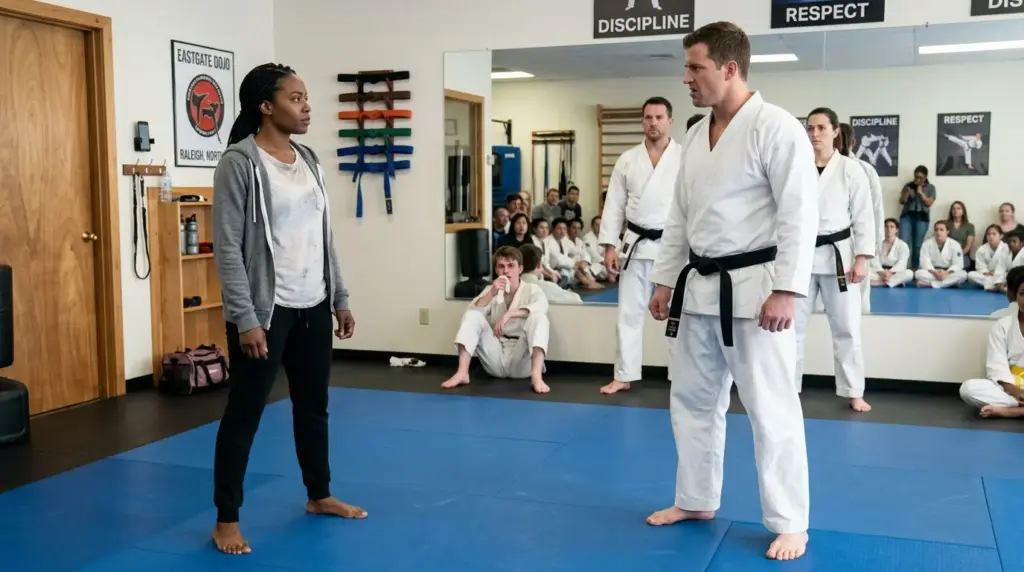
Bryce, Trevor, and Jason were barred from instructing minors for five years, with reinstatement requiring ethics training, supervised teaching hours, and review.
Bryce stormed out before the hearing ended.
This time, nobody followed him.
A year later, the old Eastgate building reopened under a new name.
Not under Callahan.
He sold it.
The new owner was an older woman named Marisol Vega, a retired boxing coach who had no patience for cruelty disguised as discipline.
She asked Naomi to help design the youth safety policy.
Naomi agreed on one condition.
Daniel got to review it too.
He was seventeen by then.
Taller.
Still quiet.
But not small in the same way.
He read the draft carefully at his kitchen table while Alicia cooked dinner.
At the bottom, he added one sentence.
No student should have to earn protection by being good enough to survive without it.
Marisol put that sentence on the first page.
Two years passed.
Daniel kept training.
He never became loud.
He never became the kind of boy who strutted into rooms looking for attention.
That was not him.
But he changed.
He stopped shrinking when people walked too close.
He joined the debate club.
He made new friends.
The boys who had bullied him at school tried once more, outside the cafeteria.
Daniel did not fight them.
He did not need to.
He stood still, looked at the loudest one, and said, “You’re not touching me today.”
Something in his voice made them pause.
A teacher arrived.
The moment passed.
For Daniel, that was victory.
Not hurting someone.
Not proving he could.
Simply not surrendering his space.
On the third anniversary of the day Naomi walked into Eastgate, Open Mat held a youth tournament.
No flashy lights.
No humiliating commentary.
No clips posted without permission.
Every match began with a bow and ended with both students checking on each other.
Daniel, now an assistant coach, stood near the edge of the mat helping younger kids tie belts.
A small boy named Marcus whispered, “What if I lose?”
Daniel knelt in front of him.
“Then you learn.”
“What if everyone laughs?”
Daniel glanced across the room.
Naomi was watching from the doorway, arms folded, calm as ever.
“They won’t,” Daniel said. “Not here.”
Marcus nodded.
Then he stepped onto the mat.
Naomi walked over to Daniel.
“You handled that well.”
Daniel smiled.
“I had a good teacher.”
“No,” she said. “You became one.”
He did not know what to say to that.
So he looked at the mats, at the kids, at his mother laughing with another parent near the snack table.
Then he said, “Do you ever regret stepping in?”
Naomi looked at him like the answer should have been obvious.
“No.”
“Even with all the trouble after?”
She smiled faintly.
“Especially because of the trouble after.”
Later that afternoon, Marisol asked Naomi to say a few words to the students.
Naomi hated speeches.
Everyone knew that.
But she stood in the center of the mat anyway.
The room quieted.
She looked at the young students sitting cross-legged in front of her, then at the parents behind them.
“Martial arts is not about becoming dangerous,” she said. “Dangerous people are everywhere. Some of them have belts. Some have titles. Some have loud voices and rooms full of people too afraid to correct them.”
The room was still.
“Real training is about becoming responsible for your strength. It is about learning that the person across from you is not an object for your ego. They are trusting you with their body, their fear, and sometimes their courage.”
Daniel listened closely.
Naomi’s eyes moved to him briefly.
“If you are strong, protect the room. If you are skilled, teach. If someone weaker than you is afraid, do not use that fear to feel powerful. Help them stand.”
She paused.
“And if you ever see three people using rank to bully one person, you do not have to be the strongest person in the room to do what is right.”
A small smile touched her face.
“You only have to step forward.”
People applauded.
Not wildly.
Respectfully.
The kind of applause that did not feel like noise.
That evening, after everyone left, Daniel helped Naomi stack mats.
The room was quiet now.
The good kind.
He looked at her.
“Can I ask you something?”
“Always.”
“That day, when you said fight me instead… were you scared?”
Naomi lifted one eyebrow.
“Of course.”
Daniel blinked.
“You were?”
“Three trained adults against one person? Only a fool would feel nothing.”
“But you looked calm.”
“Calm is not the absence of fear,” she said. “Calm is deciding fear doesn’t get to drive.”
Daniel absorbed that.
Then he nodded.
Years later, when Daniel became an instructor himself, he repeated that line often.
Calm is not the absence of fear.
Calm is deciding fear doesn’t get to drive.
He became known as the quiet coach.
Patient.
Precise.
Protective.
He taught nervous kids, bullied kids, awkward kids, angry kids, and kids who apologized for taking up space.
He never allowed advanced students to hunt beginners.
He never let laughter become a weapon.
And whenever he saw a student sitting alone after a hard round, blinking fast and trying not to cry, he sat beside them and said, “Don’t lie when you’re hurt.”
Because someone had once said that to him.
Because someone had seen him.
Because one woman had stepped into a room full of cowards and reminded everyone that courage does not always roar.
Sometimes it walks in quietly.
Sets down a gym bag.
Looks at the bully standing over a child.
And says:
Fight me instead.





