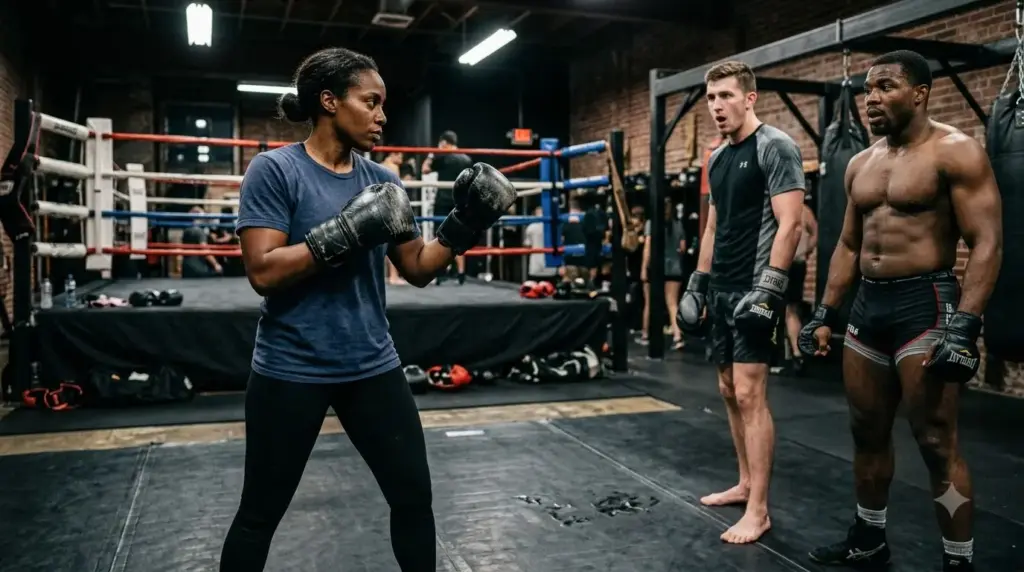
Maya answered with a right hand that touched harder than the agreement.
Lauren immediately stepped back.
“Pace.”
One word.
Maya froze.
There it was.
The same thing Caleb had once needed to learn.
The same thing Maya had praised him for learning.
Now she was the one changing the agreement.
“Sorry.”
Lauren nodded.
“Good.”
They reset.
Maya took one breath.
Then another.
The rest of the round stayed technical.
Afterward she sat beside the wall, embarrassed.
Lauren joined her.
“No problem.”
Maya shook her head.
“It is a problem.”
“I said pace. You adjusted.”
“I shouldn’t have made you say it.”
Lauren smiled.
“That’s why people talk.”
Maya looked at her.
“People?”
“Training partners.”
Maya laughed.
Fair.
Martin came over.
He did not look angry.
Worse.
Thoughtful.
“What happened?”
Maya answered before he could coach her.
“I heard people watching.”
“And?”
“I wanted to prove I was closer than I am.”
Martin nodded.
“Useful.”
“That’s it?”
“No.”
He pointed toward Lauren.
“She trusted the round you agreed to.”
Maya nodded.
“I know.”
“Then remember that embarrassment does not renegotiate pace.”
That sentence stayed.
Maya apologized again before Lauren left.
Lauren said:
“Stop apologizing.”
“I heard you.”
“Good.”
Then she smiled.
“Next time moderate from the start?”
Maya nodded.
“Deal.”
The next month Lauren returned.
They agreed to moderate.
The round was harder.
Cleaner.
Better.
Nobody needed to rescue anyone from surprise.
That became another lesson Maya brought into the returning-athlete class later.
Skill did not excuse emotional escalation.
Experience did not make someone immune to ego.
Sometimes the people who spoke most clearly about boundaries were the people who had recently crossed one.
If they were honest enough to remember.
Another moment came from someone who had no championship history at all.
A woman named Rochelle Grant joined Iron Harbor in early summer.
Forty.
Nurse.
Mother of two.
Never competed.
She had taken kickboxing fitness classes years earlier but had never sparred.
On her first night she watched Maya work with Andre and assumed Maya was one of the gym’s coaches.
“Can you teach me how to do that?”
Maya asked:
“Do what?”
“The thing where he grabs you and you turn out.”
Maya smiled.
“That thing has about six pieces.”
“Oh.”
“And I’m not your coach tonight.”
Rochelle looked embarrassed.
“Sorry.”
“No.”
Maya pointed toward Martin.
“He is.”
Then added:
“But I can be your partner if he wants.”
Martin did.
Rochelle was tense.
Too tense.
Every time Maya touched her shoulder, Rochelle flinched.
Maya slowed down.
“You okay with contact?”
“Yes.”
Another flinch.
Maya stopped.
“Real answer.”
Rochelle looked down.
“I don’t know.”
Maya waited.
Rochelle finally said:
“I had a bad relationship.”
No details.
None needed.
Maya understood enough.
She stepped back.
“We can work without grabbing.”
Rochelle looked surprised.
“Isn’t that the drill?”
“The drill can wait.”
They started with footwork.
Then hand positioning without contact.
Then Rochelle chose when Maya could touch her wrists.
Slow.
Specific.
No hero moment.
By the end of class Rochelle completed one light collar-tie exchange.
Thirty seconds.
She smiled like she had won a title.
Maya understood something that night that competition had never taught her.
Difficulty is not always visible.
Caleb’s hardest round might be a national qualifier.
Rochelle’s hardest round might be letting another person place a hand near her shoulder without freezing.
Both required respect.
Neither needed comparison.
Rochelle came back.
Months later she sparred lightly for the first time.
Afterward she cried.
Then laughed at herself for crying.
Maya said:
“Don’t.”
“What?”
“Make fun of the part that was hard.”
Rochelle nodded.
That sentence eventually became one of Maya’s coaching rules.
Do not mock the thing that took courage just because it looks small from outside.
Iron Harbor never wrote that one on the wall.
It would have sounded too inspirational.
Better to practice it.
The champions learned from Rochelle too.
Caleb stopped using “easy” to describe beginner rounds.
Andre stopped assuming physical hesitation meant lack of toughness.
Sofia became more careful about asking permission before controlling the head or neck with new students.
Not because Rochelle demanded changes.
Because paying attention creates consequences.
Good ones too.
Six months after Maya joined, Iron Harbor held a sparring workshop.
Gyms from around the city attended.
Caleb was paired with a visiting fighter named Anthony Price.
Anthony was twenty-four.
Fast.
Aggressive.
Good.
Before the round, Caleb asked:
“Experience?”
Anthony smiled.
“Enough.”
Caleb laughed.
“That means trouble.”
Then:
“Pace?”
“Technical.”
“No hard head shots?”
“Agreed.”
They started.
Thirty seconds clean.
Then Anthony increased pressure.
Caleb matched him.
Old instinct.
The round became harder.
Martin shouted:
“Pace.”
Caleb heard.
He stepped back.
“Pause.”
Anthony looked confused.
“What?”
“We said technical.”
“This is technical.”
“Not for me.”
Anthony shrugged.
“Fine.”
They reset.
Lower pace.
Afterward Maya said:
“You would not have done that last year.”
Caleb wiped sweat from his face.
“No.”
“Why now?”
He smiled.
“Because some annoying woman made me think transitions matter.”
Maya laughed.
“That sentence makes no sense.”
“It does to me.”
Good.
Another change came from Ava.
She began studying at the gym during Maya’s classes.
Never trained.
People kept asking.
“You going to try?”
“No.”
“Your mom fought.”
“I know.”





