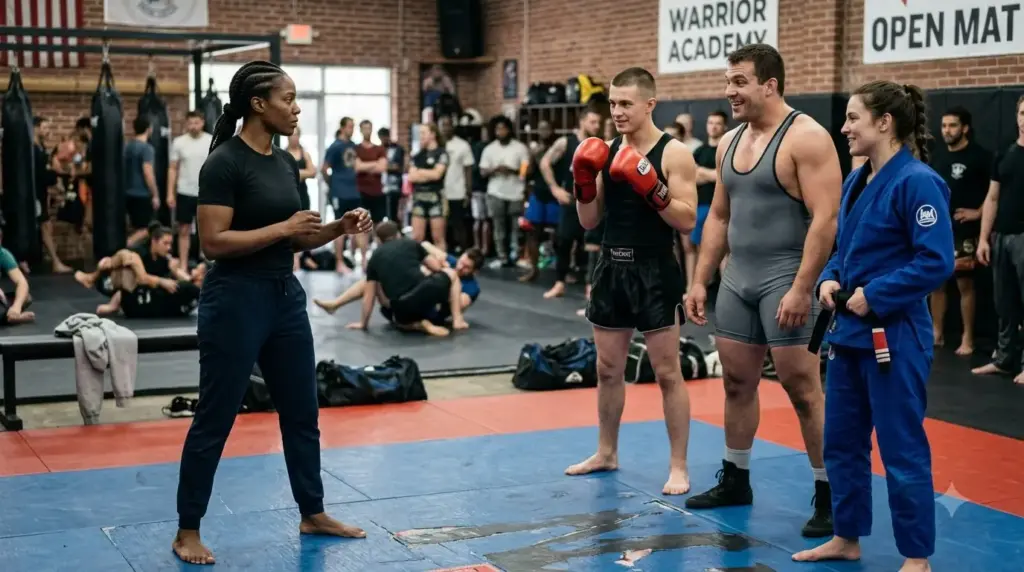
Afterward he sat alone behind the venue.
Maya found him.
“Want feedback?”
He looked at her.
Then laughed.
“Yes.”
She sat.
“You started performing.”
He stared.
“That’s Evan’s line.”
“It’s everybody’s line now.”
Tyler sighed.
“What else?”
“You got mad at the score.”
“Yes.”
“You tried to erase it in one exchange.”
“Yes.”
“Why?”
He thought.
“Crowd.”
Maya nodded.
“Same problem as the charity day.”
He smiled without humor.
“Apparently.”
She asked:
“What problem are you solving?”
He looked at her.
“Now you sound like a coach.”
“Temporary condition.”
They laughed.
Tyler returned to training Monday.
Good.
Marcus faced a different issue.
He was strong.
Reliable.
Loved wrestling.
Hated losing scrambles to smaller people.
One night Maya caught him with a foot sweep during light clinch.
Not dramatic.
He popped back up immediately.
Then went too hard on the next exchange.
Maya stepped away.
“Pace.”
Marcus stopped.
Embarrassed.
“Sorry.”
That was enough.
No lecture.
Later he told her:
“I hate getting caught.”
“Everybody does.”
“No, I mean I take it personally.”
Maya nodded.
“Why?”
“Feels like I should know better.”
She smiled.
“That sentence is poison.”
“What?”
“Should know better.”
“Then every mistake becomes identity.”
Marcus thought.
Useful.
He started resetting faster after errors.
Leah had her own blind spot.
She was technically precise.
Sometimes too precise.
A new student named Andre had mild claustrophobia from a childhood accident.
He panicked in tight mount pressure.
Leah initially interpreted it as poor breathing.
“Relax.”
He could not.
Maya noticed his eyes.
Stopped the drill.
Andre explained.
Leah apologized.
They changed position.
No chest pressure.
More side control.
Tap to reset.
Andre improved.
Leah learned.
Expertise can become tunnel vision.
Everybody gets a turn.
At one year, Maya became part of East Harbor.
Not star.
Not mystery.
Regular.
She helped new returning athletes because she understood the gap between old knowledge and current body.
Evan created a monthly session:
RETURNING TO TRAINING
Not beginner class.
Not advanced.
People coming back after injury, parenting, caregiving, grief, work, life.
Maya helped.
First question:
“What did you used to do?”
Second:
“What can you do now?”
Third:
“What do you want back?”
Sometimes the answer to the third question was:
Nothing.
One man had been a competitive wrestler.
Now wanted conditioning only.
Good.
One woman had a taekwondo black belt from fifteen years earlier.
Wanted technique.
No sparring.
Good.
Another wanted competition again.
Also good.
No single correct comeback.
Maya liked that.
Her own answer changed.
At first:
I want to feel like myself.
Later:
I want to train consistently.
Later:
I want my knee to stop being dramatic.
Never happened.
She accepted that too.
The original three-minute rotation became a gym drill.
Not because Maya invented something revolutionary.
Because it was useful.
Three stations.
One minute each.
Striking defense.
Clinch or wrestling.
Positional grappling.
Continuous.
Goal: maintain decision-making under changing rules.
Evan called it “The Rotation.”
People called it “Together.”
Maya hated that.
Then accepted it.
Rules were strict.
No ego.
No surprise intensity.
No mismatch without consent.
The goal was adaptation.
Not proving toughness.
One Saturday, a nineteen-year-old named Cole wanted to try.
He was athletic.
Confident.
After station one, he looked good.
Station two, tired.
Station three, panicked under guard pressure.
Tapped even though no submission was applied.
He sat embarrassed.
Maya handed water.
“Good information.”
“I sucked.”
“No.”
“I panicked.”
“Yes.”
“That’s bad.”
“It’s information.”
He looked at her.
“You say that about everything.”
“Most training is data.”
He laughed.
“Boring.”
“Useful.”
He came back.
Worked positional breathing.
Improved.
No humiliation story.
Good.
Years passed.
Ava graduated high school.
Went to college for architecture.
No martial arts interest.
Maya never pushed.
“Children are not sequels.”
She said that often.
Tyler eventually stopped competing.
At thirty-five.
Not because he could not fight.
Because camps cost too much time.
He wanted to coach.
Good.
Marcus moved for work.
Returned occasionally.
Leah earned brown belt.
Then black years later.
Maya never chased rank aggressively.
Her judo rank remained old.
Her grappling rank eventually progressed.
But rank mattered less than consistency.
At forty-four, she moved differently.
Slower.
Cleaner in some ways.
Worse in others.
Could not shoot deeply.
Better at hand fighting.
Could not recover from hard rounds as fast.
Better at choosing rounds.
That was skill too.
One evening, a new young woman entered East Harbor.
Quiet.
Black.
Twenty-two.
Small.
No logo.
Tyler, now head striking coach, saw her.
Old instinct flickered.
Easy.
He smiled at himself.
Then walked over.
“Experience?”
“Some.”
Maya heard from across the room.
She laughed.
Dangerous word.
Tyler continued.
“How many years?”
“Six boxing.”
“Two wrestling.”
“Current?”
“Yes.”
“Any injuries?”
“Shoulder.”
“Goal today?”
“Move.”
Tyler nodded.
“Good.”
No assumptions.
No challenge.
No smirk.
The young woman trained.
She was decent.
Not secret champion.
Not helpless.
Just a person.
Perfect.
Later Maya told Tyler:
“You looked disappointed.”
“No.”
“Yes.”
“I wanted drama.”
“Exactly.”
They laughed.
The gym had changed enough that boring became success.
The famous story still circulated.
Three fighters smirk.
Ask who goes first.
Quiet woman says together.
People imagined chaos.
Three-on-one.
Bodies flying.
Champion humiliation.
No.
The truth was better.
One minute each.
Three different problems.
One returning athlete.
She got hit.
Taken down.
Controlled.