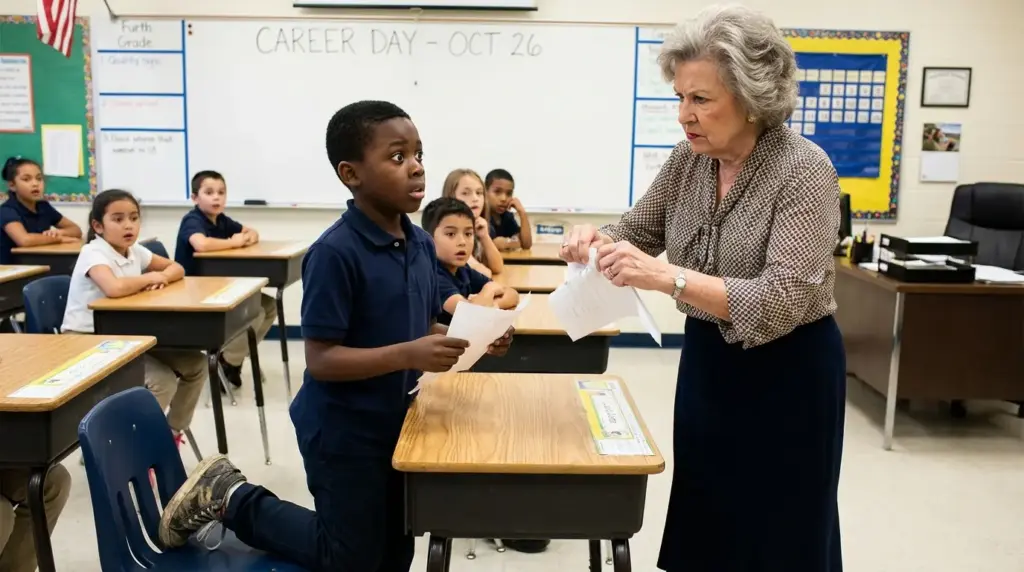
Principal Hayes made it a requirement for continued employment. The training covered racial bias, class bias, and the danger of assumptions, real scenarios, uncomfortable conversations, necessary growth. Mrs. Patricia Whitmore attended every session. She didn’t just participate, she helped lead them. In a faculty meeting two months after the incident, she stood in front of her colleagues and shared her experience.
3 Months ago, I hurt a child because I couldn’t see past my own assumptions. I looked at Lucas Hughes and decided his truth was impossible because it didn’t match the picture I had in my head of what a general’s family should look like. Her voice was steady now, stronger. I’ve spent the last few months examining my biases, the ones I didn’t even know I had. I’ve learned that my instincts about students were often just prejudices dressed up as experience.
She held up the command coin General Hughes had given her. I keep this on my desk, not as a trophy, but as a reminder that growth comes from our mistakes, not our successes. The training led to real policy changes, new protocol, verify before questioning. If a student makes a claim about their family that seems unusual, the first step is to check with parents, not to interrogate the child. The student council, inspired by Lucas’s experience, created the truth and trust initiative, a peer support system where students could talk about times they felt unheard or disbelieved.
Lucas became one of the founding members. Mrs. Whitmore’s classroom changed too. On the first day back after the incident, she gathered her students and created a new classroom charter. The kids helped write it. It hung on the wall now in large letters.
In this classroom, we believe first and question respectfully. We never assume someone is lying because their truth seems impossible. Everyone’s story matters. Every student signed it, even Lucas, especially Lucas. Mrs. Whitmore also started a monthly family stories circle.
Students could share about their families without judgment. The goal wasn’t to compare or compete, just to listen and learn. During one session, Sophia Wilson talked about how her mother took pride in her cleaning work at the capital building, how she knew every hallway and office, how senators sometimes asked her advice about the building’s history. Mrs. Whitmore listened differently. Now, she heard the pride in Sophia’s voice instead of dismissing it as less important than other careers.
Deshawn talked about how his dad could diagnose car problems just by listening to the engine, how he’d built his small mechanic shop from nothing. Tyler Bennett surprised everyone by saying his dad’s lobbying job seemed less important after meeting General Hughes, that he’d started thinking about what service really meant. And Lucas, he talked about military families, about sacrifice, about the kids who move constantly and miss their parents and keep going anyway. The class listened without interruption. That’s what changed most.
The listening. The viral photo spread faster than anyone expected. The image of General Hughes in full dress uniform, four stars visible, kneeling beside his 10-year-old son while emotional students and parents looked on. The caption that went with it told the story. How a teacher had called a black student a liar for writing about his father’s service.
How she’d torn up his assignment, how she’d humiliated him publicly, and how a four-star general had walked into that classroom to stand beside his son. News outlets picked it up. The story appeared on local news, then national broadcasts. Social media exploded with reactions. Some people focused on the racism, others on the classism, many on the courage it took for Lucas to stand his ground.
But the most shared aspect was Mrs. Whitmore’s apology and transformation. People were tired of stories where the antagonist faced consequences but never changed. This was different. This showed redemption was possible. 3 Months later, Mrs. Whitmore received invitations to speak at education conferences about implicit bias.
She accepted some, declined others, but always emphasized the same message. I’m not a hero of this story. I’m the cautionary tale. But I’m proof that people can change if they’re willing to do the hard work. Lucas today is different from the scared 10-year-old who stood at the front of that classroom.
He’s more confident, still humble, still kind, but no longer afraid to share his truth. He started a peer mentoring program at Jefferson Elementary where older students help younger ones navigate difficult situations. The first rule of the program, believe first, question with kindness. His friendship with Deshawn grew stronger.
Tyler Bennett became a regular at their lunch table. Even Sophia Wilson joined their group. They called themselves the Truth Squad. Kids who committed to listening to each other’s stories without judgment.
General Hughes attended school events when his schedule allowed, not in uniform, just as Lucas’s dad. He wanted his son to know he was proud of him for who he was, not what his father did. Dr. Angela Hughes continued saving lives at Walter Reed, but she made sure to attend every one of Lucas’s presentations about military families, because that’s what this was really about. Not generals or ranks or positions, but a family that loved each other and a son who learned that truth even when it’s hard is always worth defending.
The Hughes family went back to their quiet life. But Jefferson Elementary and everyone who heard Lucas’s story was forever changed. Sometimes the bravest thing you can do is stand in your truth. Even when the whole world tells you you’re wrong, especially then.





