“I did. For eight years.” His eyes never left the girl. “But she remembered things I never taught her.”
I lowered my voice. “That control. Those angles. She wasn’t guessing.”
“No.”
The girl stood up then, as if she sensed we were talking about her. Her braid had loosened, strands of hair clinging to her cheek. She didn’t walk over. Just stood there, hands in her hoodie pocket, waiting.
Jake finally stood too, his pride still caught between confusion and bruised ego. “She’s not normal.”
The man looked at him—not unkindly, but with weight. “No,” he said. “She isn’t.”
Jake frowned. “What was that move? That lock?”
The man glanced at me. “A modified C-clamp. Valkyrie taught it to NATO rescue medics in ’09. She was eight months pregnant when she demoed it.”
Jake looked away.
I turned toward the girl, voice soft now. “Does she want to train here?”
The old man didn’t answer. Instead, she took a single step forward.
“I want to finish what she started,” she said quietly. “But not for revenge.”
I nodded slowly. “Then we’ll train you. Properly.”
She didn’t smile. But her eyes flicked toward the trident patch on the counter. She reached out—not to take it, just to straighten it. Then she turned back toward the mat.
The gym was empty now. The mats had been cleaned. The chatter had faded. But a different kind of training had begun.
I stood at the edge, arms crossed, as she moved through footwork drills alone. Deliberate. Methodical. No music, no noise—just the soft tap of bare feet on foam and the rustle of her sleeves with each pivot. I wasn’t giving her compliments. She didn’t need them.
From the office window above the floor, the old man watched. His name wasn’t known to most—just “Mr. Hail” on the emergency contact form. But those who had served knew the name in whispers. He had once been a breacher. Recon. The kind of man who never wrote books, never gave speeches, and never stood in photographs.
He watched her move with the same quiet focus her mother had carried in the field. Not aggressive. Not hesitant. Just precise.
After twenty minutes, I stepped onto the mat with her.
“Let’s try three-point evasion. You remember the steps?”
She nodded once.
“Good. But this time, I’ll be a little faster.”
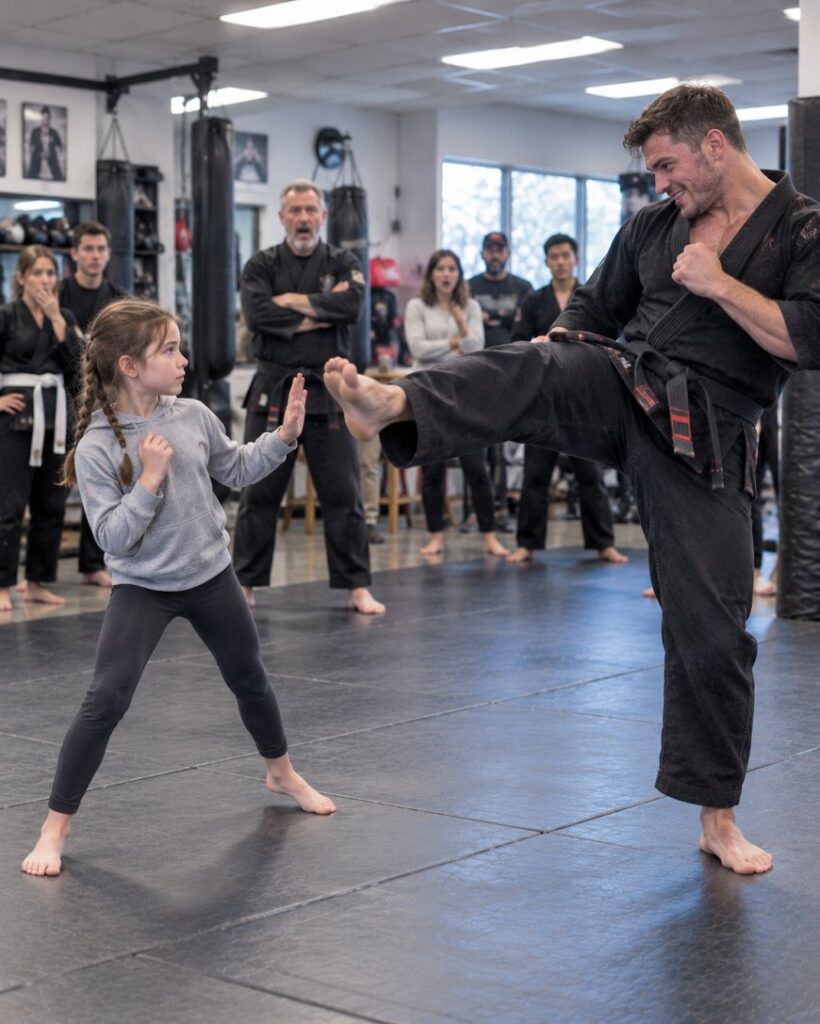
I lunged in—not full speed, not yet. Just enough to test her reactions. She slipped past me, shoulder low, and tapped my back with her palm.
“Good,” I said. “Now again.”
We reset. I lunged harder. Again, she glided off the line, slipping through space like she could see the strike before it happened. But this time, she didn’t touch my back. She paused, hands up, checking my distance. Gauging my response.
I stopped. “Why’d you hesitate?”
“You leaned into your left leg,” she said. “It wasn’t committed.”
I stared at her—not annoyed, impressed.
“She reads weight shifts like a sniper reads wind,” Mr. Hail said from the mezzanine, barely audible.
I turned. “She ever seen combat?”
“No,” Hail said. “But she’s watched it.”
A silence settled.
“She was five when her mother died,” Hail added. “Didn’t cry. Didn’t scream. Just took the journal from the coffin, sat under the flag, and read every page.”
I knelt beside Ara. “What was in the journal?”
“Even she said violence wasn’t the legacy. Precision was.” She looked up at me, eyes steady. “She wrote about restraint. About timing. About being the calm before the breach.”
My brow furrowed. “Your mom was a warrior, wasn’t she?”
She looked up, eyes steady. “She was peace where war happened.”
Outside, the rain began again, soft and rhythmic against the gym windows. I stood and exhaled.
“You’re not here to prove anything, are you?”
She shook her head. “I’m here because I won’t let her legacy be a memory that fades. People forget too fast.”
From above, Mr. Hail finally sat down. His voice was low.
“She’s not here to fight.” He looked at Jake Mercer’s duffel bag, still forgotten near the corner. “She’s here to remind people what real strength looks like.”
Sunday morning, the gym stayed closed, but the door was unlocked. I stood inside, arms crossed, watching the sun creep through the high windows. The air smelled faintly of sweat and old leather. Ara was already on the mat when I arrived—no instructions, no call time. She was just there, moving through a kata sequence. Each motion exact, like choreography pulled from memory. But it wasn’t flashy. Nothing for show. Every strike stopped one inch short of full extension. Every stance grounded with the kind of tension that spoke of discipline, not aggression.
She moved like someone who had been told never to waste energy—not because she didn’t have it, but because it meant something.
I waited until she finished, then nodded toward the corner where Jake’s black duffel still sat untouched.
“He didn’t come back for it.”
She followed my gaze, expression unreadable.
I walked over, nudged the bag with my foot. “You know what’s funny? Jake used to laugh about that belt. Said it was his ticket to teaching overseas. Claimed he earned it by surviving a hundred fights.”
I paused.
“Your mother never talked about hers. I only found out she was Valkyrie 6 after she pulled a trapped boy out of a burning Humvee alone during a hostage op. Carried him two miles through gunfire.”
Ara didn’t react. Instead, she walked over, crouched beside the bag, and unzipped it halfway. Inside was what you’d expect: hand wraps, two broken mouthguards, a pair of gym sandals. And at the bottom, the belt. Folded carefully. Reverently.
She reached in and touched it with two fingers. Not to take it. Just to feel its weight.
“He’s not coming back,” she said softly.
I raised a brow. “You sure?”
“Yes.” She zipped the bag again, slower this time. “When someone’s forced to see their reflection in someone smaller, younger, but sharper, it breaks the image they’ve built.”