“Sit where I can see you.”
He sat in guest chair.
Camille remained standing.
“Start with yesterday.”
Arthur rubbed palms.
“Daniel raised a concern about serial plates.”
“What did you tell him?”
“That we would reconcile records after event.”
Daniel stared.
Camille asked:
“Why after?”
“We had six member flights and seventy guests tonight.”
“That explains timing preference.”
“Not the mismatch.”
Arthur looked toward Daniel.
Then Camille.
“The fleet has had availability problems.”
“What kind?”
“Parts.”
“Maintenance windows.”
Camille Vaughn had attended enough charity galas to know exactly how long it took for a room full of wealthy people to stop pretending they were there for the charity.
Usually, it was forty minutes. An hour, perhaps, if the wine was particularly poor and the captive audience felt compelled to drink their way through the speeches.
That Friday evening in Miami, beneath the vaulted, frescoed ceilings of the waterfront Ritz-Carlton, she lasted exactly fifty-three minutes.
By the time the keynote speaker—a minor royal whose name escaped her—began thanking the platinum-tier sponsors beneath a canopy of suspended crystal, Camille had already contributed more than enough money to justify leaving without a word of explanation. She slipped from the grand ballroom through a hushed, carpeted side corridor, expertly ignoring the puzzled, faintly panicked look from a headset-wearing event coordinator who had desperately expected her to remain for the press photographs.
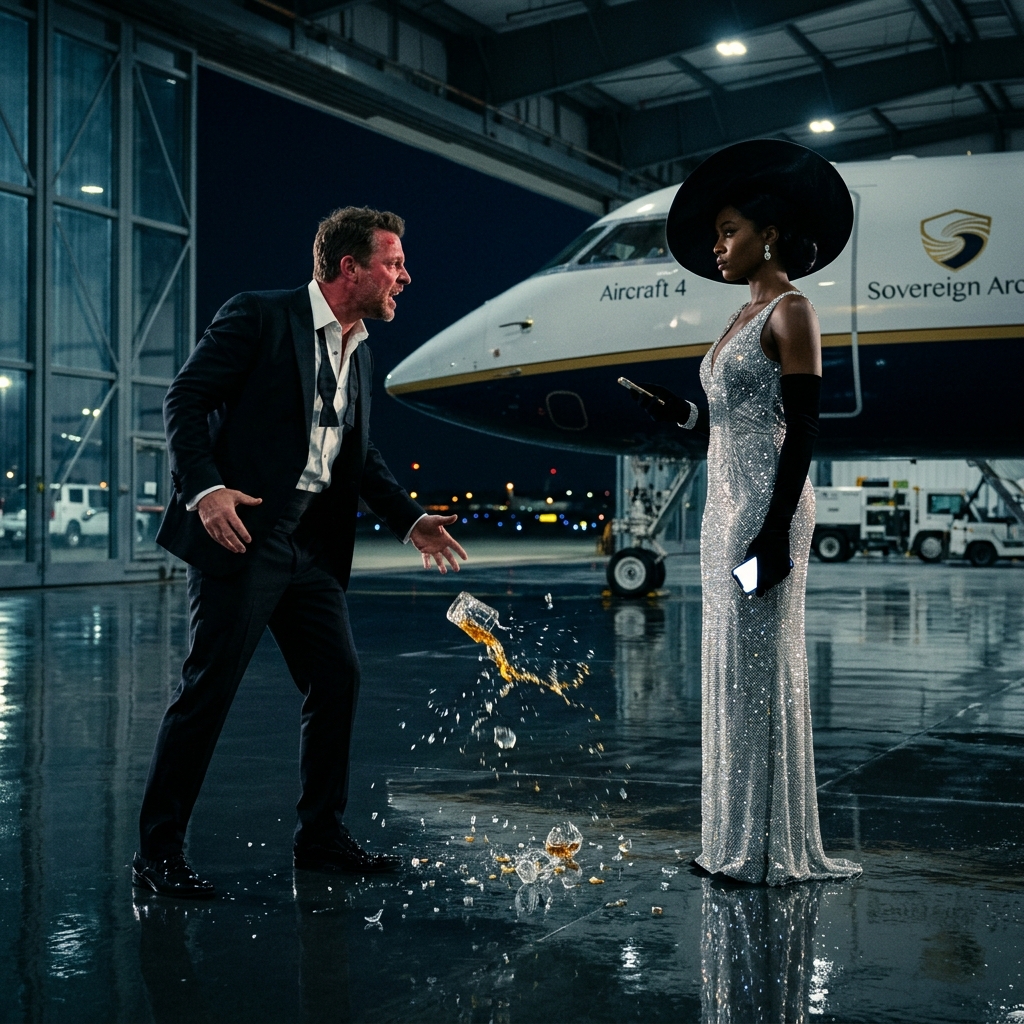
Her gown, unfortunately, made disappearing discreetly a logistical impossibility.
Thousands of tiny, hand-sewn Swarovski crystals covered the fitted silver fabric, running in fluid, glittering lines from the structured, architectural neckline all the way to the floor. Over her bare shoulders rested a matching jeweled coat that caught and refracted the light of every sconce she passed, casting a shattered disco-ball effect against the silk-lined walls. Black satin opera gloves reached nearly to her elbows, and an enormous, sculptural black hat angled sharply across her forehead, casting her dark eyes into shadow.
She looked less like a woman attempting to vanish into the Miami night and more like a woman preparing to walk into the centerfold of a high-fashion editorial.
Camille hated it. She despised the pageantry, the expectation that female executives needed to drape themselves in blinding wealth to signal their belonging in rooms where men simply wore navy bespoke suits.
But the gown was not the reason she had abandoned the gala early. The abrupt departure was entirely due to the message that had illuminated her phone screen at 8:11 p.m.
There had been no polite greeting. No contextual explanation. Just six words, glowing starkly against the dark interface.
You need to see aircraft 4 tonight.
The sender was Daniel Mercer. Fifty-six years old. Chief engineer for Meridian Crown Aviation. He was a man who spoke in maintenance logs and torque values, one of the finest, most uncompromising long-range aircraft maintenance specialists Camille had ever had the privilege of employing.
Daniel did not dramatize. He possessed zero flair for the theatrical. Five years ago, he had discovered a microscopic hydraulic irregularity on the landing gear actuator of one of the company’s flagship jets forty minutes before a high-profile celebrity client was scheduled to depart for London. Daniel had grounded the sixty-million-dollar aircraft on the spot, physically standing in front of the nose gear despite three red-faced charter executives shouting at him about breach of contract and PR nightmares.
When Camille had flown in the next day and personally thanked him for preventing a potential catastrophe over the Atlantic, he had looked at her with genuine irritation.
“I didn’t save anybody, Ms. Vaughn,” he had grumbled, wiping grease from his hands. “I did my job. The machine said no.”
That was Daniel. He was married to the metal. So, when a man like Daniel Mercer sent an encrypted text message at eight o’clock on a Friday night demanding her presence, Camille did not ask questions. She listened.
She exited the hotel through the kitchen service corridors, the heavy silver train of her gown whispering over the industrial linoleum. Her driver, an impeccably discreet former Ranger named Hayes, was waiting near the loading zone in the idling Maybach SUV.
He opened the rear door, his eyes scanning the alleyway. “Home, Ms. Vaughn?”
“Atlas Crown Hangar,” Camille said, sliding into the plush leather interior.
Hayes paused, looking at her through the rearview mirror. His eyes flicked to the blindingly reflective coat, the opera gloves, the dramatic hat. “In that?”
Camille glanced down at the glittering crystal armor encasing her body. She let out a soft, sharp exhale. “Apparently.”
Hayes offered a faint, knowing smile. “Yes, ma’am. Routing to the airfield.”
The drive to the private aviation sector of the airport took twenty-eight minutes. Camille spent twenty-six of them immersed in the encrypted files on her iPad.
Vaughn Meridian Aviation, the empire she had built and fiercely protected, held controlling interests in aircraft leasing, fractional-ownership platforms, airport infrastructure, and heavy maintenance-support operations across fourteen states. Its fleet division alone controlled, managed, or financed eighty-seven ultra-long-range aircraft.
Most people outside the labyrinthine world of aviation finance believed that rich people simply bought private jets, handed over a check, and flew away. Sometimes, they did. Far more often, the ownership structures were tangled webs of liability shielding and tax optimization that looked absolutely nothing like the corporate logo painted on the aircraft’s tail.
Aircraft were leased. Financed. Managed. Fractionalized. Placed into Delaware special-purpose entities. Registered through anonymous holding companies. Operated by third-party management firms. Maintained through certified, outsourced facilities. A billionaire could boast publicly that a seventy-million-dollar Gulfstream was “his,” while legally possessing little more than operational block-hour rights under a dry-lease financing structure strictly controlled by somebody else.
Camille had built a great deal of her multi-billion-dollar fortune understanding, exploiting, and policing precisely those distinctions.
The six aircraft currently sitting inside the Atlas Crown Hangar were a perfect, highly lucrative example of this illusion.
To the public eye, the pristine white jets belonged to an exclusive, impossibly elite private-aviation club called Sovereign Arc. Sovereign Arc had been founded by two men wealthy enough that financial publications had stopped printing their estimated net worths because the market fluctuations changed the numbers too quickly. Preston Vale and Grant Ellison. Technology money. Real estate. Private equity. Sports team ownership. Both men appeared constantly in the financial media, standing confidently beside superyachts, racehorses, skyscrapers, and jets that might or might not have legally belonged to them.





