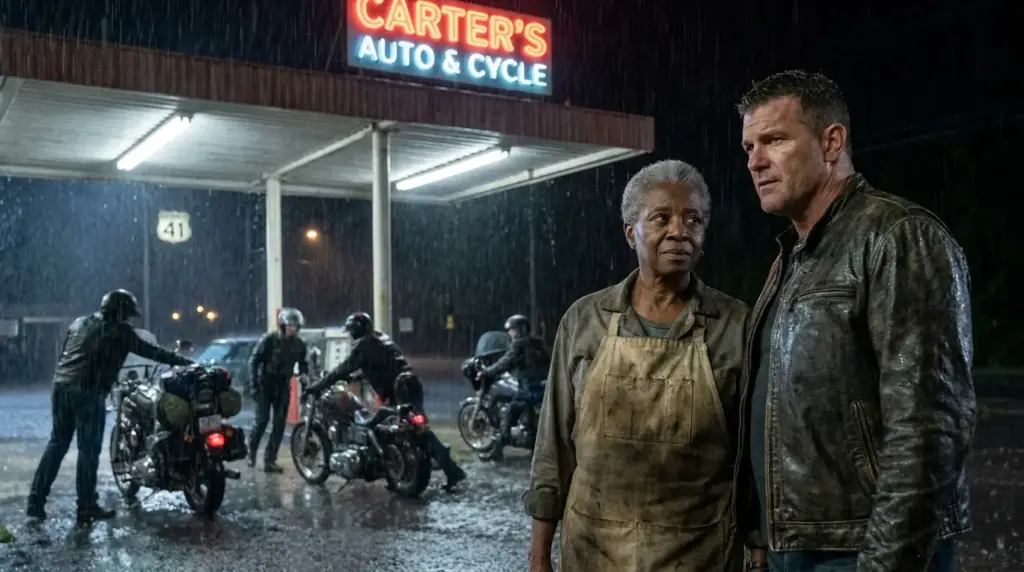
She never talked about it, not anymore. Not to the people who asked. She’d simply shake her head and say that was a long time ago and steer the conversation toward whatever vehicle needed attention. But the knowledge was there in everything she did. In the way she pressed two fingers lightly against a running engine block, the way a doctor touches a patient’s wrist to feel a pulse, in the way she listened with her head slightly tilted.
Eyes focused on something that wasn’t quite in the room, hearing the story an engine tells in its pitch and rhythm and silence. She had learned to hear machines the way some people learn to hear music, not just the notes, but the spaces between them. Not just the sound, but what the sound was trying to say. On the evening everything changed. Ruth had been alone since 4:00 in the afternoon.
She’d finished an oil change and a brake job, eaten half a sandwich she’d brought from home, drunk two cups of coffee, and was considering locking up early for the first time in recent memory. The radio on the shelf above her tool chest was playing something old and unhurried. A jazz trumpet winding through a melody like smoke, finding its way through a slightly open window. The rain had started around 6:00, first as a whisper on the roof, and then as a steady percussion that turned the parking lot into a shallow lake, and reduced the highway to a river of headlights and spray. Ruth didn’t mind rain.
She’d always found it clarifying, the way it simplified the world down to the sound of water and the smell of wet earth and the warmth of a space that kept the weather out. She refilled her coffee, turned the radio up slightly, and stood in the open doorway of the garage, watching the highway run with rain. The sound came before the lights. A rough, irregular rumble that cut through the white noise of the storm with a specificity that made Ruth straighten up. An engine misfiring, she registered immediately.
Then a second and a third, multiple bikes all running rough, all carrying the sound of machines that had been pushed past the point where they should have been stopped. The headlights appeared a few seconds later. A wavering column of white cutting through the rain. And then the first motorcycle turned off the highway into her lot, followed by another and another until there were nine of them arranged in a loose cluster under the floodlight, their engines coughing and steaming in the cold rain. They were soaked.
Not just wet the way people get caught in a shower, but soaked in the bone-deep way of people who had been riding through hard weather for hours without adequate protection. The kind of wet that had found its way through every layer and settled in. They wore leather jackets and heavy jeans. Most of them helmets or bandannas tied at the jaw. And they sat on their bikes for a moment in the rain as if not quite believing they’d found a garage or perhaps not quite believing what kind of garage they’d found.
Ruth stood in the doorway with her coffee cup watching them. The one who moved first was the biggest, a broad-shouldered man in his early 40s who swung off his bike with the practiced ease of someone who’d been riding since before he had a license. He walked toward the garage with his thumbs hooked in his belt and an expression Ruth had seen many times before. A man who had a problem and was calculating in real time how much of his pride he was willing to set aside in order to solve it. He stopped under the overhang out of the rain and looked at Ruth with flat eyes.
His name was Dean Holloway. He didn’t offer it yet and Ruth didn’t ask. “We need help,” he said without preamble. “Multiple bikes down. Fuel system issues on at least three of them.
One’s running so hot it’s probably seized. He paused, looked past her into the garage, then back at her. You, the mechanic? I’m the only one here, Ruth said. So, yes.
Something shifted behind Dean’s eyes, a rapid recalibration that Ruth had watched play out on many faces over the years. He glanced back at his group, most of whom were now dismounting, and then back at Ruth. And she could see him doing the math, weighing his skepticism against the fact that there was no one else, no other garage for 40 miles in either direction, no tow trucks running in weather like this, no other option. All right, he said, in a tone that communicated clearly that this was a concession rather than a choice, and turned to wave the others in. They came in out of the rain in ones and twos, leading or pushing their bikes, filling up the garage with the smell of wet leather and exhaust, and the specific tension of people who’d been in uncomfortable conditions together long enough that everyone’s patience was threadbare.
Ruth set down her coffee and moved to the first bike without ceremony. A big touring model, engine bay still ticking with heat, and she crouched beside it and laid one hand against the engine casing with her eyes closed for exactly 4 seconds. Fuel injectors clogged, she said. Probably has been since before the rain. You were masking it by running hard.
She moved to the next bike. This one’s ignition coil. Third cylinder’s misfiring. She walked down the line, pausing at each machine, her face neutral and focused, touching, listening, and naming faults in a quiet, precise voice that carried no performance and no hesitation. By the time she reached the last bike, the one Dean had flagged as potentially seized, the garage had gone very quiet.





