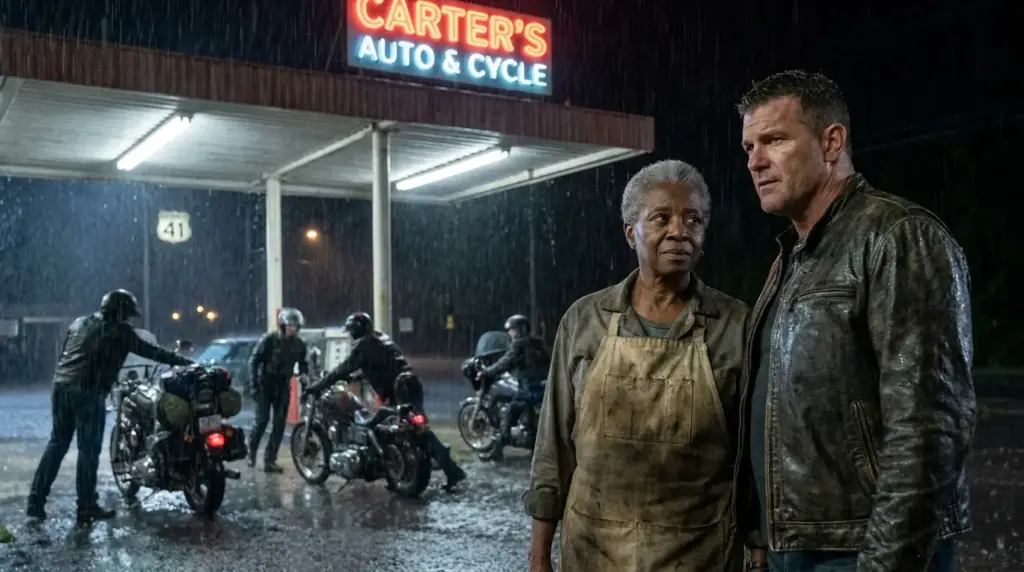
The bikers were watching her in the particular silence that falls over people when something they were certain of turns out to be wrong. “That’s not seized.” Ruth said of the last bike, pressing her fingertips to the engine casing near the top end. “The thermostat failed. It was running hot, but the piston’s fine.
You got lucky.” She straightened up and looked at Dean. “I can fix all of them. It’ll take most of the night.” Dean stared at her for a long moment.
“You can fix all of them.” He repeated. “Did I stutter?” Ruth said mildly, and turned back toward her workbench to collect her tools. The night settled into its own particular rhythm.
Ruth worked, and the bikers gradually found the spaces in the garage that felt least intrusive. A few sitting on overturned crates near the workbench, a few more leaning against the wall by the door, where they could watch the rain without being in it. Someone found the hot plate and the percolator, and Ruth wordlessly pointed at the shelf where the coffee was kept, and within 20 minutes there were mugs being passed around. And the hard-edged tension of the group’s arrival had softened into something closer to a tentative companionship. Her name was Ruth, they learned, and she’d had this garage for 30 years.
No, she didn’t have a website. Yes, she could fix motorcycles. She could fix most things with an engine, as a matter of fact, and a few things without one. She answered their questions with an economy of words that some of them initially read as coldness, but which over the course of an hour resolved into something else. The manner of someone who has learned to say exactly what is necessary and has long since stopped spending energy on what is not.
She worked while she talked, never stopping, never fumbling, moving through the repairs with the fluency of pure long practice. The bikers’ names came out gradually, in the way that names do in late-night situations, as if the ordinary social calculus of introduction requires a certain warmth before it operates. There was Marcus, who was Dean’s cousin and the group’s de facto navigator. A quiet man who seemed to observe everything from behind a carefully maintained reserve. There was Tamara, the only woman in the group, who had more mechanical knowledge than most of the others combined, and who watched Ruth with a focused, appreciative attention that was different in character from the others’ watchfulness.
There was Pete, who was cheerful in the way that people are cheerful when they’ve decided that anxiety is wasted energy, and Carlos, and a young man named Eli, who couldn’t have been more than 23, and who sat near the workbench with his hands around his coffee mug, and watched Ruth work with the expression of someone watching a language being spoken that he very much wanted to learn. It was Tamara who asked, eventually, why Ruth lived alone out here, whether she had family, whether she thought about retiring. The question was asked with genuine warmth, not intrusion. And Ruth paused over the fuel injector she was cleaning and considered it with the seriousness it deserved. “My husband, George, built this garage,” she said.
“He passed 11 years ago. Garage is the last thing we built together.” She resumed cleaning the injector with a small wire brush. “People keep asking me to sell it. There’s a company out of the city that’s been after it for 2 years.
Once the property for a chain service center.” “And you won’t sell?” Tamara said. “Not to them,” Ruth said. “Not yet.
Maybe not ever.” There was a pause. Rain ran down the roof in sheets and gathered in the lot outside with a sound like distant applause. “What do you mean, not yet?” Marcus asked.
Ruth set down the injector and looked at the workbench rather than at any of them. “The bank’s been patient,” she “but patient has a due date. Everything does.” No one pushed further. The information settled among them like something fragile that needed to be handled carefully.
And the conversation moved to other things, where they’d been riding, where they were headed, the quality of the road south of the state line, the specific miseries of a cold rain at highway speeds. Ruth reinstalled the injector, moved to the ignition coil, and the garage filled with the small, purposeful sounds of tools and work, and the rain’s steady percussion on the roof overhead. Dean Holloway didn’t soften easily or quickly, but he was, underneath the hard angles of his manner, a man who paid attention to things. He watched Ruth work through most of the night with the same expression, flat, assessing, impossible to read, but he watched. He saw how she moved around the bikes without wasted motion, how she diagnosed with her hands and ears rather than waiting for a computer to tell her what was wrong, how she worked on his own bike, the one with the most serious issues with a patience and precision that the machine seemed almost to respond to, as if being handled by someone who understood it deeply made it cooperate differently than it otherwise would.





