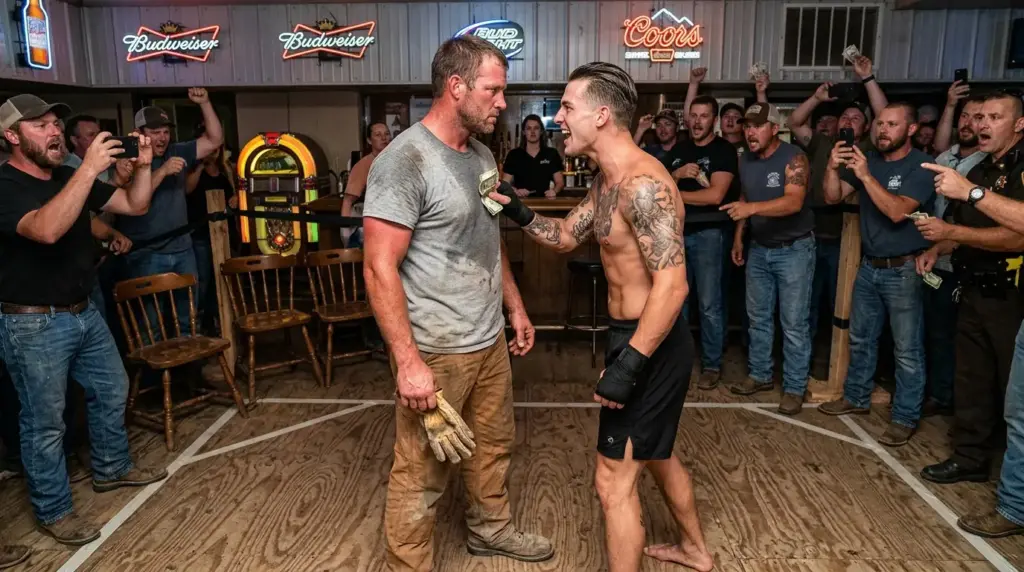
But in that town, five hundred dollars could buy a front-row seat to a man’s humiliation.
Trent Larson thought he was purchasing an easy knockout.
A farmer.
A tired local.
A heavy bag with a pulse.
He never noticed the farmer’s eyes.
Calm.
Empty.
Like deep water over jagged rocks.
Grease had a way of embedding itself into the whorls of your fingerprints so deeply that no amount of pumice soap could ever scrape it out.
Clayton James stood under the harsh yellow light of his barn, staring at his hands.
Blackened knuckles.
A jagged scar across the back of his left thumb.
Dirt beneath the nails.
The smell of burnt wiring and old diesel hung in the air, thick and metallic. The combine harvester sat in front of him like a wounded animal, silent and useless, its engine compartment open beneath the dim hanging bulb.
The July evening pressed down on his shoulders.
Outside, the cicadas screamed from the fields in one long, endless drone.
Clayton dragged a rag over his hands. It did nothing but move the grease around.
The alternator was dead.
Burned into a useless lump of copper and iron.
A replacement would cost five hundred dollars.
Clayton had eighty-three dollars in his checking account, a mortgage payment due on the first, and thirty acres of winter wheat that would not harvest itself.
He did not want to go to town.
He wanted to sit on his porch, drink a cheap domestic beer, and let the quiet ringing in his ears lull him to sleep.
That ringing had been with him for twelve years.
A parting gift from a mortar shell in Ramadi.
But the wheat did not care about his fatigue.
The bank did not care about his memories.
And the broken combine did not care that Clayton James had spent most of his life trying to become a man who did not hurt people anymore.
Thirty minutes later, his rusted Ford truck rolled into the gravel lot of the Iron Horse Tavern.
It was not really a tavern.
It was a corrugated steel pole barn sitting near the county line, filled with stale cigarette smoke, spilled draft beer, and the sour tang of nervous sweat. On Friday nights, Russell Cobb cleared away the pool tables and turned the place into something uglier.
Rusty, as everyone called him, ran an unsanctioned fight night for farmhands, mill workers, off-duty deputies, weekend tough guys, and anyone drunk enough to believe they had a chin.
Clayton pushed through the heavy wooden doors.
The air conditioning was broken. Two massive industrial fans tried to help, but all they did was stir the humid, swampy heat from one side of the room to the other.
Noise hit him first.
Shouting.
Glass clinking.
Boots stomping.
A jukebox fighting a losing battle against the roar of the crowd.
Clayton stood near the back, shoulders rounded forward to make his six-foot frame look smaller. He wore faded Carhartt pants stiff with dried mud and a plain gray T-shirt stained with engine oil.
He walked to the bar and ordered a club soda.
“You look like hell, Clayton,” Rusty grunted, sliding the sweating glass across the sticky counter.
“Combine died,” Clayton said.
His voice was low, rough, and tired.
He took a sip. The carbonation burned the back of his throat.
“Need cash.”
Rusty let out a raspy laugh and wiped the counter with a rag that looked dirtier than the wood.
“You ain’t going to find loans in here tonight,” he said. “Just bad decisions.”
Then he nodded toward the middle of the room.
“Though if you’re feeling suicidal, there’s always the open challenge.”
Clayton followed his gaze.
In the center of the room, a twenty-by-twenty square of interlocking foam mats had been taped together with duct tape. Standing in the middle of it was Trent Larson.
Trent was twenty-four years old, aggressively tanned, and smelled violently of aerosol body spray. He wore black board shorts and tightly wrapped hand tape. He bounced on the balls of his feet, throwing sharp jabs at the empty air.
Snap.
Snap.
Snap.
His punches cracked through the heavy room.
Trent ran a martial arts gym two towns over. He had three amateur MMA belts, a tribal tattoo around one bicep, and the kind of loud confidence that made Clayton’s stomach turn.
Not with fear.
With exhaustion.
“Three minutes!” Trent shouted to the crowd. “Anyone lasts three minutes with me, you walk away with five hundred cash. No gloves. Submission or knockout.”
Trent was not fighting for the money.
He was fighting for the thrill of watching lesser men fold under his hands.
Clayton watched him throw a spinning hook kick.
It was technically perfect. Beautiful, even.
The crowd of mechanics and mill workers cheered.
Clayton looked at Trent’s feet.
Clean.
Uncalloused.
The feet of a man who fought on padded mats beneath bright lights, with a referee nearby to make sure no one actually died.
“Five hundred,” Clayton muttered into his club soda.
Rusty’s face changed.
“Don’t do it, James,” he warned. “That kid’s broken two jaws this month. He’s fast, and he likes hurting people.”
Clayton closed his eyes.
The headache at the base of his skull throbbed.
He hated violence.
He had spent his twenties drowning in it.
As a SEAL officer, he had not merely committed violence. He had planned it, shaped it, and sent younger men into it. He had walked through mud-brick compounds where the air smelled of cordite, blood, and fear. He had spent the last eight years trying to scrub that cold, calculating part of his brain away with manual labor, empty fields, and silence.
But the combine needed an alternator.
Clayton set the glass down.
It made a dull, heavy thud against the counter.
He rubbed the back of his neck and felt the tight, coiled muscles there.
He did not feel heroic.
He felt deeply, profoundly tired.





