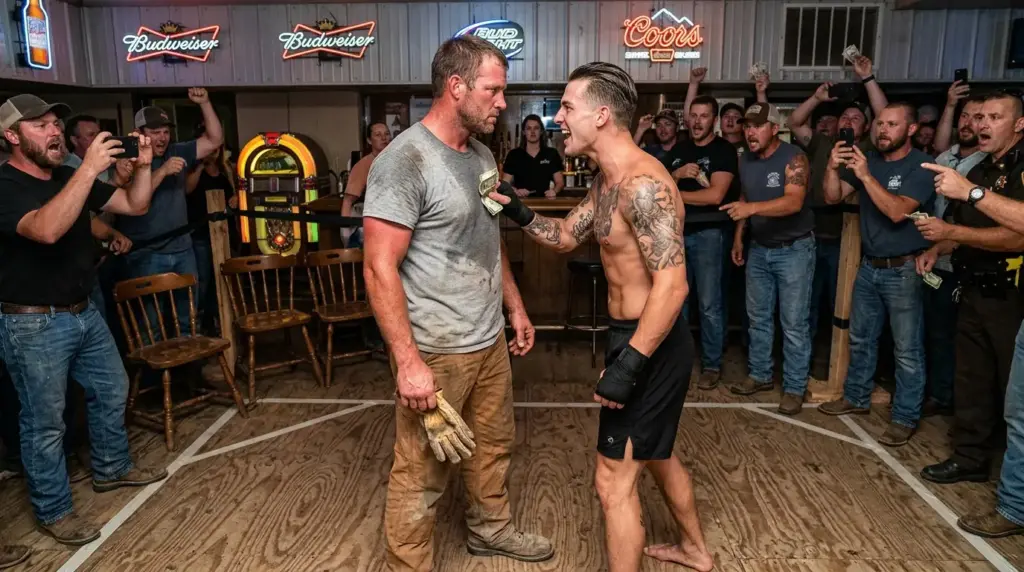
Clayton stood with a severe limp and walked to the edge of the mat. He picked up his socks, sat on a wooden stool, and methodically pulled them over his pale feet. Then he slid on his boots.
He left the laces loose.
Bending hurt too much.
The silence in the room was absolute.
The men who had been screaming for blood moments earlier were now staring at their beer bottles, suddenly fascinated by peeling labels and condensation rings.
They had come to watch a flashy show.
They had just watched a man get dismantled with terrifying, emotionless efficiency.
It felt too real.
Too intimate.
Rusty walked over, heavy boots thudding against the plywood floor. He extended a thick hand holding five crumpled hundred-dollar bills.
Clayton took the money.
The paper felt damp with Rusty’s sweat.
He folded it once and shoved it deep into the front pocket of his oil-stained Carhartts.
“Christ, James,” Rusty whispered. “Where the hell did you learn to move like that?”
Clayton looked at him.
The headache at the base of his skull had returned, fueled by the fading adrenaline. His hands were beginning to tremble slightly, a reaction he hated more than anything.
He gripped the edge of the stool to hide it.
“Just wanted to get back to my truck, Rusty,” he said.
He stood, favoring his bruised ribs, and began walking toward the door.
As he passed the mats, Trent finally sat up. His face was flushed with shame and lingering shock. He rubbed his throat and caught Clayton’s eye.
For a moment, he looked like he might demand a rematch.
Or throw an insult.
Anything to save what was left of himself.
Clayton stopped.
He looked down at the younger man and noticed the tremble in his jaw, the defensive set of his shoulders.
“Keep your chin tucked when you throw that overhand,” Clayton rasped. “And tape your wrist tighter. You’re going to break a scaphoid hitting like that.”
Trent stared at him.
His mouth closed.
Clayton pushed through the heavy wooden doors and stepped into the suffocating July night.
The heat outside felt almost welcome after the cold tension inside the tavern.
He walked across the gravel lot, stones crunching under his untied boots. His truck smelled like stale coffee, dog hair, and old dust.
He turned the key.
The starter whined for five long seconds before the engine finally caught, shuddering hard before settling into a rough idle.
Clayton slumped against the worn cloth bench seat.
He closed his eyes.
The adrenaline was gone now.
All it left behind was a deep, aching emptiness.
His ribs screamed with every breath. His right hand was swelling where it had collided with Trent’s jaw. His leg felt like someone had hit it with a pipe.
He reached into his pocket and pulled out the money.
Five hundred dollars.
He stared at it in the dim green glow of the dashboard lights.
It was not a trophy.
It was a transaction.
He had traded pieces of his body and one ugly glimpse into his past for a piece of copper and iron.
He put the truck in gear and pulled out onto the empty county highway.
The headlights cut a weak yellow cone through the darkness.
The cicadas were still screaming.
The next morning, the sky was the color of bruised iron.
A heavy summer storm was building, threatening to soak the fields before Clayton could get the wheat cut.
He stood at the parts counter of O’Reilly Auto, sipping black coffee from a Styrofoam cup that tasted like burnt plastic.
Every shift in his weight sent pain through his side.
Gary, the parts manager, hauled a heavy cardboard box onto the counter.
“Got it right here, Clayton. Remanufactured alternator for the John Deere. Four hundred eighty-two even.”
Gary looked up and noticed the dark purple bruise blooming across Clayton’s cheekbone.
Then he noticed the stiff, awkward way Clayton held his left arm.
“You take a spill off the tractor, James?”
Clayton pulled the five crumpled hundred-dollar bills from his pocket and laid them flat on the counter.
“Something like that,” he said. “Tripped over a stump in the dark.”
Gary chuckled and rang up the transaction.
“Gotta watch your step. Getting too old to bounce off the dirt.”
“Yeah,” Clayton muttered, sliding the box toward his chest. “Too old.”
An hour later, he was back under the glaring lights of his own barn.
The smell of grease, diesel, and ozone filled the air.
Clayton wrestled the heavy alternator into the cramped engine bay of the combine. Every time he had to torque a bolt, pain ground through his injured ribs and into the surrounding muscle. Sweat stung his eyes and mixed with grease on his face.
He did not feel victorious.
He did not feel like a man who had humbled a bully.
He just felt like a farmer racing a thunderstorm.
He tightened the final mounting bolt, groaning when a sharp spasm hit his back. Then he connected the wiring harness.
The plastic clip snapped into place with a satisfying click.
Clayton wiped his hands on the same greasy rag.
The black stains remained where they had been yesterday.
He climbed into the cab of the massive green machine and settled into the worn operator’s seat.
Then he turned the ignition key.
The diesel engine roared to life on the first crank.
The voltage meter immediately climbed to a healthy fourteen volts.
The new alternator hummed beneath the floorboards with a steady, even vibration.
Clayton sat there for a long moment, listening to the rhythm of the engine.
Then he looked through the dusty windshield at thirty acres of golden wheat swaying in the rising wind.
The storm was coming.
The work was waiting.
It always was.
Clayton reached down, put the combine into gear, and drove out into the field.





