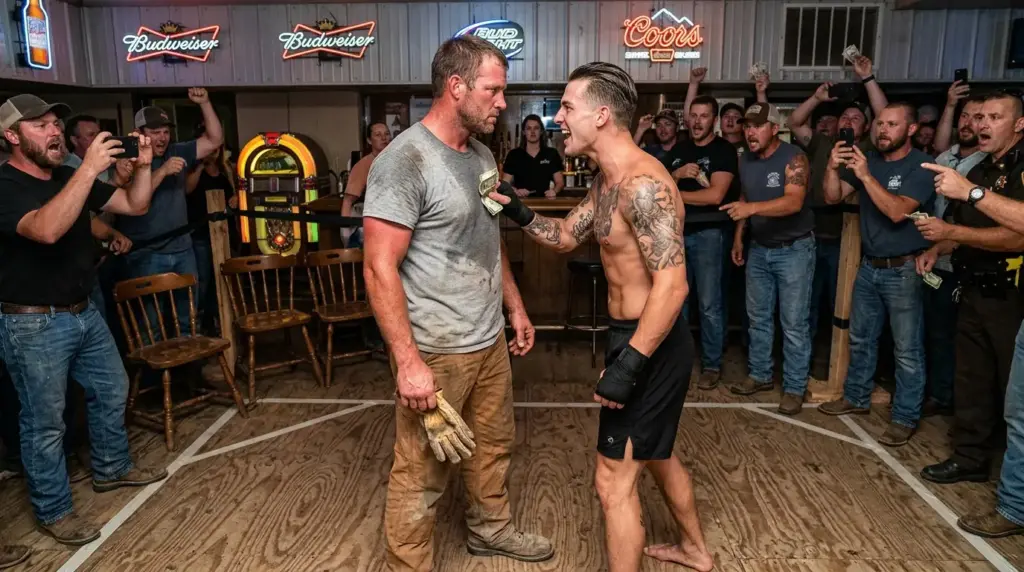
He wiped it away with the back of his taped hand.
He did not look at the crowd anymore.
The performance was gone.
Now there was only rage, panic, and the desperate need to recover the story he had promised himself.
He had never been handled like that.
He was used to men who swung wild. Men who telegraphed punches from across the room. Men who gassed out in sixty seconds.
Clayton was not swinging.
Clayton was not even breathing hard.
He just stood there, shoulders slightly hunched, bare feet gripping the peeling duct tape, watching Trent’s hips with dull, tired eyes.
“Lucky push,” Trent snarled.
He stepped forward, abandoning the flashy point-karate bounce. He brought his hands high, tucked his elbows, and moved into a tight Muay Thai guard.
He meant to walk the farmer down and chop his legs from under him.
Trent threw a hard low kick.
This time, Clayton lifted his lead leg and checked it perfectly.
Bone cracked against bone.
The sound was sharp, like a baseball bat striking a wooden post.
Trent hissed in pain, but he did not stop.
He planted his foot and threw a brutal elbow toward the bridge of Clayton’s nose.
Clayton slipped it by a fraction of an inch.
The rough fabric of Trent’s hand wrap grazed his cheek.
The closeness brought Trent’s smell directly into Clayton’s nostrils.
Aerosol deodorant.
Fear sweat.
Metallic adrenaline.
It smelled like every terrified young man Clayton had ever dragged out of a compound in Fallujah.
The memory flashed hot and bright.
Glass crunching under combat boots.
Radio static.
The heavy weight of ceramic plates against his chest.
Clayton blinked and forced the desert out of his eyes.
Back to the tavern.
Back to the heat.
Back to the beer-soaked air.
Trent caught the microsecond of hesitation.
He locked both hands behind Clayton’s neck in a tight clinch and yanked his head down.
Then he drove his knee up into Clayton’s ribs.
The impact landed with a sickening thud.
Clayton felt something shift.
Not a clean snap, but a deep grinding in the cartilage that stole his breath.
A spike of white-hot pain shot through his left side.
His vision swam.
The crowd erupted.
They smelled blood.
Trent tried to throw a second knee.
He never got the chance.
The pain did not make Clayton panic.
It flipped a switch.
The weary farmer disappeared.
What remained was a neural pathway built through years of close-quarters combat, exhaustion, blood, fear, and repetition.
Clayton did not try to break the clinch.
He drove both thumbs into the soft notch at the base of Trent’s throat, just above the collarbone.
Then he pressed inward and up.
Hard.
Trent choked.
His gag reflex fired violently. His hands unclasped from Clayton’s neck as his brain screamed for air.
Freed from the clinch, Clayton still did not throw a punch.
He grabbed the back of Trent’s head with his left hand, tangling grease-stained fingers in gelled hair. With his right forearm, he slammed a crossface across Trent’s jaw.
It was not a boxing strike.
It was ugly.
Gross motor.
Mechanically devastating.
The torque twisted Trent’s neck to the side and shattered his balance. At the same time, Clayton kicked out the back of his supporting calf.
They crashed to the mat together.
Trent scrambled frantically, trying to shrimp his hips out, trying to use the Brazilian jiu-jitsu he taught at his gym.
He tried to pull half guard.
Clayton bypassed it entirely.
He did not play the sport.
He dropped his full weight — two hundred ten pounds of dense, farm-hardened muscle — directly onto Trent’s chest.
The mount was heavy.
Suffocating.
Like a concrete slab had fallen from the ceiling.
Trent gasped as his lungs compressed.
He tried to bench-press Clayton off him.
A rookie mistake born of claustrophobic panic.
Clayton easily swam his arms inside the push.
He did not rain down blows.
He did not smash Trent’s face.
He flattened himself out, grinding his stubbled chin into Trent’s eye socket, creating a terrible abrasive pressure that made Trent twist and panic.
Then Clayton slid his left arm under Trent’s neck and secured his grip. His right hand crossed to the opposite side of Trent’s throat, grabbing fabric and pressure in a crude, modified choke meant for street clothes and bare hands.
Clayton dropped his forehead beside Trent’s ear.
Then he squeezed.
He did not yank.
He did not jerk.
He applied pressure with the slow inevitability of an industrial vise.
Trent thrashed beneath him like a netted shark.
His legs kicked wildly.
His hands clawed at Clayton’s forearms, nails digging half-moons into the skin and drawing small beads of blood.
Clayton did not blink.
His breathing stayed slow through his nose.
“Three seconds,” Clayton whispered into Trent’s ear.
No anger.
No triumph.
Just a statement of biological fact.
Trent’s face turned a deep mottled purple.
His thrashing slowed.
The panic in his eyes began to glaze over.
At the edge of the mat, Rusty stood frozen with a wet rag dangling from one hand.
The entire tavern was silent except for the hum of the fans and the frantic squeak of Trent’s heels against the mat.
Just before his eyes rolled back, Trent slapped the mat.
Tap.
Tap.
Tap.
Clayton released instantly.
He did not jump up.
He did not pound his chest.
He did not glare at the crowd.
He slowly pushed himself off Trent and rolled to one knee.
His breath was faster now, catching sharply against the injured rib. He pressed one hand to his side, his face tightening with pain and exhaustion.
Trent rolled onto his side, coughing violently.
Huge ragged gasps tore through his bruised throat. He curled into himself, clutching his neck, tears of oxygen-starved panic shining at the corners of his eyes.
He looked up, expecting Clayton to taunt him.
Clayton was not even looking at him.
He was looking at his work boots.





