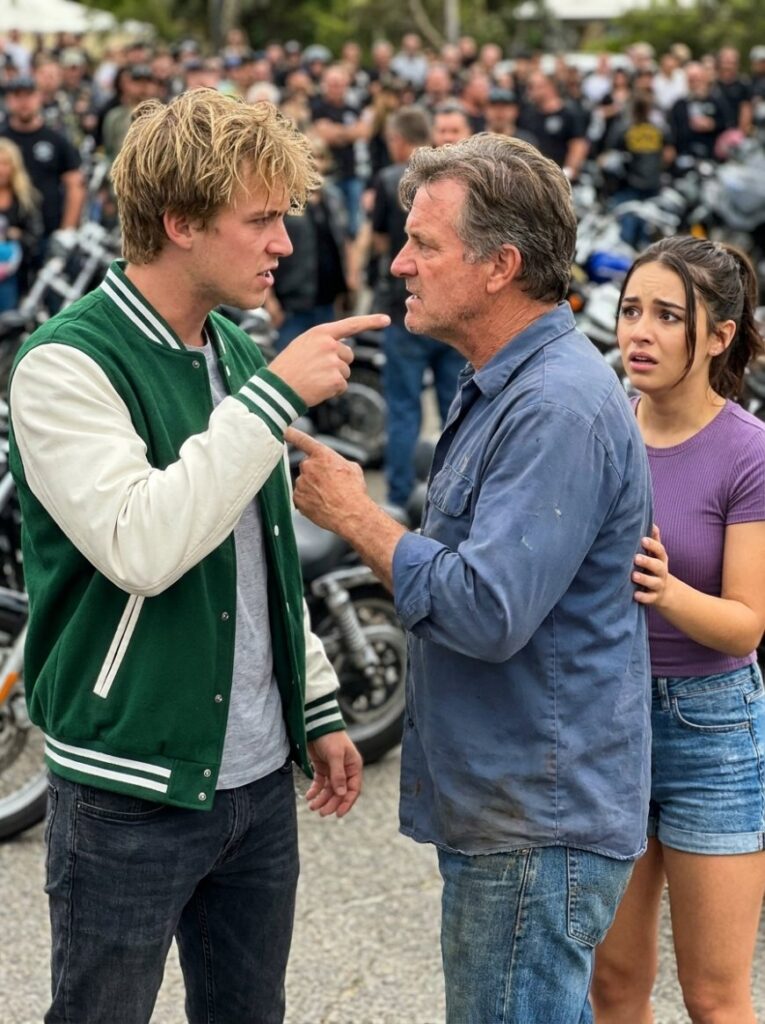
His right foot pivoted. That was all I needed. I saw the weight shift, the slight bend of his knee, the way his hips coiled like a spring. He was going to throw a right cross. Powerful. Fast. The kind of punch that ends fights on television. But I wasn’t watching television. I was watching my daughter’s future. I stepped inside his range before he could extend the punch. My left hand found his wrist, redirecting the momentum he had committed to. My right hand pressed against his shoulder, guiding rather than striking. His fist sailed past my ear with a whoosh of air that rustled my hair. The crowd screamed. He stumbled forward, off balance, his eyes wide with confusion. He hadn’t expected me to move. He had expected me to cower, to cover up, to give him the spectacle he craved. Instead, I gave him physics. His own weight carried him past me. I rotated with him, keeping control of his wrist, and applied just enough pressure to his shoulder to bring him down. Not slam. Not throw. Guide. He dropped to one knee on the concrete, his arm twisted behind him at an angle that wasn’t painful unless he resisted. He resisted. I applied a fraction more pressure. He stopped resisting. The music from the stage seemed to fade. The crowd’s screams became a low murmur. Even the lights felt dimmer, as if the entire festival had held its breath. I leaned down, close to his ear. “The night is over,” I said quietly. “Do you understand?” He didn’t answer. His friends stood frozen. One of them had his phone up, recording. The others had their mouths open, unsure whether to rush forward or back away. I waited. The fighter’s breathing was heavy. I could smell the alcohol on him, the sweat, the cheap cologne. His muscles tensed beneath my grip, testing, calculating. He was deciding whether to keep fighting or accept what had happened. I gave him time. Not because I needed it. Because he did. Finally, his shoulders dropped. Just slightly. A surrender so small most people wouldn’t have noticed. I noticed. I released him and stepped back, offering my hand. He stared at it like it was a foreign object. “Come on,” I said. “Get up.” He didn’t take my hand. He pushed himself to his feet, his face flushed red. His friends started moving toward him, but he waved them off with a sharp gesture. “I’m fine,” he muttered. “I’m fine.” He wasn’t fine. His hands were shaking. His eyes kept darting to the crowd, to the phones, to the faces watching him. I understood what he was feeling. Humiliation. Confusion. The sudden, terrifying realization that the world wasn’t what he thought it was. I had felt it once. A long time ago. In a gym that smelled like sweat and regret. But this wasn’t the time to share that story. I turned away from him and scanned the crowd. My daughter. She pushed through the sea of bodies, her small frame weaving between adults who barely noticed her. When she reached me, she didn’t speak. She just wrapped her arms around my waist and pressed her face against my chest. I held her. The crowd began to murmur. Someone clapped. Then another person. Then another. The applause spread like a wave, hesitant at first, then growing stronger. I didn’t acknowledge it. I just held my daughter and waited for the shaking in my hands to stop. Because my hands were shaking. They always did afterward. Not from fear. From the memory of what I could have done. What I had been trained to do. What I chose not to do. A woman stepped forward from the crowd. She was older, maybe late fifties, with silver-streaked hair pulled back in a neat bun. She wore a festival volunteer badge on her lanyard. “That was the most controlled thing I’ve ever seen,” she said. Her voice was calm but her eyes were sharp, studying me like I was a puzzle she wanted to solve. “Thank you,” I said. “I’ve watched men fight before. Real fights. Street fights. Bar fights. That wasn’t a fight.” “It didn’t need to be.” She nodded slowly. “No. It didn’t.” She glanced at my daughter, then back at me. “You’ve had training.” It wasn’t a question. “A long time ago,” I said. She smiled, just a small curve of her lips. “I thought so. The way you moved. The way you watched his feet instead of his hands. That’s not something you learn at a gym on weekends.” I didn’t respond. She didn’t press. “I’m glad you were here tonight,” she said. “Most people would have run. Or frozen. Or made it worse.” “I almost did.” “No,” she said. “You didn’t. I was watching.” She turned and walked back into the crowd, disappearing as quickly as she had appeared. My daughter looked up at me. “Dad?” “Yeah, sweetheart?” “Can we go home now?” I nodded. “Yeah. Let’s go home.” We walked away from the festival, past the booths and the rides and the games. The Ferris wheel was still spinning, its lights blinking in lazy circles against the dark sky. She never got to ride it. She never got to win that stuffed animal. She never got the normal night I had promised her. I hated that. But as we walked, her hand in mine, she squeezed my fingers. “Dad?” “Yeah?” “That was really cool.” I looked down at her. She was smiling. Actually smiling. “Cool?” “Yeah.” She nodded emphatically. “The way you moved. It was like… like you were dancing. But scary dancing.” I laughed. I couldn’t help it. “Scary dancing?” “Yeah. Like you knew exactly what he was going to do before he did it.” I squeezed her hand back. “I got lucky.” “No, you didn’t.” She looked up at me with those eyes, her mother’s eyes, and I felt my chest tighten. “You knew what you were





