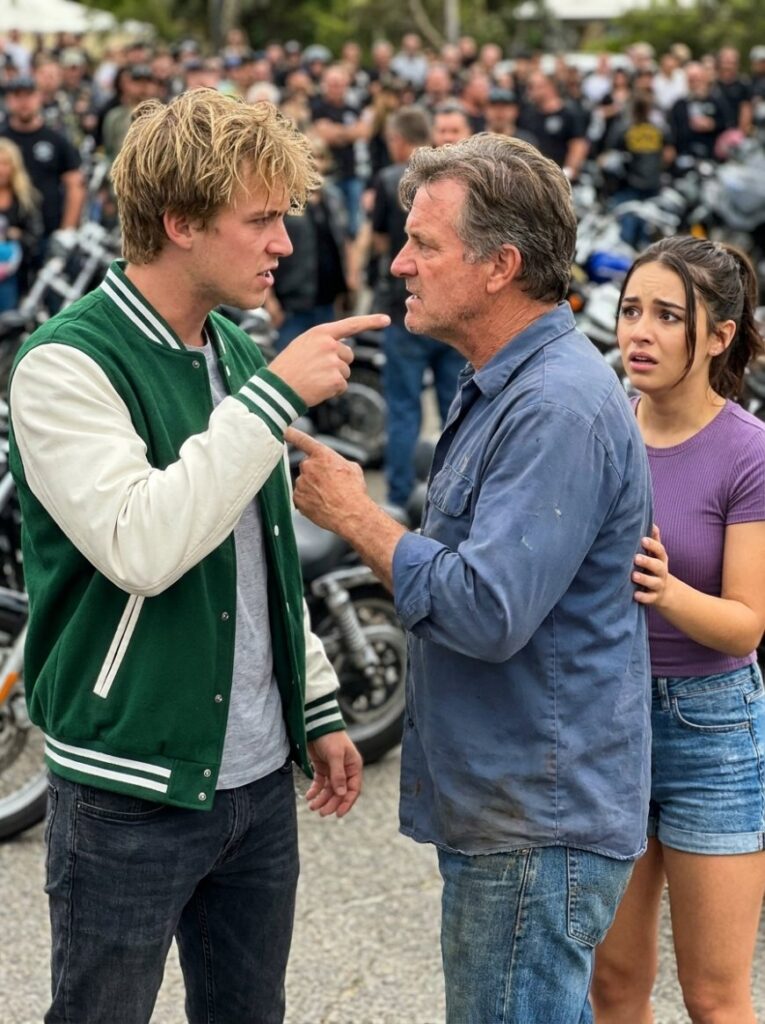
continued. Homework continued. Life continued. We didn’t go to any more festivals that summer. Instead, we went to the beach. The park. The library. We went to see movies and eat ice cream and laugh at bad jokes. Normal things. The way it was supposed to be. But something had changed between us. Something subtle. She walked a little taller. She spoke with more confidence. She started watching people the way I did—not with fear, but with understanding. One evening, we were sitting on the porch, watching the sunset. “Dad?” “Yeah?” “I’ve been thinking.” “That’s dangerous.” She laughed. That laugh. The one that made everything okay. “I’ve been thinking about what you said. About strength.” “What about it?” “It’s not about hitting people, is it?” “No.” “It’s about protecting them.” “It’s about protecting the right things.” “What are the right things?” I looked at her. “You,” I said simply. “You’re the right thing.” She smiled. That smile. “I love you, Dad.” “I love you too, sweetheart.” She leaned her head against my arm. We sat there as the sun dipped below the horizon. The sky turned orange, then pink, then purple. The stars came out one by one, like someone was lighting candles in the dark. “Do you miss Mom?” The question caught me off guard. She had asked before. Many times. But it always caught me off guard. “Yeah,” I said. “Every day.” “What was she like?” “Like you,” I said. “Exactly like you.” “What does that mean?” “It means she was strong. And kind. And stubborn. And she didn’t let anyone tell her what she could or couldn’t do.” “She sounds amazing.” “She was.” We were quiet for a moment. “I wish I could have met her.” “You did meet her,” I said. “Before you were born. When you were inside her. She used to sing to you.” “What did she sing?” “The same songs I sing to you.” She was silent. Then, quietly: “That’s why I know them.” “Yeah. That’s why.” She took a shaky breath. “I miss her. Even though I didn’t know her.” I pulled her closer. “I know. I miss her too. But we’re not alone.” “No?” “No.” I pointed at the stars. “She’s up there.” She looked up. “Which one?” I pointed to the brightest star. “That one.” She stared at it for a long time. “You’ll show me all the things she would have shown me?” “Everything,” I said. “I’ll show you everything.” She smiled. That smile. The one that made everything okay. — The summer ended. School started. Life settled into a new rhythm—different from before, but not unfamiliar. The video became a memory. A story we told now and then, on quiet evenings when the world felt far away. She didn’t ask me to teach her to fight. Not yet. But I knew she would. Sooner or later, she’d want to learn. And when she did, I would teach her everything. Not just how to move. How to stay calm. How to read a man’s feet before his hands. But also when to stand. When to walk away. When to protect. When to relent. That was the real lesson. That was the thing I had spent years learning. That was the thing I wanted her to know. Strength wasn’t about proving something. It was about knowing what you were willing to protect, and how far you were willing to go to protect it. And what I was willing to protect was sitting beside me, breathing softly, dreaming of Ferris wheels and stuffed animals and a normal life that didn’t exist. But that was okay. We could build our own normal. We could build it together. And that was enough. — The knock came three weeks later. I wasn’t expecting anyone. It was a Tuesday evening, and my daughter was at her friend’s house for a sleepover. I opened the door. A man stood on my porch. Tall. Broad. Wearing a leather jacket that creaked when he moved. He looked like an older version of the fighter from the festival. Same shaved head. Same build. Same hard eyes. But there was something different about him. A weariness. A weight. “Can I help you?” He looked at me for a long moment. “You the guy from the video?” “I’m a guy from a lot of things.” His jaw tightened. “My name’s Marcus. I’m his brother.” I didn’t respond. “The fighter. The one you humiliated at the festival.” “Ah.” “He didn’t take it well.” “I figured.” “He’s been different since then. Quiet. Not eating much. Lost a fight last week that he should’ve won. His coach says his head isn’t in it.” I waited. Marcus shifted his weight from one foot to the other. “He’s my little brother,” he said. “I raised him after our dad left. I taught him everything he knows. Taught him to fight. Taught him to hit. Taught him that strength is the only thing that matters.” He paused. “I was wrong.” I stayed quiet. “I saw the video. The way you handled him. I thought you’d hurt him. Break something. Make an example out of him.” He shook his head. “But you didn’t. You just… stopped him.” “Wasn’t worth hurting him.” “That’s what I mean,” Marcus said. “That’s what I’ve been trying to figure out. How do you do that? How do you have all that power and just… not use it?” I leaned against the doorframe. “Because I learned the hard way what happens when you do.” He looked at me. “What happened?” “I hurt someone. Someone I loved. Not physically.” I paused. “I was too angry. Too loud. I didn’t know how to just be still.” He nodded slowly. “He called me,” he admitted. “After he talked to you. He told me you said something that stuck with him.” “What did I say?” “That it’s not hardness that makes a man. It’s the decision to protect something more than himself.” I felt something loosen in my
PART 2: AN MMA fighter targeted my daughter and me at the festival—then SHOVED a chair and demanded I fight. He didn’t know