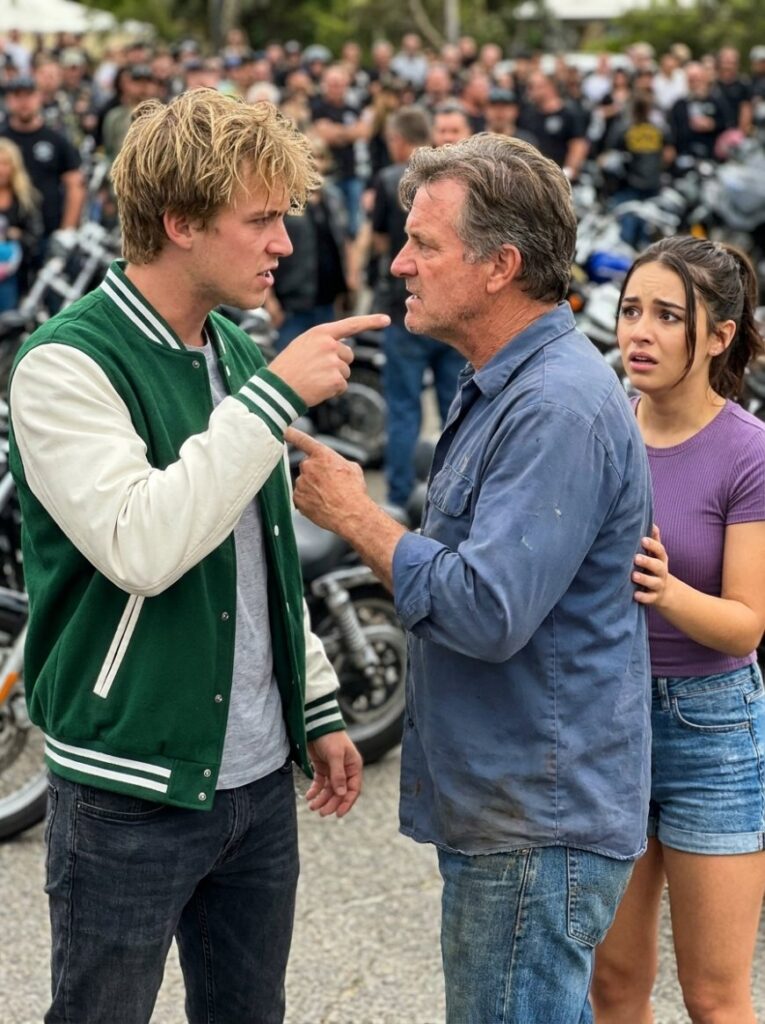
doing. You just didn’t want to hurt him.” I stopped walking. We were at the edge of the festival grounds now, near the parking lot. The sounds of the crowd were fading behind us, replaced by the hum of streetlights and distant traffic. “How do you know that?” I asked. She shrugged. “Because you’re my dad. You don’t hurt people. You help them.” I knelt down so I was at her level. “I almost hurt him tonight,” I said. “I could have. Part of me wanted to.” “But you didn’t.” “No. I didn’t.” She touched my face with her small hand. “That’s why you’re my dad.” I didn’t have words for that. So I just hugged her. Right there in the parking lot, under the flickering streetlight, with the festival noise fading behind us and the rest of the world carrying on like nothing had happened. We stayed like that for a long time. — The drive home was quiet. She fell asleep in the passenger seat, her head resting against the window, her breath fogging the glass in small, rhythmic puffs. I kept the radio off. I needed the silence. The night replayed in my mind like a film I couldn’t stop watching. The way he moved. The way I moved. The way the crowd gasped when they realized the quiet man wasn’t as quiet as they thought. I had spent years burying that part of myself. The training. The discipline. The muscle memory that never truly left, no matter how many years passed. I had walked away from it all when I became a father. I told myself I was done with that world, that I had no use for violence anymore, that I wanted to be the kind of man who solved problems with words instead of hands. But the world didn’t always cooperate. Sometimes, the world sent men like him. Men who mistook kindness for weakness. Men who needed to prove something to themselves and chose the wrong person to prove it to. I could have walked away tonight. I could have grabbed my daughter and run, let him shout at my back, let his friends laugh, let the crowd record my retreat. Part of me wanted to. But another part—the part I had tried to bury—knew that running wasn’t always the answer. Sometimes, running just delayed the inevitable. Sometimes, standing your ground was the only way to protect what mattered. And what mattered was sitting beside me, asleep, safe. I glanced at her. She looked so small. So fragile. So unaware of the world’s cruelty. I wanted to keep her that way forever. But I knew I couldn’t. Tonight had proven that. The world would find her eventually. It would test her, push her, try to break her. All I could do was prepare her. And show her what strength really looked like. — The house was dark when we got home. I carried her inside, careful not to wake her. She stirred once, mumbling something about Ferris wheels, then settled back into sleep. I laid her on her bed and pulled the blanket up to her chin. I stood there for a moment, watching her breathe. Then I went to the kitchen and poured myself a glass of water. I drank it standing at the sink, staring out the window at the quiet street. My phone buzzed. Then again. Then again. I picked it up. Messages. Dozens of them. From friends. From coworkers. From people I hadn’t spoken to in years. I opened the first one. A link. I clicked it. The video loaded. There I was, standing in the middle of the festival, a man on his knees in front of me. The camera shook slightly, but the image was clear. The comments were already pouring in. “Who is this guy?” “That was insane. He barely moved and the bully just… dropped.” “MMA fighter my ass. That dude got handled.” “Real strength right there. No punches thrown.” I scrolled through the comments, my jaw tight. Someone had captioned the video: “Quiet Dad Destroys MMA Bully Without Throwing a Single Punch.” I closed the app. More messages came in. “Hey man, saw the video. You okay?” “Is that you? What happened?” “Dude, you’re famous now.” I put the phone down and stared at it. I didn’t want to be famous. I didn’t want to be a viral sensation. I didn’t want strangers analyzing my movements, debating my past, speculating about who I was and where I learned to fight. I just wanted my daughter to be safe. I just wanted to be a normal father. But normal was gone now. The video was spreading. People were watching. And somewhere out there, the fighter was watching too. I thought about him. Not with anger. Not with satisfaction. With something closer to pity. He had made a mistake tonight. A public mistake. Everyone had seen it. His friends, his fans, his rivals. They had all watched him get humbled by a man he had dismissed as weak. That kind of humiliation didn’t fade quickly. It festered. And men like him, men who built their identities on strength and dominance, didn’t handle festering well. I knew that because I had been him once. A different version of him. Younger. Angrier. Hungrier. I had spent years learning to fight, honing my body into a weapon, believing that strength was the only currency that mattered. Then I met her mother. She had changed everything. She had shown me that strength wasn’t about hurting people. It was about protecting them. It was about restraint. It was about knowing when to fight and when to walk away. She had given me my daughter. And then she was gone. I still couldn’t think about it without feeling the hole in my chest. The one that had never healed. The one I filled with bedtime stories and school plays and pancakes on Sunday mornings. My daughter was all I had left. And I
PART 2: AN MMA fighter targeted my daughter and me at the festival—then SHOVED a chair and demanded I fight. He didn’t know