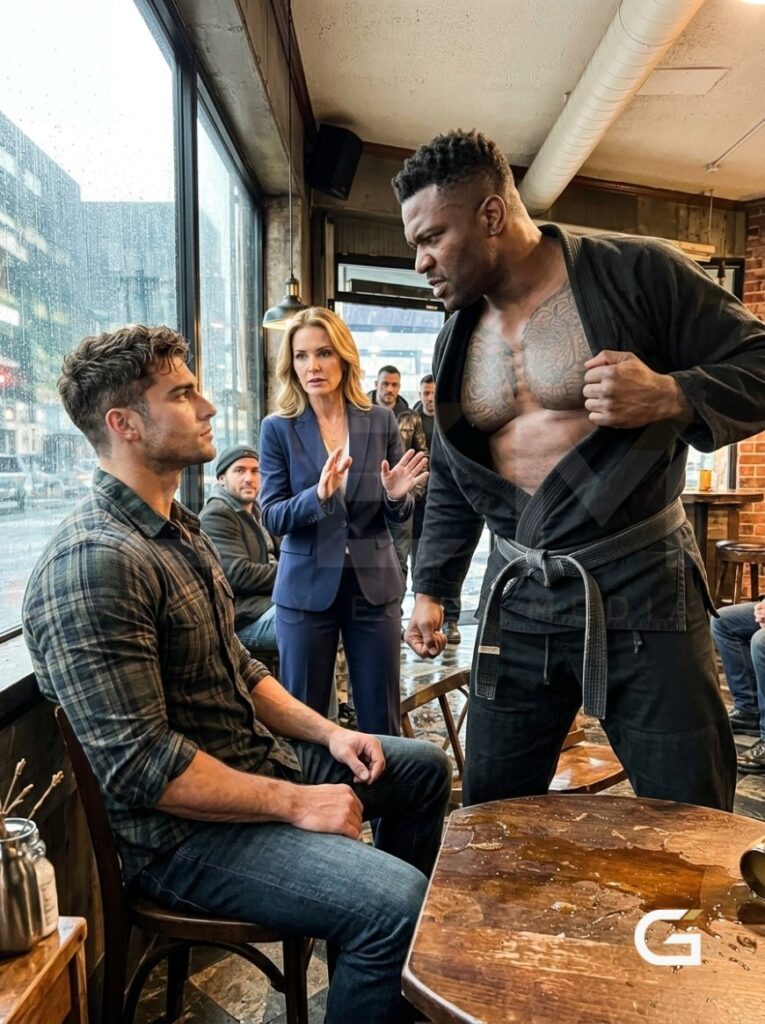
I let it ring twice before I picked it up.
Not because I didn’t know who it was. Because I did.
The garage was dark except for the one lamp over the workbench, and the rain had finally stopped outside, leaving that heavy, dripping quiet that makes a place feel emptier than it is.
I put the phone to my ear and said his name before he could say mine.
“Jackson.”
A short breath on the other end. Almost a laugh, almost not.
“You always did answer like you were already standing at attention.”
“I’m sitting at a desk.”
“Same thing, for you.”
I heard traffic behind him. Wind. The low idle of an engine parked somewhere with the windows down.
“You saw it,” I said.
“I saw it.” A pause. “Half of Denver saw it, Mason. It’s on three local feeds already, and it’s cut.”
“Cut how.”
“Cut the second his hand touched her.”
My jaw tightened, but I didn’t answer.
“They start the clip when you’re already moving,” Jackson went on. “No context. No audio of what he said. Just a man in a canvas jacket crossing a room and two bodyguards going down. They’re calling you a threat to public safety.”
“That’s fast.”
“That’s not fast. That’s rehearsed.”
I leaned back in the chair and looked at the drawer I’d closed an hour earlier.
The photograph was still in there with the six of us in desert fatigues, and I could feel it through the wood the way you feel a bruise under a sleeve.
“The woman,” I said. “The one who got grabbed. Is her name in it?”
“Not yet. That’s the part that bothers me.”
“Why.”
“Because whoever edited that footage knew exactly what to leave out,” Jackson said. “They knew the waitress’s name would turn the whole thing around. So they took her out of it.”
I sat there with the receiver warm against my ear and let that sink in the way cold water sinks into boots.
“They’re protecting him,” I said.
“They’re protecting the deal.”
Twenty minutes later I knew the shape of it, and I didn’t like any of the sides.
Jackson had heard the name Connor Vail before, and not from me.
He’d heard it in Charlotte, then Phoenix, then a small office park outside Sacramento, always attached to a company that had been publicly embarrassed by documents nobody could trace and a chief executive who resigned before anyone could ask real questions.
“Every time,” he said, “it’s the same pattern. Somebody refuses to sign. Then suddenly they’ve got fabricated HR files, manufactured lawsuits, a leaked recording that sounds incriminating if you only read the headline.”
“And then they sign.”
“Or they lose everything and somebody friendlier signs anyway.”
I turned off the workbench lamp and let the dark close in around the conversation.
“Who’s behind him.”
“That’s the part I don’t have yet,” Jackson said. “Vail’s not smart enough to run this by himself. He’s loud, he’s expensive, and he’s disposable. Somebody uses him to be the face.”
I knew that kind of man. I’d met a dozen of him in rooms where the furniture cost more than my truck and the carpet was too thick to hear your own footsteps.
They were never the ones in charge. They were simply the ones willing to say the thing out loud.
“You’re going to help her,” Jackson said.
It wasn’t a question.
“I haven’t decided.”
“You decided in that cafe.”
“I decided about a wrist,” I said. “That’s different.”
There was a long silence on his end, the kind that used to happen between us in the field when a plan was already agreed on and neither man wanted to be the first to admit it.
“She gave you a card,” he finally said.
“How do you know that.”
“Because she’s still standing on that sidewalk in the footage,” Jackson said. “You’ve been gone two years. That’s how long it took somebody to hand you a number and mean it.”
I hung up without saying goodnight. That was old habit, and I hated that it was back.
Sleep didn’t come that night, so I worked instead.
I replaced the brake pads on a sedan that had been sitting in the bay for a week, checked the torque twice, and reorganized a shelf of sockets that didn’t need reorganizing.
At four in the morning I stood in front of the small mirror by the office door and looked at a man I hadn’t seen clearly in a while.
Same face. Rougher around the edges. But the eyes had that flat, forward look again, the one I’d spent two years training out of them with school runs and oil changes and reading the same bedtime story eleven nights in a row.
I turned the light off and told myself I was still deciding.
By seven, the decision started being made for me.
The first sign was the driveway. Empty. Usually there were two cars waiting by seven-thirty, drop-offs from customers who liked to get their vehicles in before work.
Nobody came.
By nine I had four voicemails, all cancellations, all vague.
One of them was a man I’d known for six years, a contractor who brought his work trucks to me and called me “brother” every time he shook my hand.
He said something about a family thing up in Fort Collins. His voice was careful in a way it had never been careful with me.
I listened to the message twice, then deleted it.
The second sign came at eleven, when a black sedan rolled past the bay door slow enough that I could count the occupants without meaning to.
Two men. Dark jackets. Neither one looked at the garage. That was how I knew they were looking at it.
I kept my head down under the hood of a truck and let them pass.





