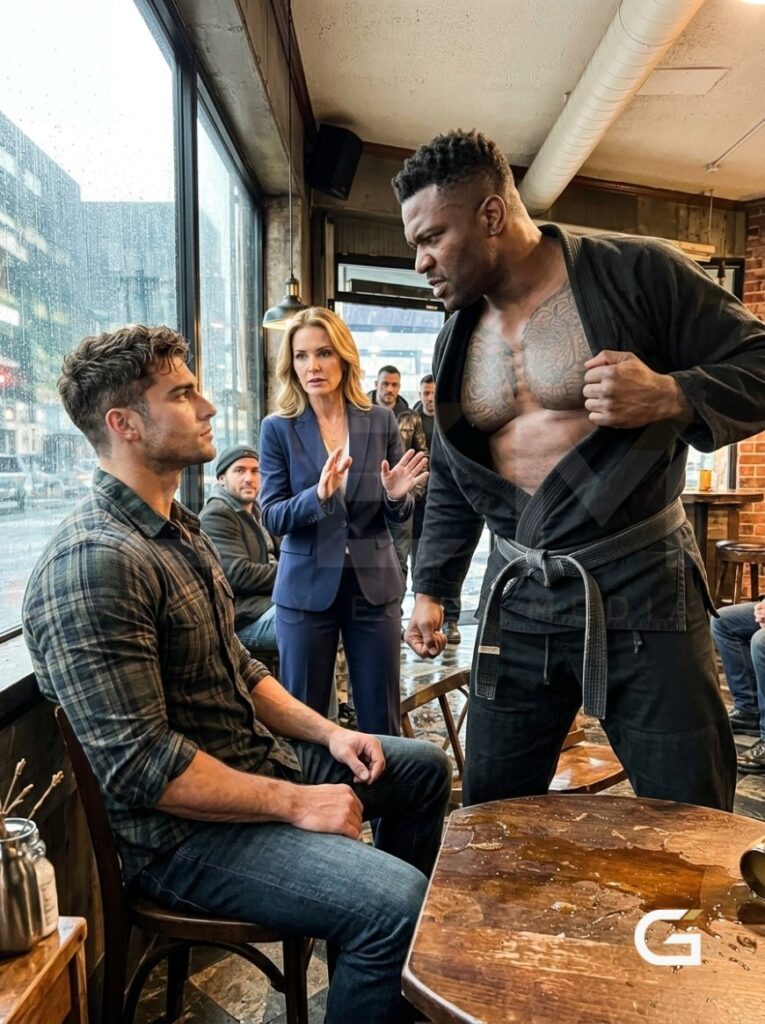
He took the phone and scrolled, and his face went still in a way I hadn’t seen in years.
“I know one of these names,” he said.
“From where.”
“From a briefing I wasn’t supposed to be in.” He handed the phone back. “That man has been doing this for a decade, Mason. He doesn’t lose. He doesn’t get charged. He doesn’t get named. He buys people who make sure of it.”
“Then he bought the wrong city.”
Jackson looked at me for a long moment.
“You sound like you again,” he said.
“I know.”
The drive back took forty minutes and I spent most of it thinking about my daughter, who was at her aunt’s until Friday, who still asked me every single week whether I was going to be home for dinner.
I was. That was the whole point. That was always the whole point.
Evelyn called a meeting on Monday morning to sign the contract.
She did it through her own executive assistant, in writing, with a proposed location: a private suite at the Halston downtown, Thursday, 7 p.m., one signatory, minimal staff.
Connor answered within nine minutes. He suggested the time be moved up to 6. He suggested the suite be on the top floor. He suggested — politely, in writing — that she come alone.
She agreed to all of it.
That Thursday, I sat in a service corridor two levels below the top floor with a maintenance schematic open on my phone and a small toolkit in my jacket.
Jackson was three blocks away in a rented van with a scanner tuned to the hotel’s security channel and an attorney on speed dial who had already been briefed on the recording laws.
Lisa’s written statement was signed, dated, and saved in two separate places — one of them a cloud folder named “Recipes 2019.”
At 6:02, Evelyn walked into the suite with a recording device stitched into the inside of her lapel, and Connor Vail closed the door behind her.
What neither of us had accounted for was the scanner by the door, installed that afternoon by a consultant Connor had flown in from out of state.
At 6:11 it went off.
I heard the change in the hallway before I understood it — the flat electronic tone, then the sudden movement of men who had been standing still for an hour.
Then the elevator bank chimed, and a voice on the security channel said, “Seal the floor.”
I was already moving.
The service stairwell door had an auxiliary lock wired to the floor’s badge reader, and the panel for it was in a utility closet on the mezzanine, exactly where the schematic said it would be.
I opened the closet, found the control board, and pulled the two leads that fed the stairwell reader. It didn’t disable the alarm. It just told the system the stairwell door was closed when it wasn’t.
Then I went up.
On the top floor, the corridor lights were on a motion timer, and I killed one bank by tripping the breaker on the far panel, which left the hallway in a long strip of shadow with a single lit section near the suite door.
Two men stood outside it. Neither was looking at the stairwell, because in their experience nobody ever came up the stairwell.
I didn’t want a fight. I wanted their positioning.
The first one heard me when I was already too close to do anything about it. I caught his wrist, turned his weight into the wall beside the door, and held him there until his grip on his own radio went slack.
The second spun toward the sound and threw a punch through the space where I had been standing half a second earlier. I let his momentum carry him past me and used the doorframe to finish the conversation.
Neither of them was hurt badly. Both of them were on the floor when I stepped into the suite.
Evelyn stood against the window with her chin up and her hands at her sides, and Connor had his fingers wrapped around her wrist.
The same grip. The same hand. The same man, in a better room.
He saw me and something in his face came apart — not fear, exactly, but the collapse of a plan he had never once considered could fail.
“You,” he said.
“Let go of her.”
“She’s not going anywhere. Neither are you. This floor is sealed, there’s a scanner on the door, and I have lawyers on the way who will—”
“Let go of her.”
He didn’t.
So I crossed the room the way I had crossed the cafe, slow and without noise, and when I reached him I turned his hand at the wrist, the same point, the same pressure, and his fingers opened on their own.
Evelyn stepped back and put both hands around her own wrist, breathing hard.
Connor stumbled into the side table, caught himself, and stared at me with his mouth open.
“You don’t know what you’ve done,” he said. “You don’t know who I work for.”
“I know both of them,” I said. “Their names are on page four.”
That stopped him cold.
“You—”
“Page four,” I said again. “Under ‘principals.’ You’re listed as a subcontractor.”
For a second Connor Vail looked like a man who had just been told the terms of his own contract.
Then the stairwell door at the end of the hall opened, and Jackson came through it with two officers and a woman in a gray suit carrying a legal pad.
They came in while Connor was still explaining, loudly, that he had been assaulted in a private suite and that everything that had happened was the fault of a violent man with a criminal history.





