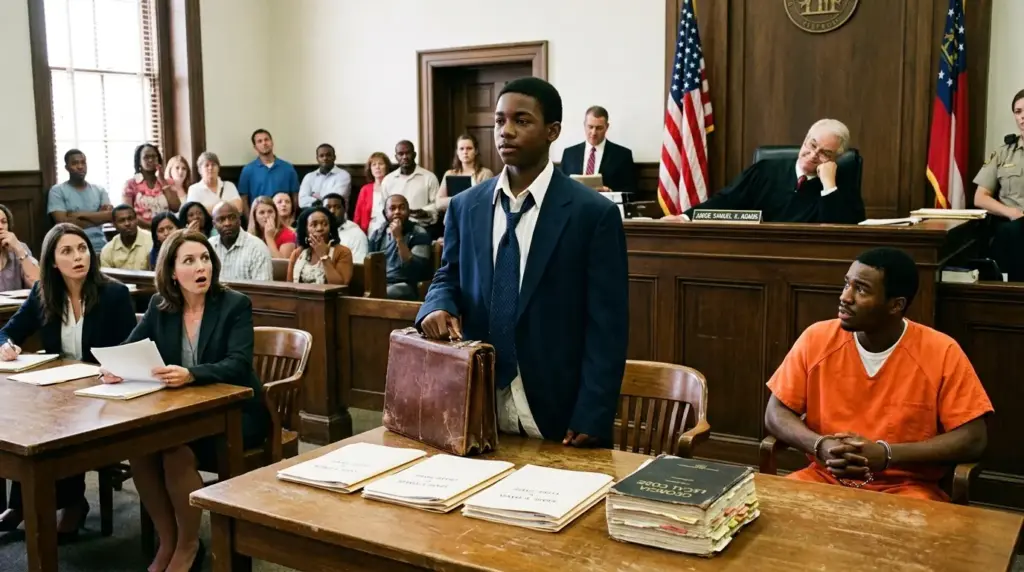
Nobody expected the kid in the oversized navy suit to speak. He walked through the double doors of the Miller County Courthouse in Camilla, Georgia like he’d done it before. Only the jacket didn’t quite fit. The sleeves ran long, hiding most of his hands. His tie was crooked. The briefcase he carried was scuffed, like it had been passed down through a few lifetimes. But the way Elijah Carrington moved—calm, straight-backed, eyes locked forward—looked like he was there for business.
Inside the courtroom, the crowd turned; whispers buzzed. Who was this boy? A clerk’s little cousin? Somebody’s assistant? A kid who wandered in off the street?
Judge Raymond Tolbert looked up from his bench. His reading glasses sat low on his nose. He didn’t say anything at first, just smirked. It wasn’t subtle—one of those sideways grins that says everything without saying a word, the kind of smile that makes your stomach turn.
Elijah didn’t flinch. He walked straight toward the defense table, opened the briefcase, and pulled out three neatly stacked file folders and a worn copy of the Georgia Code. He placed them carefully, like someone lining up tools before getting to work.
Tolbert finally spoke. “You lost, son?”
“No, sir,” Elijah said, voice steady. “I am here representing my brother, Isaiah Carrington.”
A pause fell so heavy, even the courtroom clock seemed to hold its breath. The bailiff blinked. The prosecutor, Andrea Lindholm, looked up from her notes with a raised eyebrow. Someone in the third row stifled a laugh.
Tolbert leaned back in his chair. “Representing? You mean observing?”
“No, sir. Representing.” Elijah held up a document, carefully notarized and signed. “Isaiah filed a pro se motion requesting self-representation. He then designated me under Georgia’s lay representation allowances to act as his representative.”
Tolbert’s smirk widened. “Son, this isn’t a mock trial. This is a felony case.”
“I understand.”
“You’re 17.”
“Yes, sir.”
“You have no license, no formal legal training.”
“No, sir.” Elijah glanced briefly at the gallery, then back at the judge. “But I’ve studied the law for two years, and I’ve read everything related to my brother’s case twice.”
The courtroom shifted again. No more chuckles. Just silence now—tight, uncomfortable silence.
Tolbert exhaled, slow and deliberate. “Well, we’ll see how long that confidence holds.” He turned to the prosecutor. “Ms. Lindholm?”
She looked unsure. “If the paperwork’s in order, it’s legal. Strange, but legal.”
The judge shook his head and looked down at his docket. “This is a preliminary hearing. We’re here to decide whether there’s enough to proceed to trial. If your brother really wants you to speak on his behalf, I’m not stopping you.”
Elijah didn’t smile, didn’t move, just said, “Yes, Your Honor,” and sat down.
From the back row, Isaiah, his older brother, watched in silence. His hands were cuffed, orange jumpsuit wrinkled at the collar, but his eyes—they held something quiet, something proud.
The clerk called the case: State of Georgia versus Isaiah Carrington.
The room reset. Andrea Lindholm stood, began laying out the charges: burglary, resisting arrest, and possession of stolen property. “A simple case,” she said. Mr. Carrington was caught red-handed fleeing a home with electronics in his car; the arresting officer ID’d him on site. No mention of the lack of fingerprints. No mention of the alibi. No mention of the anonymous tip that had led to Isaiah being pulled over in the first place.
Tolbert nodded along. Everything seemed to move fast—too fast.
Then Elijah stood up calmly. “Your Honor, may I cross-examine the officer?”
A flicker of surprise crossed Tolbert’s face. “You may.”
The officer stepped up: Officer Paul Haskins, big guy, 45, with the build of a linebacker and a voice made for radio. He looked down at Elijah like he was a science experiment.
“State your name for the record,” Elijah said.
“You serious?”
“Name, please.”
A few people in the back tensed up. Elijah’s tone wasn’t rude, just different, like he wasn’t asking—he was conducting.
“Haskins. Paul Haskins.”
“And you said you saw my brother inside the vehicle with the stolen property?”
“Yeah. Flat-screen TV in the back seat, two laptops. I pulled him over after I got the tip.”
“Right. This tip—did you log it?”
“No.”
“You said he ran.”
“He tried. I stopped him.”
Elijah flipped open a file. “Then how do you explain this?”
He held up a photo: Isaiah, face down, handcuffed, kneeling, timestamped five minutes before the traffic stop was officially recorded.
The courtroom stirred. Haskins blinked.
Tolbert leaned forward. “Where did you get that?”
“From a neighbor’s Ring cam. The arrest didn’t happen during the stop; it happened before. That’s an unlawful seizure.”
And just like that, the temperature shifted. But what came next would make the entire courtroom forget they were looking at a teenager.
The silence didn’t last. It cracked when Officer Haskins mumbled, “I must have gotten the time wrong.”
Elijah didn’t even blink. “So, your official report is wrong, your body cam was off, and you didn’t record the anonymous tip.”
Tolbert interrupted. “Let’s keep the tone respectful, Mr. Carrington.”
Elijah nodded. “Of course, Your Honor. Just trying to get to the truth.”
People shifted in their seats. Whispers passed like wind between the rows. A few folks who’d come expecting to be entertained now sat up straighter. This wasn’t funny anymore.
From the defense table, Elijah picked up a second file. “I’d also like to submit a sworn statement from Mrs. Wanda Freeman, the homeowner whose house was allegedly burglarized.”
Judge Tolbert glanced at the document. “You had her sign this yourself?”
“Yes, sir. Yesterday afternoon.”
“And what does she say?”
“She says nothing was missing. She found her TV right where she left it. The door was closed. No signs of a break-in.”
Andrea Lindholm stood quickly. “Your Honor, this wasn’t in discovery.”





