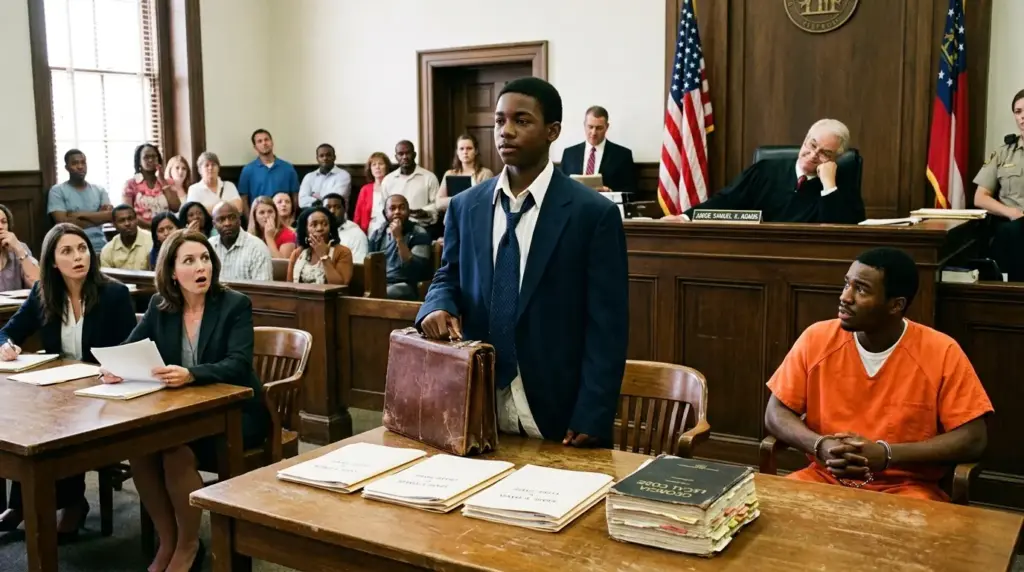
Elijah responded without missing a beat. “She wasn’t interviewed by police. I found her on my own.”
Tolbert raised an eyebrow. “How’d you get her to talk to you?”
“I asked,” Elijah said, “politely.”
A couple of people chuckled this time—not at Elijah, but with him.
The judge scanned the statement. “And she confirms that Isaiah was not in her home?”
“She says she didn’t see him at all that day. She only found out someone had been arrested in connection with her house from the local paper.”
Tolbert’s eyes narrowed. His smirk was gone. Now he was thinking.
The courtroom door creaked open as someone slipped in late. It was Mr. Klein, the town’s unofficial court watcher—retired, nosy, always carrying a notepad. He whispered to someone in the back, “What’s going on?”
“Some kid is defending his brother,” the woman replied. “He’s killing it.”
Outside the courthouse earlier that morning, Elijah had stood by the cracked sidewalk with his brother’s lawyer—well, former lawyer—just a few feet away from the rusted bike rack. That man, Elijah remembered his name was Dwayne Carter, had looked down at him like he was trying to solve a math problem he hadn’t studied for.
“You can’t do this, kid,” Carter had said. “Court’s not some school project.”
“I know,” Elijah said calmly. “But you don’t believe my brother, and I do.”
“Belief doesn’t win trials.”
“No, but the truth might.”
Carter had shaken his head, muttered something about watching too many movies, and walked off.
Now, in that courtroom, Elijah made good on every hour he’d spent studying on his own: late nights at the Camilla Public Library, listening to recorded lectures on his cracked iPhone, watching old trials on YouTube, reading from the stack of used law books he bought for five dollars each at a secondhand shop in Albany. He didn’t have a degree, but he had facts. He didn’t have courtroom experience, but he had instinct. And right now, he had momentum.
Judge Tolbert cleared his throat. “Let me get this straight: the arresting officer’s timeline is off, the supposed victim denies anything was stolen, and there’s no proof of forced entry.”
“Yes, sir.”
“And you, Mr. Carrington—you dug this up on your own?”
Elijah looked over at his brother, then back at the judge. “I had to. No one else was doing it.”
A heavy pause. The judge leaned back again. This time, no smirk—just a crease between his eyebrows. “You said you’re 17?”
“Yes.”
Tolbert sighed through his nose, almost like he didn’t want to say what he said next. “Well, so far, you’re more prepared than half the licensed lawyers who stand in front of me.”
Gasps, a few murmurs. Andrea Lindholm crossed her arms; she wasn’t smiling.
Elijah kept his expression flat, but inside his heart hammered. Not from nerves—from focus. Every moment counted. Every word mattered. And he wasn’t about to slow down now.
He stepped back to the table, slid the folders into a clean pile, and whispered something only Isaiah could hear: “You all right?”
Isaiah nodded. “You’re doing better than I ever imagined.”
Elijah smirked slightly, still looking ahead. “You just wait.”
Because if they thought the kid with the baggy suit was done, they were about to learn how wrong they really were.
By the time Elijah stepped back up for his second round of questions, you could feel it: the whole room had shifted. People weren’t staring at the suit anymore. They were watching him, watching how he spoke, how he never raised his voice, never stumbled, never looked unsure—not once.
Elijah flipped open his notebook, hand-scribbled and dog-eared; it looked like it had seen some things. He turned to Officer Haskins again.
“Officer, you testified you found two laptops in the vehicle. Do you have the serial numbers of those items?”
“I… no,” Haskins said. “They were logged after the fact.”
“By who?”
“Property division.”
“Can you confirm they were reported stolen?”
“I believe so.”
“You believe?” Elijah asked.
Haskins hesitated. “Well, that’s what I was told.”
Elijah stepped aside, grabbed another paper. “Because according to this report from the electronics store three blocks from my house where those laptops were purchased, my brother bought them two days earlier using his own debit card.”
He held up the receipt. Haskins stared at it.
Lindholm stood, objected. “Your Honor, I wasn’t provided this during discovery.”
“You didn’t ask,” Elijah shot back, holding her gaze, “because you assumed he was guilty.”
Tolbert raised his hand. “Enough. Let me see the document.”
Elijah walked it over, calm, steady. Tolbert adjusted his glasses and read. No emotion showed on his face, but something flickered behind the eyes. Lindholm sat back down slowly.
From the third row, someone whispered, “That boy came with receipts.”
But Elijah wasn’t finished. “I’d like to call my next witness: a man named Travis Dent.”
A man stood in the back: mid-30s, goatee, wore work boots and a faded mechanic shirt. He raised his hand and walked to the stand.
Tolbert looked surprised. “Was this witness disclosed?”
“No, sir, but he’s relevant. I can explain.”
Tolbert sighed. “Make it quick.”
Elijah turned to Travis. “Can you tell the court your relationship to Officer Haskins?”
Travis shifted, looked at the officer. “He’s my cousin.”
“And did he talk to you the night Isaiah Carrington was arrested?”
“Yes.”
“What did he say?”
“Objection,” Lindholm stood. “Hearsay.”
“Goes to motive, Your Honor,” Elijah argued. “Let me finish.”
Tolbert motioned forward. “I’ll allow it for now.”
Travis cleared his throat. “He said he finally got him. Said he was tired of seeing those Carrington boys walking around like they owned the place. Said Isaiah thought he was slick with the system, but wasn’t smart enough to beat a uniform.”
Gasps—audible, sharp. Tolbert’s expression darkened. Lindholm scribbled furiously in her notes.
Elijah stepped closer to the witness stand, his voice quieter now. “Did he say anything about setting him up?”





