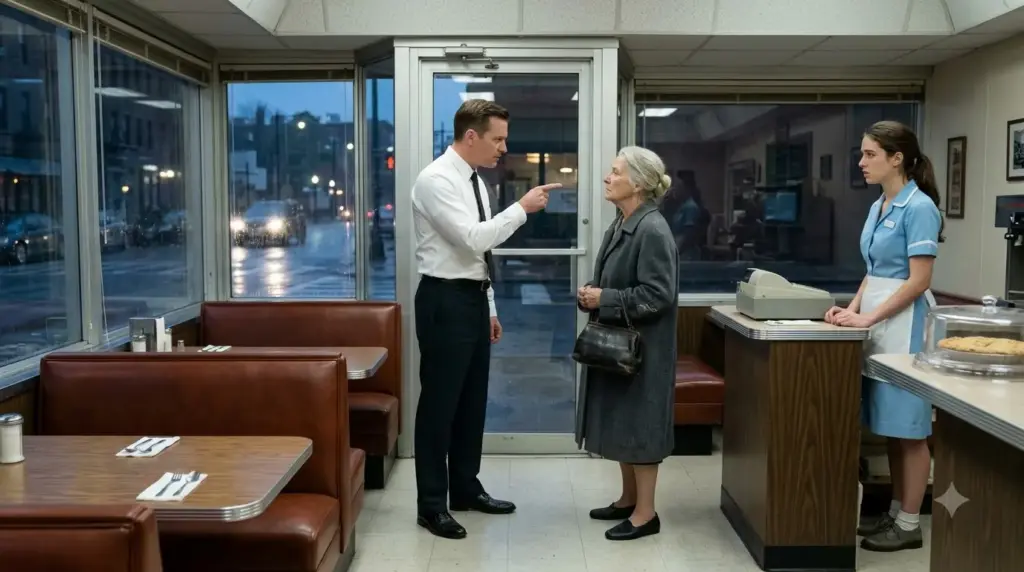
Margaret stood beneath the entry light in a charcoal wool coat with a repaired cuff, sensible black shoes, and a leather handbag whose corners had gone soft with age. Water had darkened the shoulders of her coat, and a few silver strands had escaped the bun at the back of her neck.
The greeter looked at her, then past her, as though expecting someone more suitable to appear. “Good evening,” he said. “Are you meeting a party?” Margaret shook her head and glanced toward the rows of booths. “No. I was hoping for a small table. Just dinner for one.” The greeter’s expression changed so subtly that most people would not have noticed, but Margaret did. She had spent most of her life noticing the small things people tried to hide.
A man in a fitted navy blazer approached before the greeter could answer. He was the flagship diner’s general manager, Adrian Pike, forty-two years old, precise in every movement and proud of a location corporate executives liked to call the face of the Bellamy brand.
He looked Margaret up and down once, then offered a smile that reached only one side of his mouth. “I’m afraid we’re at capacity for walk-ins tonight,” he said. Margaret looked toward three empty booths along the rear wall. “Those seem open.” Adrian did not turn to look. “Held for invited guests and later parties.”
Margaret nodded. “I see. I don’t need much. A bowl of soup would be enough, and perhaps some bread.” Adrian’s smile disappeared altogether. “Ma’am, tonight is a high-profile anniversary service. We’re trying to keep those booths available for guests connected to the company event.”
His voice was quiet enough to sound polite and loud enough for the greeter, two servers, and a couple waiting near the door to hear. “There’s another Bellamy’s location about ten minutes away that may be better suited for a simple meal.”
At the server station ten feet away, twenty-two-year-old Daniel Ruiz stopped stacking clean coffee mugs. He had heard the entire exchange. Daniel had been working at Bellamy’s Diner for eleven months while studying hospitality management at Northeastern, taking morning classes, grabbing whatever sleep he could in the afternoon, and working evening shifts until close. He needed the job badly.
That afternoon he had opened an email from the bursar informing him that a remaining tuition balance of $3,840 had to be paid within twenty-two days or he would lose registration for the next term.
Daniel had stared at that number until the screen blurred. His mother cleaned offices in Chelsea and had already offered to sell the gold bracelet Daniel’s late father gave her when he was born. Daniel refused. He had picked up extra shifts, skipped meals, and agreed to work Thanksgiving, Christmas Eve, and every holiday rush he could. Bellamy’s paid better than most diner jobs because the flagship stayed busy from breakfast through late night, but not well enough to erase $3,840 in three weeks. Losing the position could mean losing school.
Margaret turned toward the door. She did not argue, complain, or ask to speak with anyone else. That quietness bothered Daniel more than anger would have. He thought of his own mother, Teresa, who wore discount-store shoes because she spent money on everyone else first. He imagined her standing in a bright diner entrance like this one, being measured and dismissed before anyone asked her name. Before he could talk himself out of it, Daniel set down the mug rack and stepped forward.
“Ma’am,” he called. Margaret stopped. Adrian’s eyes snapped toward him. Daniel swallowed and pointed toward a small table near the kitchen corridor, half-hidden behind a marble column. “Table twelve is open until the late seating. I can serve you there.” Adrian’s expression hardened. “Daniel.” One word, sharp as the edge of a plate. Daniel pretended not to hear the warning inside it.
Margaret looked at the small table. “I don’t want to cause trouble.” Daniel smiled. “You’re not causing any.” Adrian moved closer. “That table is held for walk-in discretion.” Daniel knew what the phrase meant. Wealthy hotel guests. Influencers. Executives. Anyone management considered worth impressing. Daniel also knew table twelve had remained empty almost every night of the week.
“Then use my staff meal,” Daniel said. The sentence escaped before he had time to consider it. Adrian stared at him. Daniel took the meal voucher from his apron pocket and placed it on the counter beside the register. “Staff dinner is mushroom soup, grilled bread, and a side salad tonight. She can have mine.” Margaret shook her head immediately. “No. I can pay.” Daniel gave her a small, embarrassed smile. “I know. But I’ve already made this awkward enough. Please let me make it less awkward.”
Adrian leaned close to him. “You are crossing a line.” Daniel’s pulse began to hammer. “I’m serving a guest.” “You are giving away employee food during a packed service.” “Then deduct it from my check.” “That is not the point.” Daniel looked at Margaret, whose hands were resting lightly on the strap of her old handbag. “Maybe it should be.”





