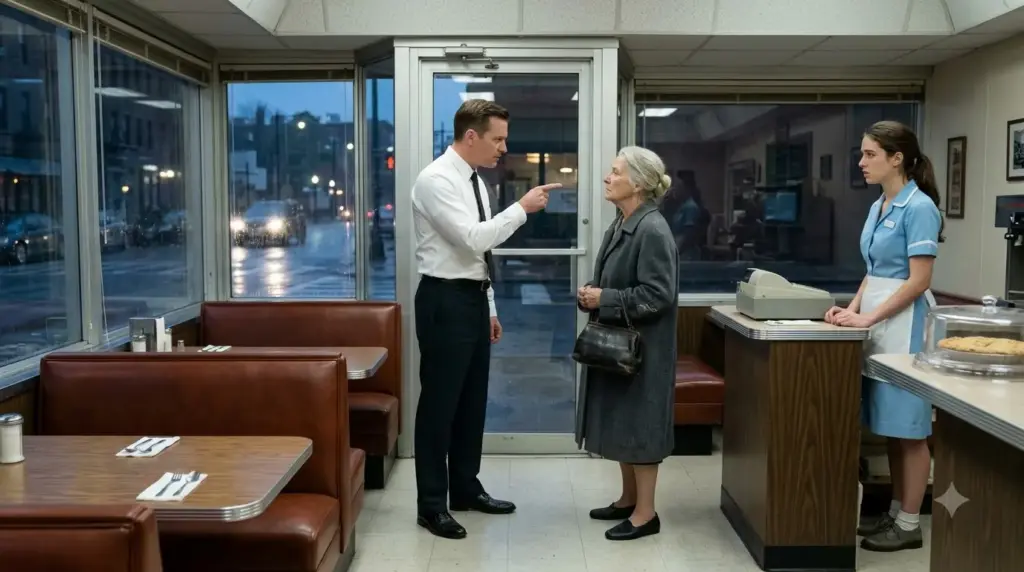
For a second, the entire entrance seemed frozen. Then Margaret stepped toward booth twelve, a small two-person booth near the kitchen pass-through. Daniel wiped the tabletop, poured water, and disappeared into the kitchen. He returned with a bowl of mushroom soup, two thick slices of grilled bread, and a small pat of butter. It was not the diner’s famous pot roast, stacked turkey club, or mile-high pie. Yet when he set it down, Margaret looked at the bowl as though it were something sacred.
“Thank you,” she said. Daniel nodded and started to turn away. “Young man.” He stopped. “What is your name?” “Daniel Ruiz.” “Are you always this reckless, Daniel Ruiz?” He laughed under his breath. “Only on Thursdays.” Margaret smiled for the first time.
She tasted the soup slowly. Her eyes closed for just a moment. Daniel thought she was savoring the warmth after standing in the rain. He did not know the recipe had been served in the same building forty-one years earlier, back when Bellamy’s had only twenty-eight seats, a hand-painted sign, and a counter salvaged from a closed roadside café. He did not know Margaret could identify the thyme, black pepper, and splash of cream before the spoon reached her lips. And he did not know that the first bowl of soup ever sold at Bellamy’s had been ladled by her own hands.
After a few bites, Margaret looked toward the black-and-white photographs lining the wall above the booths. Most guests barely noticed them. One showed the diner on opening night in 1985: mismatched stools, handwritten menus, flowers in jelly jars, and a thin young couple standing in front of the door with exhausted smiles. The man wore an apron crookedly tied at his waist. The woman beside him had dark hair, bright eyes, and a flour smudge across one cheek.
Daniel saw where Margaret was looking. “That’s the founders,” he said. “Thomas and Margaret Bellamy. I think.” Margaret’s mouth moved slightly. “You think?” Daniel grimaced. “We’re supposed to know the history, but most of training was about speed-of-service targets, upselling combos, and table turnover.” Margaret took another spoonful. “That sounds efficient.” Something in her tone made Daniel wonder if he had disappointed her without knowing why.
Across the floor, Adrian watched booth twelve with increasing irritation. Bellamy’s flagship was expecting several regional executives at eight and a television food host at eight-thirty for the chain’s anniversary week. Every detail mattered to him. Condiment caddies had to face the same direction. Coffee cups could not sit empty for more than two minutes. Servers were expected to greet within thirty seconds and keep ticket times below the company target. To him, the flagship’s reputation required control, and control required removing anything that seemed unpredictable.
Margaret, in her wet coat and repaired shoes, was unpredictable.
Adrian approached the booth after Daniel stepped away. “Ma’am, I hope everything is satisfactory.” Margaret looked up. “The soup is very good.” “Excellent.” He lowered his voice. “I do need to let you know that we may need this booth shortly. Perhaps when you’re finished, we can call a car to take you to another location.” Margaret folded her paper napkin beside the bowl. “Another location for whose comfort?” Adrian’s jaw tightened. “I simply mean this flagship has a particular image to maintain tonight.”
“And I do not fit it.”
“I did not say that.”
“You were careful not to.”
Adrian straightened. “We have standards.” Margaret looked around the room. “Standards are useful. They tell people what a place values.” Adrian nodded, relieved that she seemed to understand. “Exactly.” Margaret returned her eyes to him. “Sometimes they tell people more than intended.”
Daniel arrived with a small plate containing two slices of apple pie. “From the pie case,” he said, though the kitchen manager had given them to him because one crust had cracked while being plated. Adrian noticed immediately. “Daniel, a word.” They stepped toward the service corridor. “Clock out,” Adrian said. Daniel thought he had misheard. “What?” “Clock out and return your apron.”
Daniel felt the room tilt. “You’re firing me?”
“You knowingly ignored instruction, gave away employee property, and served a guest outside policy after I explicitly told you not to.”
“She was hungry.”
“This is not a shelter.”
Daniel stared at him. “No. It’s supposed to be hospitality.”
Adrian’s face went still. “And now you’re insubordinate. Hand over your apron.”
Daniel’s first instinct was to apologize. The tuition email flashed through his mind. $3,840. Twenty-two days. His mother’s bracelet. Registration canceled. He could hear the blood rushing in his ears. Then he looked past Adrian at Margaret sitting alone at table twelve, hands wrapped around the warm bowl as though it was the first kind thing she had been offered all evening.
Daniel untied his apron.
He folded it carefully because his father had taught him never to throw things in anger. Then he placed it on the service counter. “Can I finish clearing her table?” Adrian gave a disbelieving laugh. “You are no longer an employee.” Daniel nodded. “Then I’ll say goodbye.”
Margaret saw his empty waist before he spoke. “He fired you.” It was not a question. Daniel sat briefly in the booth across from her, though former employees were not allowed to sit in the guest area during service. “I’ll be okay.” “No, you will not.” “Maybe not tonight.” He forced a smile. “But I’ve had worse Thursdays.”
She studied him. “You need this job.”
Daniel looked toward the kitchen. “Most people who work here do.”
“Why did you risk it?”





