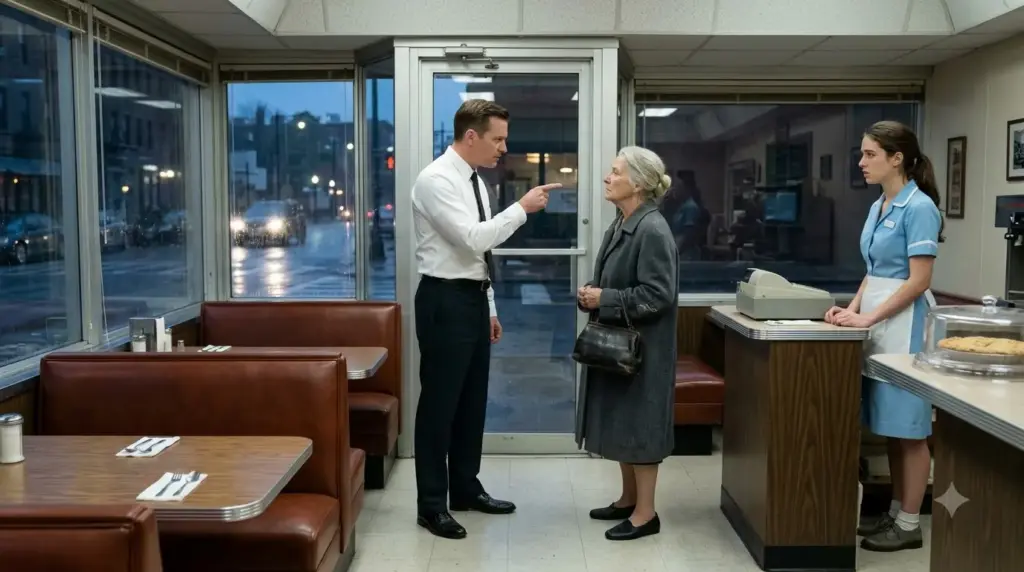
“Was there a dress code posted at the entrance that my clothing violated?”
“No.”
“Were all tables actually reserved?”
Adrian did not answer.
Margaret waited.
“No,” he said at last.
She turned back to Malcolm. “Then Daniel was not the employee who abandoned standards tonight.”
Adrian’s voice sharpened. “I have run this floor for six years. Revenue is up. Reviews are excellent. We have a reputation because I refuse to let standards slip.”
Margaret looked genuinely sad. “You think kindness is slippage.”
“That is not what I said.”
“It is what you practiced.”
Malcolm stepped in. “Adrian, I need you to surrender your keys and leave the floor. Human resources will meet with you tomorrow.”
Adrian stared at him. “You’re suspending me over one misunderstanding?”
Margaret shook her head. “No. We are investigating a decision you defended repeatedly after understanding its meaning.”
His face flushed. “And him?” He pointed toward Daniel. “You’re rewarding insubordination?”
Margaret looked at Daniel, then back at Adrian. “No. I am recognizing judgment.”
The manager removed the key ring from his belt and set it on the counter beside the register. For the first time that evening, his shoulders lost their rigid symmetry. He left through the same glass doors Margaret had nearly been pushed through less than an hour earlier.
The room remained quiet until Margaret sat down again. “Please,” she said to the guests around her. “Eat. Thomas hated cold food.” A ripple of uncertain laughter moved through the booths and counter seats, and conversations slowly resumed.
Daniel remained by the entrance. Malcolm approached him. “You can put your apron back on.” Daniel glanced at Margaret. “I appreciate it, sir, but I was fired.” “Not anymore.” “I mean… I don’t want special treatment because I happened to help the owner.”
Margaret heard him. “Good.”
Daniel looked over.
She gestured for him to return to table twelve. “Sit.”
He approached reluctantly. “I’m technically not supposed to.”
“Tonight has suffered enough from rules used without judgment.”
Daniel sat.
Margaret folded her hands. “You said you are in school.”
“Hospitality management.”
“Why?”
He hesitated. “My father ran a food truck. Tacos, tortas, coffee. Nothing fancy. When I was thirteen, he got sick and had to stop working. The customers kept coming to the house with food, money, whatever they could give. I learned that places like diners can be more than food.”
Margaret’s eyes softened. “Your father understood the business.”
“He died when I was sixteen.”
“I’m sorry.”
Daniel nodded. “My mom says he would be proud I work here.” Then he laughed bitterly. “Well, she said that before tonight.”
Margaret studied him. “What is happening with school?”
Daniel stiffened. “Nothing.”
“Your face changed when Mr. Pike fired you. Not because of the job itself. Because of something the job pays for.”
Daniel looked down. “Tuition.”
“How much?”
“That’s private.”
Margaret smiled slightly. “Good answer.”
Malcolm had remained nearby. “Daniel, the Bellamy Foundation has an education grant for employees.”
Daniel frowned. “I applied.”
“And?”
“Denied. Too few hours last spring because my mom had surgery and I cut shifts to help her.”
Margaret looked at Malcolm. “That policy sounds efficient too.”
Malcolm rubbed the bridge of his nose. “I’m beginning to dislike that word.”
Margaret reached for her spoon again. “Daniel, I am not going to hand you a management job because you gave me soup.”
He blinked. “I didn’t ask for one.”
“I know. That is why I am saying it.” Her voice grew gentler. “Kindness is not a qualification for leadership by itself. But judgment, courage, and humility are a start. Finish school. Learn the work properly. Let people correct you. Learn kitchens, labor costs, scheduling, complaints, procurement, payroll, safety, and the miserable art of seating wealthy people who all believe they deserve the same window table.”
Daniel smiled.
“If you still want this industry when you graduate,” Margaret continued, “apply to our management training program. You will not be guaranteed a position. You will earn it.”
Daniel nodded slowly. “That seems fair.”
“One more thing.”
“Yes?”
“Your tuition problem will be reviewed tomorrow under the foundation’s hardship provision. Not because you helped me, but because any employee caring for a sick parent should not lose eligibility through a rule designed to help employees.” She looked at Malcolm. “Fix that.”
Malcolm nodded. “Tomorrow.”
Daniel exhaled. For the first time all evening, he looked his age.
Margaret finished the chowder. Before leaving, she asked for the check.
The temporary supervisor tried to waive it. Margaret refused. “Thomas would haunt this building if he heard we stopped charging for dinner.” She paid for the soup, grilled bread, salad, and apple pie at full menu price, then added a tip large enough to make Daniel stare. “That is not for you,” she said. “Split it with the kitchen and dish crew.”
Outside, the rain had softened to mist. Margaret stood beneath the awning while Malcolm arranged a car. Daniel held the door. “Mrs. Bellamy?”
She looked back.
“Why did you really come alone?”
Margaret glanced through the glass toward the opening-night photograph. “Thomas died eleven years ago tonight. Every year since then, people bring me flowers, make speeches, invite me to memorial dinners, and ask me to tell the same stories about him.” She smiled faintly. “I did not want a memorial. I wanted to sit where we once sat after closing, eat what we ate when we were broke, and miss him privately.”
Daniel swallowed. “I’m sorry we made it harder.”
“You did not.” Margaret looked at him for a long second. “You reminded me why the place was worth building.”





