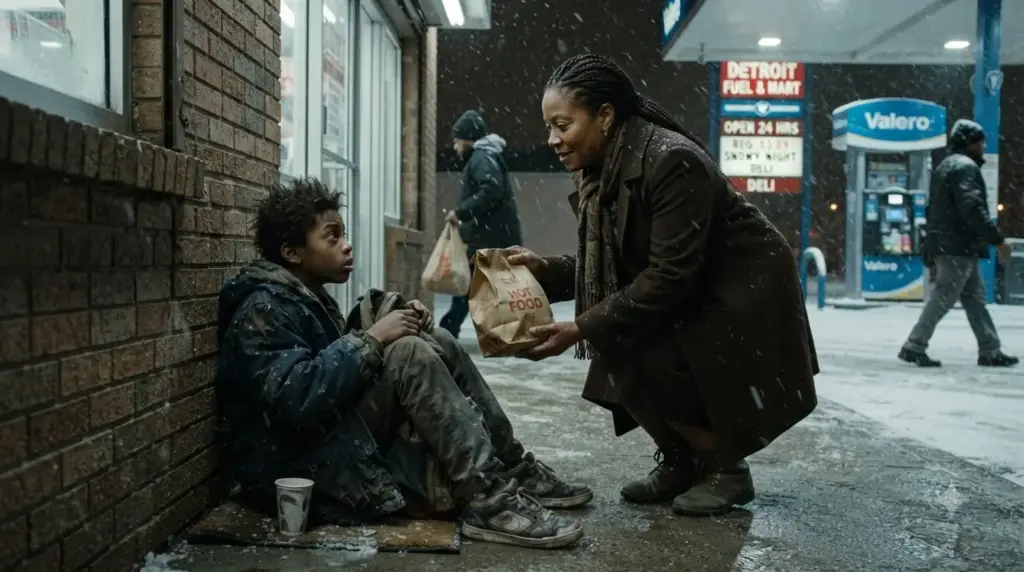
He was standing beneath the red neon OPEN sign with his arms crossed tightly over a coat that was too thin for February, shifting from one sneaker to the other because the cold had already soaked through the soles. Every few seconds, he looked past the glass at plates of meatloaf, fries, and steaming soup, then looked away before anyone could catch him staring. Most customers did not notice him at all. The few who did noticed only long enough to decide he was somebody else’s problem.
Evelyn was sixty-one then, a widow with sore knees, a grocery-store cashier’s paycheck, and exactly twenty-three dollars and eighty cents left in her purse until Friday. She had stopped at the diner after a late shift because the bus transfer was forty minutes away and she could no longer feel two of her fingers. She had planned to spend three dollars on coffee, warm herself, and go home. Then she saw the boy outside fold his body tighter against the wind.
When the waitress opened the door to dump a bucket of mop water, the boy stepped back quickly, as if he expected to be chased. Evelyn watched him move, and something about that reflex made her stand. She carried her coffee to the door and opened it before she could talk herself out of what she was doing. “Honey,” she called. “Are you waiting for somebody?”
The boy looked behind himself first. He was ten, maybe eleven, with dark brown skin, a narrow face, and eyes that tried very hard to look older than the rest of him. “No, ma’am.” “Have you eaten?”
His pride answered before his stomach could. “I’m okay.” Evelyn had raised a son. She knew the sound of a child lying because the truth felt expensive. “That isn’t what I asked.”
The boy swallowed. “Yesterday.” She opened the door wider. “Come inside.”
He shook his head immediately. “I don’t have money.” “Good thing I didn’t ask whether you had money.” He hesitated long enough for a gust of wind to drive snow through the doorway. Evelyn stepped aside and waited. Finally, the boy entered.
The manager behind the register gave him a look that made Evelyn turn before he could speak. “He’s with me,” she said. The manager shrugged and went back to counting receipts.
The boy sat across from Evelyn in a booth near the radiator. He kept both hands beneath the table, perhaps because they were shaking. Up close, she could see a small split at one corner of his lip and the gray exhaustion around his eyes. She pushed her untouched coffee toward him.
“What’s your name?” “Leon Brooks.” “I’m Evelyn. Where are your people, Leon?”
His gaze dropped. “My sister’s with me.” “Where?” He stared toward the window. “Church steps on Hanover. There’s a place under the back stairwell where the wind doesn’t get in much.”
Evelyn felt something inside her tighten. “How old is she?” “Seven.” “And when did she eat?”
Leon did not answer.
Evelyn picked up the menu. She did not ask whether he was telling the truth. Hunger had its own vocabulary, and she had heard enough of it during the years after her husband died. She ordered two bowls of beef stew, two grilled-cheese sandwiches, two hot chocolates, and two pieces of apple pie wrapped to go.
When the check came, the total was nineteen dollars and forty-two cents. Evelyn stared at it for a moment. Bus fare home would be two dollars. She still needed bread and eggs before Friday. Her electric bill was already ten days late.
She opened her purse anyway. Leon watched her count the bills. “You don’t have to do that.” “I know.”
“I can take one sandwich.” “There are two children.” “I can split it.” Evelyn looked at him over the top of her glasses. “And I can mind my own business. Apparently neither one of us is doing the sensible thing tonight.”
For the first time, his mouth almost formed a smile. He ate half a bowl of stew, then stopped. Evelyn noticed him place the grilled cheese into the paper bag untouched. “You don’t like it?”
“It’s for Keisha.” “Your sister?” He nodded. “She says she isn’t hungry when there’s only enough for one person.”
Evelyn looked away so he would not see her face. Then she stood, walked back to the counter, and used the last four dollars in her purse to add another sandwich and two cartons of milk. The cashier whispered, “Ma’am, are you sure?” “No,” Evelyn said. “Ring it up anyway.”
When she returned, Leon was holding his hot chocolate with both hands. “Why are you helping us?” Evelyn sat down slowly. “Because I saw you. That’s enough for tonight.”
He frowned as if the answer was incomplete. “People saw me outside.” “Looking at someone isn’t the same as seeing them.”
He thought about that. Then he reached into his coat and produced a small notebook with a bent cardboard cover. On the first page he wrote her name carefully: EVELYN CARTER. Beneath it he wrote ROSIE’S DINER, FEBRUARY 12.
“What are you doing?” “Remembering.” “You don’t owe me anything.” “I know.” His voice became serious. “But one day I’m coming back.”
Evelyn smiled gently. “For what?” “To say thank you when I’m not hungry anymore.”
She reached across the table and covered his small hand with hers. “Then don’t spend your life chasing me. Spend it becoming the kind of man who notices somebody else standing outside the window. If you ever find me again after that, we’ll call it a bonus.”
Leon looked at her as if he were memorizing the sentence too. “I promise.”





