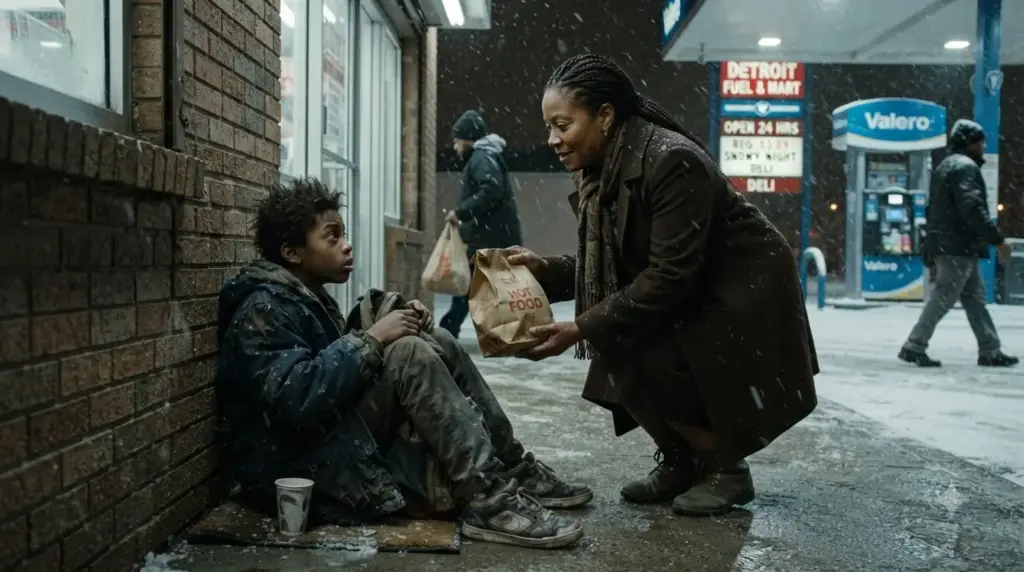
Evelyn packed the food into two bags, wrapped her own wool scarf around his neck, and walked with him as far as Hanover Street. Keisha was exactly where he had said she would be, curled beneath a concrete stairwell with her knees against her chest. Evelyn did not ask for a story the children were too tired to tell. She watched them eat, called a church emergency number from a pay phone inside the vestibule, and waited until a night volunteer arrived with keys to a warming room.
Before Evelyn left, Leon ran after her. Snow stuck to the scarf she had given him. “Mrs. Carter!”
She turned. “I’m going to keep it.” “Keep what?” “The promise.”
Evelyn waved one gloved hand. “Then stay alive long enough to make it inconvenient for me.” That was the last time Leon saw her for twenty years. The children entered emergency foster placement the next morning and, after three chaotic months, were reunited with an aunt in Toledo who agreed to take them both. Leon never forgot the diner, but life gave him little time for nostalgia. He delivered newspapers before school, washed dishes after it, tutored younger students for grocery money, and learned early that adults were more willing to help a child who arrived with a plan than one who arrived only with need.
At sixteen, he found work repairing returned computers for a small electronics recycler. At nineteen, he earned a community-college scholarship and discovered that the routing problems he solved for delivery trucks interested him more than the hardware itself. He transferred to a state university, graduated late because he worked nights, and spent five more years building software for regional warehouses that larger companies had ignored.
His first company failed because he trusted a partner who understood sales better than cash flow. His second nearly failed when a client disappeared owing six months of invoices. The third survived. By the time Leon was thirty, Brooks Route Systems coordinated deliveries for hospitals, food banks, pharmacy networks, and grocery distributors across nine states. He was not famous enough to be recognized in airports, but he had more money than the child at Rosie’s Diner could have imagined existed.
He had also kept the notebook. The original was water-stained, the cardboard cover separated at the spine, and several pages had gone soft with age. On the first page, beneath Evelyn Carter’s name, he had added one sentence at fourteen: FIND HER WHEN YOU CAN. Every few years, he tried.
Rosie’s Diner had closed before he finished high school. The property became a tire shop, then a vacant lot. Old employee records were gone. City directories listed several Evelyn Carters, none with enough information to prove which was his. The church volunteer who had taken Leon and Keisha inside remembered an older woman helping them, but not her last name. Leon found dead ends, remarriages, bad addresses, and one Evelyn Carter who politely told him from Florida that she had never been north of Tennessee.
Then, on the twentieth anniversary of the snowstorm, Leon decided casual searching was another form of postponement. He hired a licensed investigator named Nina Salazar, a former fraud analyst who disliked dramatic promises and charged by the hour. He gave her the notebook, a rough description, the old diner address, and everything he remembered. Keisha, now a pediatric nurse, added the detail that Evelyn had worn a gold wedding band on a chain around her neck even though she had called herself a widow.
Nina found her within six weeks. Or rather, she found the first proof that Evelyn Carter had intentionally disappeared.
Evelyn had worked at a supermarket in Detroit until the autumn after she met Leon. Then she quit without notice. Her small bungalow on Marlow Street was sold under financial distress eleven months later. Utility records ended. A forwarding address led to a post-office box in Indiana, then to another in Kentucky, then nowhere.
“People move,” Leon said when Nina showed him the file. “They do,” she replied. “But most people don’t repeatedly change addresses while leaving no utilities in their own name.” “You think she was hiding.”
“I think somebody made her believe being found was dangerous.”
The first clue came from an old civil docket. Evelyn had been sued twenty years earlier on three promissory notes totaling more than one hundred eighty thousand dollars. The borrower named on the original accounts was her son, Darren Carter, who owned a struggling auto-detailing and used-car business. Two later notes showed Evelyn as guarantor.
One signature looked nothing like the signature on her home deed. A third document listed her bungalow as collateral even though county records showed no notarized mortgage from Evelyn. The lender was not a bank. It was a private finance company that specialized in high-interest bridge loans to small businesses with poor credit.
Nina kept digging.
Darren had developed a sports-betting problem, then borrowed against his business, then borrowed again to pay the first lenders. When legitimate credit ended, he moved into private debt arrangements with men who used businesses for paperwork and intimidation for collections. He convinced Evelyn to co-sign one twenty-five-thousand-dollar equipment note, telling her it would save the shop. After that, documents began appearing with her name whether she had signed them or not.
When Darren stopped paying, collection notices went to Evelyn. When Darren vanished, men started coming to her house.
A neighbor remembered two men sitting in a sedan outside for hours. Another remembered red paint thrown across Evelyn’s front door. Police reports from the period showed complaints about threatening calls, trespassing, and a broken kitchen window. None identified a suspect. One officer wrote that the dispute appeared “primarily civil.”
Then came the sale of the house.





