“We will if you want us to.” “Leave now.” Nina looked at Leon. He nodded. They returned to the SUV, but instead of driving away immediately, Leon stood beside the passenger door and tried one last thing.
“My name is Leon Brooks,” he called. Nothing moved behind the curtain. “Twenty years ago, during a snowstorm, you met a boy outside Rosie’s Diner in Detroit.” The curtain went still.
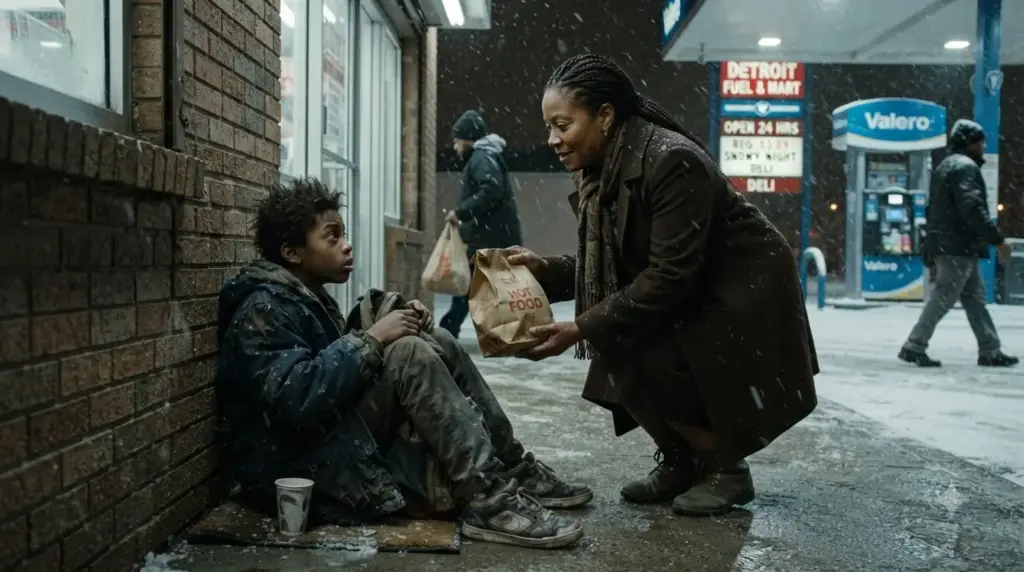
Leon continued. “He told you his little sister was waiting under the stairs of a church on Hanover Street. You bought him beef stew and grilled cheese. Then you went back and bought more because he was trying to save his sandwich for her.”
No sound came from the house. “You wrapped your scarf around his neck,” Leon said. “And when he told you he’d come back rich enough to thank you, you told him not to come back rich. You told him to come back as a man who notices somebody else standing outside the window.”
The lock clicked. The door opened three inches. Evelyn looked out through the gap. She studied Leon’s face for a long time without speaking. He was six feet tall now, clean-shaven, wearing a charcoal coat and shoes that cost more than everything he had owned at ten. There was no reason she should recognize him.
“Leon?” she whispered. His throat closed. “Yes, ma’am.”
The door opened wider. Evelyn stepped onto the porch but kept one hand on the frame, as though the house were holding her upright. “The boy with the notebook?” Leon reached into his coat and took out the small, weathered book.
Her mouth opened. He held it toward her without moving closer. On the first page, beneath the bent plastic sleeve, her name remained exactly where he had written it twenty years before. Evelyn covered her mouth.
“Oh,” she said. Then again, smaller, “Oh, Lord.” Leon expected her to cry. Instead she looked at the SUV, at Nina, at Priya, and fear returned to her face.
Evelyn stepped backward. “You need to go.” “Mrs. Carter—” “Don’t call me that.”
The sentence came out with such force that Leon stopped.
“They find names,” she said. “They find addresses. They say debts don’t disappear. They say family pays. I changed everything and they still found me twice. I can’t do this again.”
Priya spoke carefully from the path. “Evelyn, we found records of the old judgments. Some of them appear to be based on forged documents. One was entered after service went to an address where you did not live. We are not here to collect anything. We came because we may be able to help you challenge what remains.”
Evelyn stared at her. “Why?” Leon answered before Priya could. “Because you helped me when you had less than I have ever had since.”
“That was dinner.” “It was more than dinner to me.”
Evelyn’s eyes hardened. “That’s what Darren used to say. Every time he wanted something. ‘Mama, it’s just this once. Mama, I swear I’m fixing it. Mama, I only need your name because mine isn’t enough.'” She laughed once, bitterly. “People always have good reasons when they need to borrow your life.”
Leon took that in without defending himself.
“Then don’t give me anything,” he said. “Not your trust. Not a signature. Not permission to fix anything. Just let us sit on the porch for ten minutes and explain what we know. After that, if you tell us to leave, we leave.”
Evelyn looked at the notebook in his hand. Finally, she unlocked the screen door.
“Ten minutes,” she said.
The cottage was smaller inside than it looked from the road. Two chairs faced a window that overlooked the orchard. A kettle sat on the stove. Beside the back door, Leon noticed a canvas bag packed with bottled water, medicine, socks, and copies of identification documents. It was not an emergency kit for storms. It was a bag prepared by someone who had taught herself to leave quickly.
Evelyn saw him looking at it. “Habit,” she said. Nobody asked what kind.





