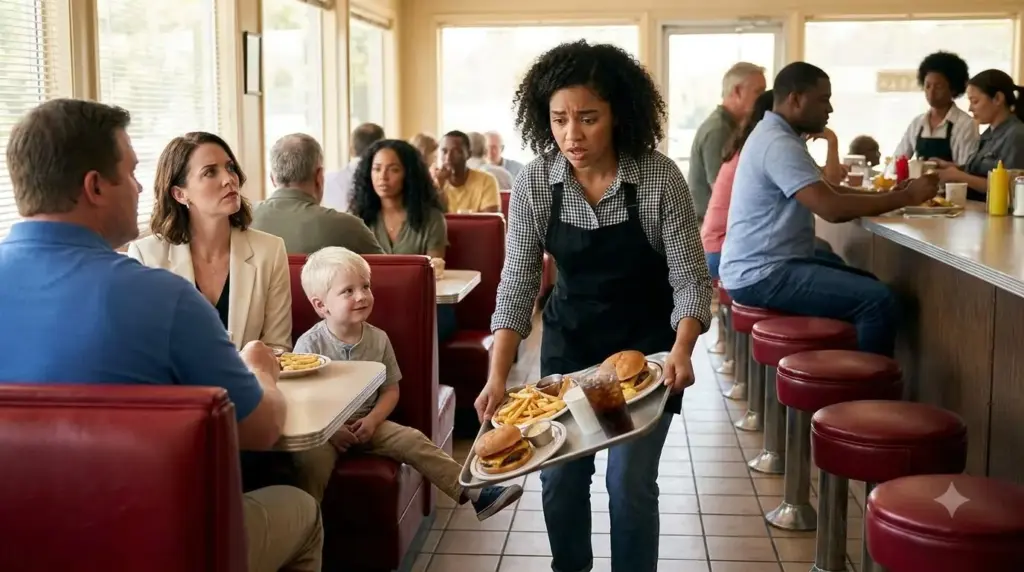
The silverware scattered across the polished floor. A glass of ice water shattered beside her shoe. Lemon wedges rolled under a chair, and the plate of rosemary chicken slid face down near the leg of a table occupied by a family of three who had already made the entire lunch shift feel like a punishment.
Lena froze with one hand still in the air, her dark curls slipping loose from the clip at the back of her head. Water ran down her apron. A smear of sauce streaked her sleeve. Behind her, at table twelve, a little boy with pale blond hair and a face too pleased with himself pulled his foot back under the table.
His mother gasped as if she had witnessed a crime.
“Are you serious?” Jessica Whitford snapped, pushing her chair back. She was a white woman in her late thirties, elegant in the stiff way people became when money had never taught them mercy. Her cream blazer had gold buttons. Her diamond bracelet flashed each time she waved her hand. “Did you just throw food at our table?”
Lena opened her mouth, but the words caught. She was twenty-three, working her first week as a server in a restaurant that smelled of money, polished wood, and herbs she still could not always pronounce correctly. She had been hired only because the head chef, James Nance, had taken one look at her application, noticed the three years she had spent caring for her grandmother, and decided kindness mattered more than experience.
The manager had disagreed.
Emily Price stood near the host station now, already frowning as she marched across the dining room. Her heels clicked sharply against the floor, each step a warning.
“What happened?” Emily asked, though her eyes had already settled on Lena with accusation.
Jessica pressed a hand to her chest. “Your waitress dropped her tray and nearly hit my son. Now she looks like she’s about to blame him for it.”
“That is not what happened,” Lena said softly. “He tripped me.”
The boy’s father laughed once, cold and loud. Dan Whitford was tall, broad-shouldered, and pink-faced from the wine he had ordered before noon. He wore a blue dress shirt open at the collar and the impatient expression of a man used to people moving faster when he raised his voice.
“Our Tommy tripped you?” he said. “He’s seven years old. Listen to yourself.”
Tommy widened his eyes in the practiced innocence of a child who had learned that adults could be arranged like furniture if he cried at the right moment.
“I didn’t do anything,” he said.
Jessica leaned forward, triumphant. “See? He didn’t do it. Maybe instead of accusing a child, you could learn to carry a tray.”
A few diners looked away. One elderly woman lowered her eyes to her soup. A man near the windows lifted his phone, thought better of it, and set it down again. No one spoke for Lena.
Emily’s mouth tightened. “Lena, clean this up. Apologize to the Whitfords. Then bring them new drinks and desserts on the house.”
Lena stared at her. “But I—”
“No,” Emily said under her breath, stepping closer. “No excuses. Do it.”
The humiliation burned up Lena’s throat. It was not only the spill. It was the way Jessica looked at her, the way Dan smirked, the way Tommy kicked his little feet under the table like he was waiting for the next game to begin. It was the old familiar feeling of being expected to swallow unfairness because swallowing it was cheaper than defending herself.
“I’m sorry,” Lena said.
Jessica tilted her head. “That was barely an apology.”
Lena bent down and began gathering broken glass with a towel.
She had been awake since five that morning. Before the shift, she had taken two buses from Eastlake, dropped her younger brother Malik at school, called the electric company to beg for three more days, and checked the mailbox with the kind of dread people developed when every envelope might contain bad news. Her grandmother’s medical bills sat stacked on the kitchen table at home. Rent was nine days late. The job at Hampton House was not a dream. It was a rope.
So she cleaned the floor.
She apologized again.
And when Tommy laughed quietly as she wiped water from beneath his chair, she pretended not to hear it.
Hampton House sat in the oldest part of Maple Ridge, Virginia, inside a restored brick building that had once been a train depot. The restaurant was known for white tablecloths, local trout, and people who liked to say they supported small businesses while treating the staff as if they were part of the furniture. Bruce Hampton owned forty percent of it. His name opened doors in that town, and his money kept them open.
James Nance owned the rest.
James was thirty-one, tall, calm, and built like someone who had carried restaurant equipment before he ever learned to arrange it beautifully on a plate. He was Lena’s older brother, though most people did not know that yet. They had different fathers, different last names on paper, and the same mother who had worked double shifts until her heart gave out when Lena was seventeen. James had fought his way through culinary school and kitchens that wanted his talent but not his authority. When he finally opened Hampton House with Bruce’s investment, he promised himself that if Lena ever needed work, she would have a place.
He was in the kitchen when the first tray fell. He heard the crash, but lunch service was at its sharpest point, and a sauce had split on the line. By the time he looked through the pass, Emily was already handling it.
That was the first mistake.
The second came twenty minutes later.





