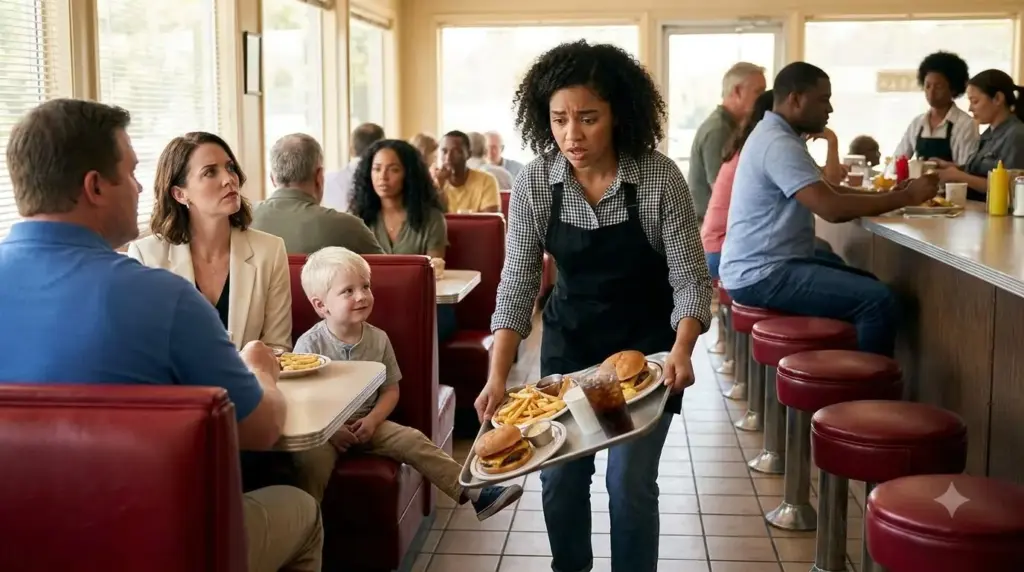
The dining room went still when she walked through the door. She looked different. The gold buttons were gone. So was the diamond bracelet. Her hair was shorter, her face thinner. Tommy, now nine, stood beside her in a school uniform, staring at the floor.
James saw them from the kitchen and moved toward the front, but Lena raised a hand.
“It’s okay,” she said.
Jessica approached the host stand. Her voice trembled. “Could I speak to you for a minute?”
Lena could have said no.
A part of her wanted to.
Instead, she led them to a quiet corner near the windows.
Jessica clasped her hands tightly. “I know I don’t deserve your time. I came because Tommy asked me to bring him.”
Tommy looked up then. His face was pale with embarrassment, but his eyes were wet and sincere.
“I’m sorry,” he said. “For tripping you. For the water. For lying.”
Lena studied him.
Children learned cruelty somewhere. But they also had to learn what came after it.
“Why are you apologizing now?” she asked.
Tommy swallowed. “Because people at school found the video again. They made fun of me. And I got mad because it felt unfair. Then my teacher asked me if I thought it felt unfair to you first.”
Jessica closed her eyes briefly.
Lena looked at the boy for a long time. “It did.”
“I know,” Tommy whispered.
“Do you understand that saying sorry doesn’t erase what happened?”
He nodded.
“Good,” Lena said. “Then maybe it can still mean something.”
Jessica began to cry quietly. “I was awful to you. I was awful before that day too, probably in ways I didn’t even notice because no one ever stopped me. I am sorry.”
Lena did not rush to forgive her. Forgiveness was not a napkin someone could demand because they had made a mess.
But she accepted the apology.
That was enough for one afternoon.
Years passed. Hampton House became known for more than trout and white tablecloths. People came because the food was good, but they talked about the hiring program, the second chances, the way every employee seemed to stand a little taller than restaurant workers usually did. James won awards. Bruce aged into the role of gruff benefactor. Marcus saved enough to buy a small house. Jackson eventually opened a breakfast counter two blocks over and hired teenagers who reminded him of every version of himself he wished someone had corrected sooner.
Lena became general manager before she turned thirty.
On the wall near the staff entrance, she hung a simple framed note.
Treat people well on your way up. You never know who you may need on your way down.
Some employees thought it was a motivational quote. Others knew pieces of the story. A few knew the whole thing.
One rainy evening, after closing, Lena sat alone in the dining room while James balanced invoices at the bar. The room was quiet, chairs turned up, lights low. She could still remember exactly where the tray had fallen. She could still feel ice water running down her neck. She could still hear Jessica’s voice demanding that she apologize for being humiliated.
James came over and set a cup of tea in front of her.
“You thinking about that day?” he asked.
Lena smiled faintly. “Sometimes.”
“You okay?”
She looked around the restaurant. At the polished tables. At the kitchen where Marcus was teaching a new hire how to close properly. At Jackson’s breakfast counter glowing through the rainy window down the street. At the little framed note by the staff door.
“Yeah,” she said. “I think I am.”
James sat across from her.
“You know, I still regret not stepping out sooner.”
“You stepped out when it mattered.”
“Should’ve mattered earlier.”
Lena wrapped both hands around the tea. “That’s the lesson, I guess. Don’t wait until the powerful person walks in to do the right thing.”
James nodded slowly.
Outside, rain washed the sidewalk clean. A couple hurried past under one umbrella. A bus sighed at the corner. The city moved on, as cities always did, carrying thousands of private humiliations and quiet rescues no camera would ever catch.
Lena thought of the younger version of herself kneeling in broken glass, certain that keeping a job meant keeping quiet. She wished she could go back and lift that girl’s chin. She wished she could tell her that one day, the same room that watched her suffer would watch her lead.
But maybe that was what life did when it was merciful.
It did not erase the worst day.
It built something around it.
The next morning, Hampton House opened at eleven. Marcus unlocked the front doors. Jackson dropped off fresh biscuits from his breakfast counter just because he had made too many. James shouted from the kitchen that somebody had better not touch his prep list. Bruce arrived in a gray overcoat, pretending he only came for coffee when everyone knew he liked being part of the noise.
At noon, a new server named Alana dropped a spoon near table six and froze as if the world might end.
Lena walked over, picked it up, and smiled.
“Accidents happen,” she said. “Get another one. You’re doing fine.”
The girl breathed again.
And just like that, the story kept changing.





