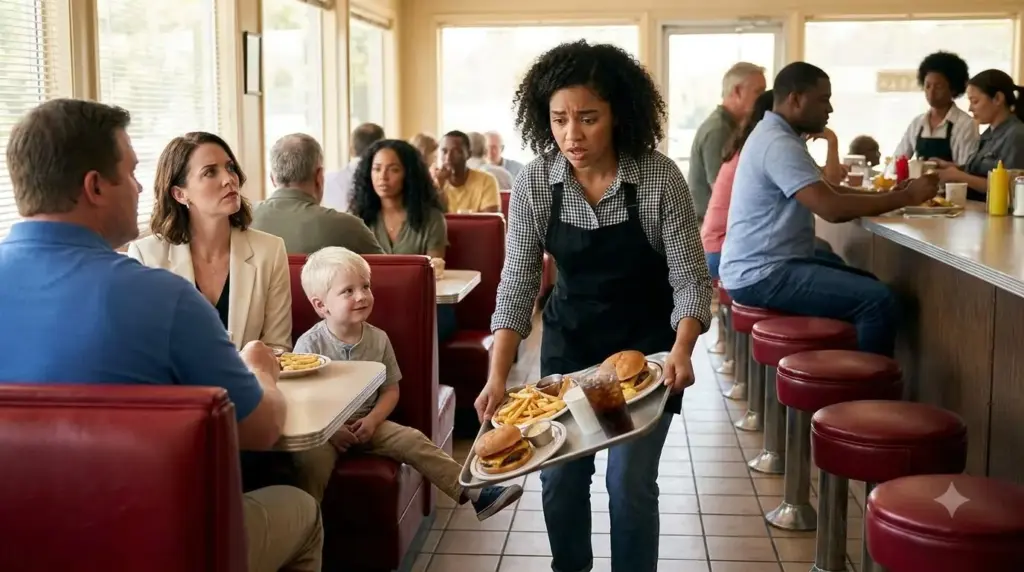
He told her in pieces while they stacked chairs after closing or waited for the last bus in the rain.
“I used to treat people bad,” he admitted one night, staring at his hands. “Servers. Cashiers. Janitors. Anybody I thought was beneath me. Guess life has a way of teaching you what beneath feels like.”
Lena leaned against the brick wall behind the restaurant. “Did you learn?”
Marcus gave a humorless laugh. “I hope so.”
There was a man Marcus had gone to college with named Jackson Cole. Jackson worked at a fast-food place across town now. Years earlier, when Marcus was still a rising star, he had walked into that same place wearing designer sneakers and a watch he could not afford, laughed at Jackson behind the counter, and told him he had ended up exactly where losers belonged.
“He told me something,” Marcus said. “Treat people well on your way up. You never know who you’ll need on your way down.”
Lena recognized the shape of the lesson.
“Did you listen?”
“No,” Marcus said. “Not then.”
Three months after the Hampton House video, Marcus saw Jackson again.
It happened outside a bus station downtown, on a wet Thursday evening when the sky had turned the color of dirty steel. Marcus had finished a long shift and was walking toward the stop with a paper bag of leftover rolls in one hand. He saw a cluster of men laughing near the corner, their phones out, their bodies angled toward someone sitting on the ground.
Then he heard a voice he knew.
“Look at you now,” one man jeered. “Used to be Mr. Big Shot. Now you can’t even buy a sandwich.”
Jackson Cole sat against the wall with a backpack beside him and an old hoodie pulled over his head. His face was thinner than Marcus remembered. His shoes were split at the sides. He kept looking down, letting the words hit him because he had nowhere else to go.
Marcus stopped walking.
The old shame moved through him first. He remembered Jackson behind the counter years ago, quiet under Marcus’s insults. He remembered throwing a hundred-dollar bill down like a trophy, laughing when Jackson had to count change.
One of the men nudged Jackson’s shoe. “How does it feel, man? From college ball to this?”
Marcus stepped forward.
“Leave him alone.”
The men turned. One recognized Marcus and smirked.
“Ain’t you Marcus Reed? Man, weren’t you locked up?”
“I said leave him alone.”
Something in his voice made them pause. Not violence. Not threat. Just a line drawn clearly enough that even foolish men could see it.
They cursed, laughed to save face, and moved on.
Jackson looked up.
For a long moment, neither of them spoke.
Then Jackson said, “Well, that’s funny.”
Marcus nodded. “Yeah.”
“You come to finish the joke?”
“No,” Marcus said. “I came to apologize.”
Rain ticked against the bus shelter roof.
Jackson’s expression did not soften. “For what?”
“For the fast-food place. For college. For every time I thought being good at a game made me better than people. I was wrong.”
Jackson looked away. “Took you long enough.”
“Prison gives you time.”
That made Jackson look back.
Marcus held out the paper bag. “You hungry?”
Jackson stared at it. Pride wrestled with need on his face.
“Yeah,” he said finally.
They sat together under the bus shelter and split the rolls while traffic hissed over the wet street. Jackson told his story slowly. He had been a bench player in college, then a restaurant worker, then a manager, then a man who made one bad investment after another trying to prove he was more than people thought. His apartment was gone. His car was gone. He had slept three nights behind the bus station because the shelter was full.
“I used to think life was waiting to give me my big moment,” Jackson said. “Turns out life was waiting to see what I’d do with the small ones.”
Marcus thought of Lena.
He brought Jackson to Hampton House the next morning.
Lena was arranging silverware when Marcus walked in with him. She took one look at Jackson’s wet hoodie, the stiffness in his shoulders, the way shame made him stand near the door instead of stepping fully inside, and understood enough.
“You looking for work?” she asked.
Jackson blinked. “I can wash dishes. Sweep. Anything.”
James came out of the kitchen, listened for three minutes, and hired him for nights.
“Your record?” Jackson asked Marcus quietly later, as if still trying to understand. “They don’t care?”
Marcus shook his head. “They care who you are now. That’s different.”
Jackson stared through the kitchen window at Lena, who was laughing with one of the cooks while carrying a tray balanced perfectly on one hand.
“She the one from that video?”
“Yeah.”
“She still serves tables after all that?”
Marcus smiled faintly. “She says nobody gets to shame her out of honest work.”
Over the next year, Hampton House changed in ways that were not obvious to people who only came for dinner. The staff break room got rebuilt. Employees received paid sick days. James created a training program for people who had records, gaps, or stories that made other employers nervous. Bruce funded it. Lena ran it.
She did not become famous. Not in the way the internet had briefly tried to make her. Fame had arrived too loudly and left too quickly. What stayed was quieter and more useful.
A teenager who had aged out of foster care got hired as a host. A mother returning from rehab learned prep work. Marcus became shift lead. Jackson washed dishes, then learned inventory, then became the person new hires went to when they were too embarrassed to ask questions.
Lena watched them all with a tenderness sharpened by memory.
She also watched Tommy Whitford grow up in the distance.
Two years after the incident, Jessica brought him into Hampton House again.





