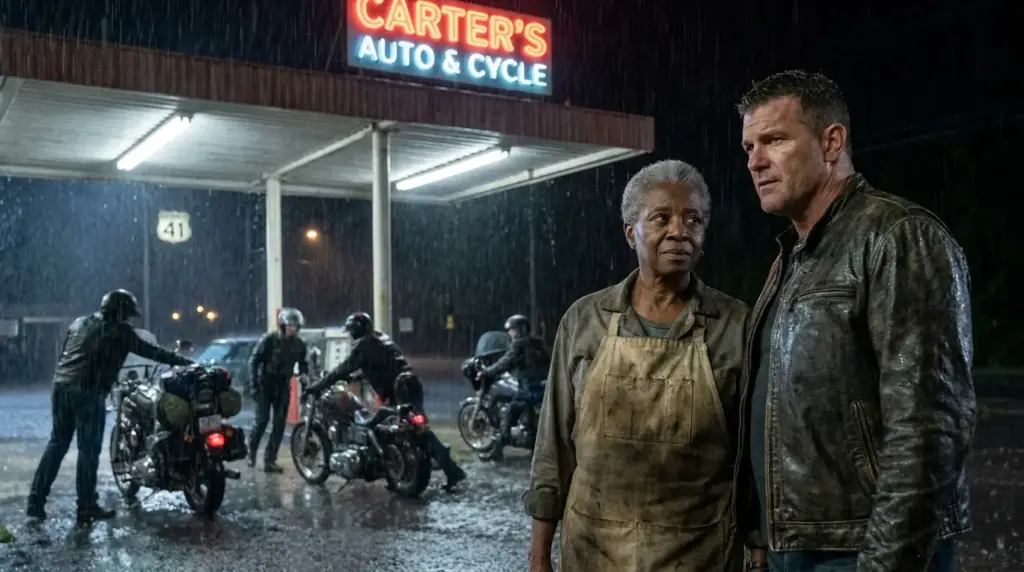
The town of Maplewood Crossing sat along a stretch of Highway 41 like a forgotten footnote. A two-block main street, a diner that hadn’t changed its menu since the 1980s, and a gas station whose neon sign flickered on and off depending on whether the wind was blowing from the east or the west. Most drivers passed through without stopping, eyes fixed on the road ahead. The town visible only as a blur of clapboard buildings and chain-link fences in their peripheral vision.
Those who did stop usually needed gas, maybe a cup of bitter coffee and a bathroom, and then they were gone again, swallowed by the highway as if Maplewood Crossing had never existed at all. For most of its residents, this invisibility was simply the rhythm of life, something you either accepted or something that slowly wore you down until accepting and surrendering felt like the same thing. Ruth Carter’s garage sat at the edge of town, exactly where the asphalt cracked and crumbled into the gravel shoulder of the highway. The building was old, not charmingly old, not vintage or quaint, but genuinely, stubbornly old in the way that only structures built by hand and maintained by will ever managed to be. The white paint on the exterior had long since gone gray, then yellow at the edges where the sun hit hardest.
The sign above the roll-up door read Carter’s Auto and Cycle. The letters hand stenciled in black paint that had been touched up so many times that the newest layers sat on top of the older ones in slight misalignment, giving the whole sign the slightly blurred appearance of a sentence spoken through a mouthful of exhaustion. A single floodlight mounted above the sign threw a cone of yellow light into the parking lot each evening, attracting moths and the occasional confused bat, illuminating the two gas pumps Ruth had kept running through three decades of mechanical coaxing and stubborn refusal to replace them. Inside, the garage smelled of motor oil and iron and something faintly sweet that no one who visited could ever quite identify later. Some would guess it was the coffee Ruth kept simmering on a hot plate in the corner, a battered aluminum percolator that had brewed its first pot sometime in the late 1990s and had never once been replaced.
The walls were hung with tools arranged with a specificity that bordered on obsessive wrenches graded by size from left to right, sockets nested in their labeled holders, specialty tools whose names most mechanics only half remembered hung with the same care as other people reserved for framed photographs. And photographs there were as well, tucked between the tool racks and mounted above the workbench in mismatched frames. Some in black and white, some in the washed-out color of old Kodachrome, some in the sharper tones of more recent decades. Ruth never spoke about most of them. She simply worked beneath their silent gaze each day.
Her movements as practiced and unhurried as water finding its level. The people of Maplewood Crossing had, over the years, developed a particular relationship with Ruth Carter that they would have struggled to articulate honestly. They brought her their trucks when the dealership was booked out. They asked her to look at their tractors when the harvest seasons brought mechanical failures at the worst possible times. They paid her in cash, sometimes in casseroles or cuts of venison, and they were genuinely grateful in the specific way that people are grateful to someone they don’t quite believe exists.
Because what Ruth was, what she had always been, sat slightly outside the frame of what they expected the world to look like. A 68-year-old black woman running a garage on the edge of a mostly white small town diagnosing engine faults by sound alone, rebuilding transmissions that certified shops had declared irreparable, doing it all in a pair of worn work boots and a canvas apron that had absorbed so much oil over the years it’d become its own kind of armor. The town admired her the way people admire something that confuses them at a distance, with a mixture of respect and a faint unexamined wariness. New residents sometimes wandered in with a skepticism they didn’t bother to fully conceal. A few years back, a man named Patterson had moved up from the city, bought the old hardware store and converted it into a real estate office.
He’d brought his Cadillac to Ruth once, grudgingly, when the dealership was backed up 6 weeks. He’d stood in the doorway of the garage with his arms crossed and watched her work with the expression of a man waiting to be proven right about something. When she’d handed him his keys 40 minutes later and explained the valve timing issue in language that was technically precise and completely accessible at the same time, he’d paid without a word and driven away faster than was strictly polite. He’d never come back, which Ruth understood was its own form of tribute, the kind paid by men who find their certainty gently dismantled and don’t know how to sit with the feeling. She had been doing this for over 30 years on this particular stretch of highway, but her hands had known engines since long before that.





