Amara stared at her mother’s smile, the way the sunlight had caught her face that day in the park, back when everything still felt possible. It had been exactly 1 year. She reached out and touched the frame, her fingertips tracing the outline of her mother’s face. 1 year since the funeral. 1 year since she’d held that frail hand in the hospital room and felt it go still.
1 year since the world had gone silent. Amara pulled her hand back and wrapped her arms around herself. The apartment was cold. She turned the heat down to save money, wearing two sweaters instead. The bills were still piled on the kitchen counter, some of them overdue.
Medical debt didn’t care that you were grieving. She closed her eyes and let herself remember. 2 years ago, she’d been standing in a cap and gown, diploma in hand, her mother beaming in the front row, business administration degree from State University. Honors. Job offers starting to come in.
The future had stretched out before her like an open highway, bright and full of promise. Then came the diagnosis. Stage four. Aggressive. 6 months, maybe less.
Amara had withdrawn her job applications one by one. She’d moved back home. She’d learned to change IV bags, to measure medication, to smile when her mother asked if she was okay. She’d work double shifts at the diner, then triple shifts when the treatment bills came. She’d watched her mother shrink day by day until there was almost nothing left, and then there was nothing left.
“I’m sorry, baby. ” Her mother had whispered near the end. “You were supposed to have everything. ” Amara opened her eyes. The photograph stared back at her, unchanging. She stood up slowly, smoothing down her black slacks and white shirt, her waitress uniform for the Meridian, the upscale restaurant downtown, where she’d been working for the past 3 months. It wasn’t what she’d imagined for herself, but it paid better than the diner, and she was good at it.
Attentive, patient, kind. The bus ride took 40 minutes. She watched the city change through the window, the buildings growing taller, the cars getting newer, the people walking faster. By the time she reached the Meridian’s block, everything gleamed. Even the sidewalks looked expensive.
She entered through the staff entrance and clocked in. The kitchen was already alive with noise, chefs shouting orders, pans clattering. She tied her apron and checked her reflection in the small mirror by the door. Professional. Presentable.
Invisible. “Amara, you’ve got section three tonight. ” Marcus, the floor manager, said without looking up from his tablet. “VIP reservations. Don’t mess it up. ” “I won’t. ” She walked into the dining room. Crystal chandeliers hung from the ceiling, casting warm golden light across white tablecloths and silver cutlery.
Piano music drifted from the corner, where a woman in an evening gown played something soft and classical. The air smelled like expensive wine and fresh flowers. Amara moved between tables, taking orders, pouring water, smiling. The guests barely looked at her. She was part of the furniture, there to serve and disappear.
Then she saw him. He sat alone at table 12, a man in his 70s with thin white hair and trembling hands. He wore a suit that might have been elegant once, but now hung loose on his frame. His eyes were focused on the menu, but his hands shook so badly he could barely hold it. Amara approached.
“Good evening, sir. Can I start you with something to drink? ” He looked up, and she saw the embarrassment in his eyes. “Water would be fine. ” His voice was soft, almost apologetic. She poured his water and waited while he studied the menu. His hands continued to shake.
After a moment, he set the menu down. “I’ll have the chicken the roasted chicken. ” “Excellent choice. That comes with seasonal vegetables and yes, that’s fine. Thank you. ” She took the menu and walked back to the kitchen. Something about him stayed with her.
The loneliness in his eyes. The way he tried to steady his hands and failed. When she brought out his food, she placed it carefully in front of him. He looked at the plate, then at his hands, and she saw his shoulders sag slightly. He picked up the fork.
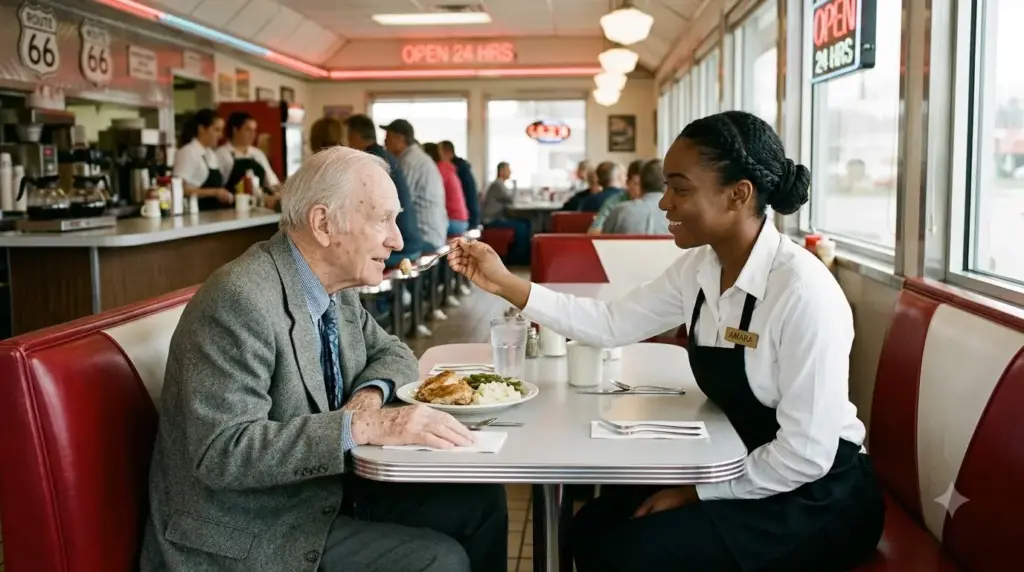
It trembled in his grip. He tried to spear a piece of chicken, but the fork wavered and slipped. He tried again. The fork clinked against the plate. Amara glanced around.
At the next table, a woman in diamonds whispered to her companion. They were both staring at the old man. At another table, a businessman frowned and looked away. The old man tried once more. His hand shook harder now, whether from the effort or the shame, Amara couldn’t tell.
The piece of chicken fell from his fork. He set the utensil down and stared at his plate. Amara’s chest tightened. She thought of her mother in those final weeks, how her hands had trembled just like this, how she’d cried the first time she couldn’t hold a spoon. She walked back to table 12.





