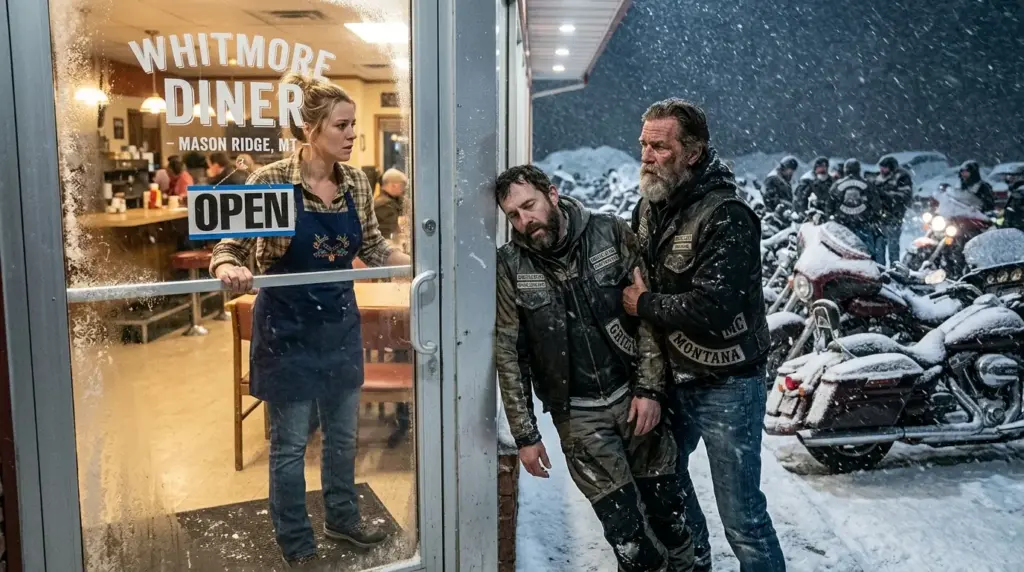
Sarah Whitmore stood behind that locked door for 11 seconds. She counted them later. 11 seconds that would change everything she thought she knew about fear, about people, and about what it really means to be brave. The wind came first. It always did in Mason Ridge, Montana.
In the deep throat of winter, this particular kind of wind that didn’t just blow, it pushed it, pressed, it got personal. It found the gaps in window frames that had survived 30 Montana winters and decided tonight was the night to make itself known through every single one of them. It rattled the hanging coffee mugs above the counter. It made the neon open sign in Sarah Whitmore’s window buzz and flicker like it was trying to warn somebody about something. Sarah heard it and paid it no mind.
She had 37 things to worry about before she got to the weather. The grease trap under the flat top grill needed replacing. The replacement cost $412 and she had $219 in the account that wasn’t already earmarked for something else. The walk-in cooler had been making a sound for the past week. Not a bad sound exactly, more like a sound that was deciding whether it wanted to become a bad sound.
The women’s restroom faucet ran cold even when you turned it all the way to hot. And two customers this week had come out and mentioned it in that particular polite complaint tone that people used when they were thinking about not coming back. And then there was the letter. The letter from First Montana Bank sat on the back counter folded, refolded, and folded again as if the number of creases in it could somehow change what the number inside it said. 30 days.
That was what Gerald Hasting, the bank’s regional manager, had written in the kind of formal language that made something devastating sound almost reasonable. 30 days to bring the outstanding balance current or the property would enter foreclosure proceedings. The property, her father’s diner. Sarah pressed her palms flat on the counter and breathed. She was 34 years old, and she looked at tonight in the way that women who work 14-hour days and raise a child alone sometimes look their age all at once, like it had been saving up.
Her blonde hair was pulled back because there was no point in it being anything else during a dinner rush. Even a dinner rush as thin as this one. She had her father’s hands wide across the palm, short-fingered, the kind of hands that were made for work and knew it. Behind the counter, she moved the way she always moved in this diner efficiently without wasted motion because she had learned from watching her father that a small space demanded small movements and that everything had a place and the place mattered. Dale Whitmore had built this diner with those same hands.
Not built it, built it. He hadn’t poured the foundation or frame the walls. But he had built it in every way that mattered. He had found it when it was a failing pie shop with bad lighting and a reputation for cold coffee. And he had turned it into something that people in Mason Ridge and 50 mi in every direction knew by name.
Whitmore. You don’t need to describe it beyond that word. People in this county understood what that word meant. It had meant hot food and a fair price and a seat for anyone who walked through the door, no matter what they looked like or how much they had in their wallet or what the rest of the town thought of them at that particular moment in time. Dale Whitmer had been a man with a philosophy about human beings.
And his philosophy was simple. People are more than what you see first. He had said that to Sarah so many times during her childhood that it had become less a lesson and more a piece of furniture, something that was just there, always solid and unmoving in the background of everything she did. She had been running this diner for 4 years now since Dale had his stroke and then 8 months later the second one that finished the first one’s work. She had taken over because that there was nobody else and because the alternative was watching something her father loved get sold to strangers and because if she was being honest with herself in a way she rarely allowed herself to be honest anymore because she needed it.





