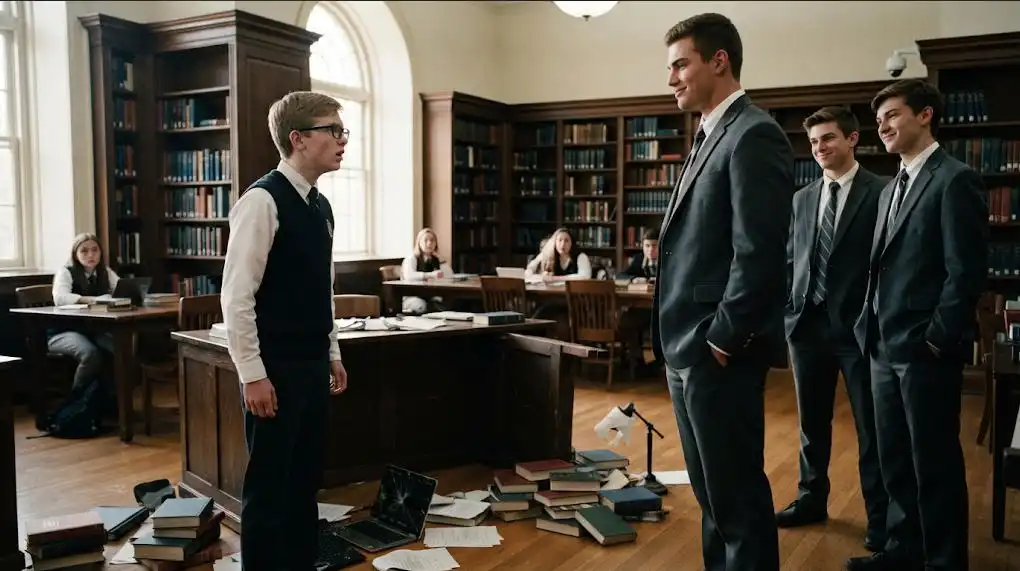
The speakers crackled.
Grant Whitmore’s voice filled the school board hearing room.
“You think you can write me up?”
Then came the unmistakable sound of heavy furniture crashing against the floor.
A laptop shattered.
Books scattered.
And someone laughed.
Grant stopped smiling.
His grandfather, one of the school’s senior trustees, sat several seats away.
Neither of them had expected the recording to sound quite so clear.
My name is Ethan Miller. I was seventeen years old, a sophomore at an elite private high school in Boston.
I wasn’t born into a wealthy family.
I didn’t have a famous last name or a grandfather sitting on the school’s board.
I had a scholarship, a part-time job as a library assistant, and one goal that mattered more to me than anything else.
I wanted to attend Harvard Law School someday.
I knew that meant years of studying, hard work, and sacrifice.
But I didn’t mind.
The library was where I felt most comfortable.
I loved the smell of old books, the quiet atmosphere, and the feeling that every shelf contained something worth discovering.
My assigned desk was near the back of the main reading room.
It was a large, dark wooden table with a desk lamp, several reference books, and enough space for my laptop and handwritten notes.
I spent nearly every free afternoon there.
Some days I helped students locate books.
Other days I organized returned materials, checked borrowing records, and helped the librarian maintain the reading room.
I took the job seriously.
Especially the rules.
No food.
No smoking.
No disruptive behavior.
Those rules existed because hundreds of students depended on the library to study.
Most people understood that.
Grant Whitmore didn’t.
Grant was the grandson of Arthur Whitmore, a senior member of the school’s board of trustees.
His family name appeared on a donor recognition plaque near the main entrance.
He was wealthy, popular, and accustomed to getting his way.
Teachers often tolerated his behavior because his grandfather had considerable influence at the school.
Grant knew it.
And he used it.
He frequently entered the library with two friends, talking loudly and treating the reading room like an extension of his private lounge.
I had reminded him several times to lower his voice.
He never listened.
One afternoon, I noticed something even worse.
Grant was smoking inside the reading room.
I couldn’t believe it.
The room was filled with books, paper, wooden furniture, and students trying to concentrate.
I walked over.
“Grant, you can’t smoke in here.”
He barely looked at me.
“Mind your own business.”
“I’m serious. This is a smoke-free area.”
He exhaled and looked at his friends.
“Did you hear that? The library police are here.”
They laughed.
I didn’t laugh.
“Please put it out. I’ll have to document the violation.”
That was when his expression changed.
He looked directly at me.
“You’re going to report me?”
“I’m following school policy.”
He stepped closer.
“You know who my grandfather is, right?”
“Yes.”
“Then maybe you should think about what you’re doing.”
I didn’t answer.
I returned to my assigned desk and entered the incident into the library’s internal reporting records.
I also continued my normal duties.
I thought that would be the end of it.
I was wrong.
About twenty minutes later, I was sitting at my desk reviewing research materials on my laptop.
I had several books open and a handwritten notebook beside the keyboard.
Then I heard footsteps approaching.
Grant was walking toward me.
His two friends followed him.
I looked up.
He stopped directly in front of my desk.
“You really think you’re important, don’t you?”
I closed my notebook.
“I’m working.”
He looked at the books spread across my table.
Then he looked at my laptop.
“You think you can write me up?”
I stood up slightly.
“Grant, I already told you the rule. You can’t smoke in here.”
His face twisted with anger.
Then he did something I will never forget.
He grabbed the edge of my heavy wooden desk with both hands.
Before I could react, he pulled upward with all his strength.
The entire desk tipped over.
My laptop slid across the surface and crashed onto the hard floor.
The screen shattered.
My desk lamp struck the ground.
Dozens of reference books, notebooks, and research papers flew everywhere.
The noise echoed through the entire reading room.
I jumped backward to avoid the falling furniture.
For a moment, I couldn’t even speak.
My laptop had been with me for years.
I had used it to complete assignments, organize scholarship applications, and prepare for my future.
Some of my most important research notes were stored on it.
Now the screen was destroyed.
Grant stood over the wreckage.
He laughed.
“Maybe now you’ll learn to mind your own business.”
His friends laughed with him.
But the rest of the room was silent.
Students stared at the overturned desk.
One girl slowly lowered her book.
Another student stood up and looked toward the library entrance.
I felt humiliated.
I was angry.
I wanted to scream at him.
But I knew that if I reacted physically, Grant might turn the situation around and accuse me of starting a fight.
So I took a breath.
I looked at the broken laptop.
Then I looked at the library camera mounted high above the reading room.
I knew exactly what I needed to do.
“Call the librarian. Save the recording.”
A few minutes later, the head librarian arrived.
She looked at the overturned desk, the scattered books, and the shattered laptop.
“What happened here?”
Several students immediately began explaining.
“He flipped the whole table!”
“I saw everything!”
“He was angry because Ethan told him to stop smoking.”
Grant rolled his eyes.
“Everybody’s exaggerating. It was just a joke.”
The librarian looked at him.
“A joke?”
Grant shrugged.
“Maybe the table wasn’t stable.”
But the table had been standing in the same place for years.
And everyone in the room had just watched him overturn it.





